If you have read the Mahabharat or the Bhagavad Gita, you must have definitely heard Sanjay’s name. However, the interesting question is — who is Sanjay in the Mahabharat, and how was he able to see the Kurukshetra battlefield while sitting in Hastinapur beside Dhritarashtra?
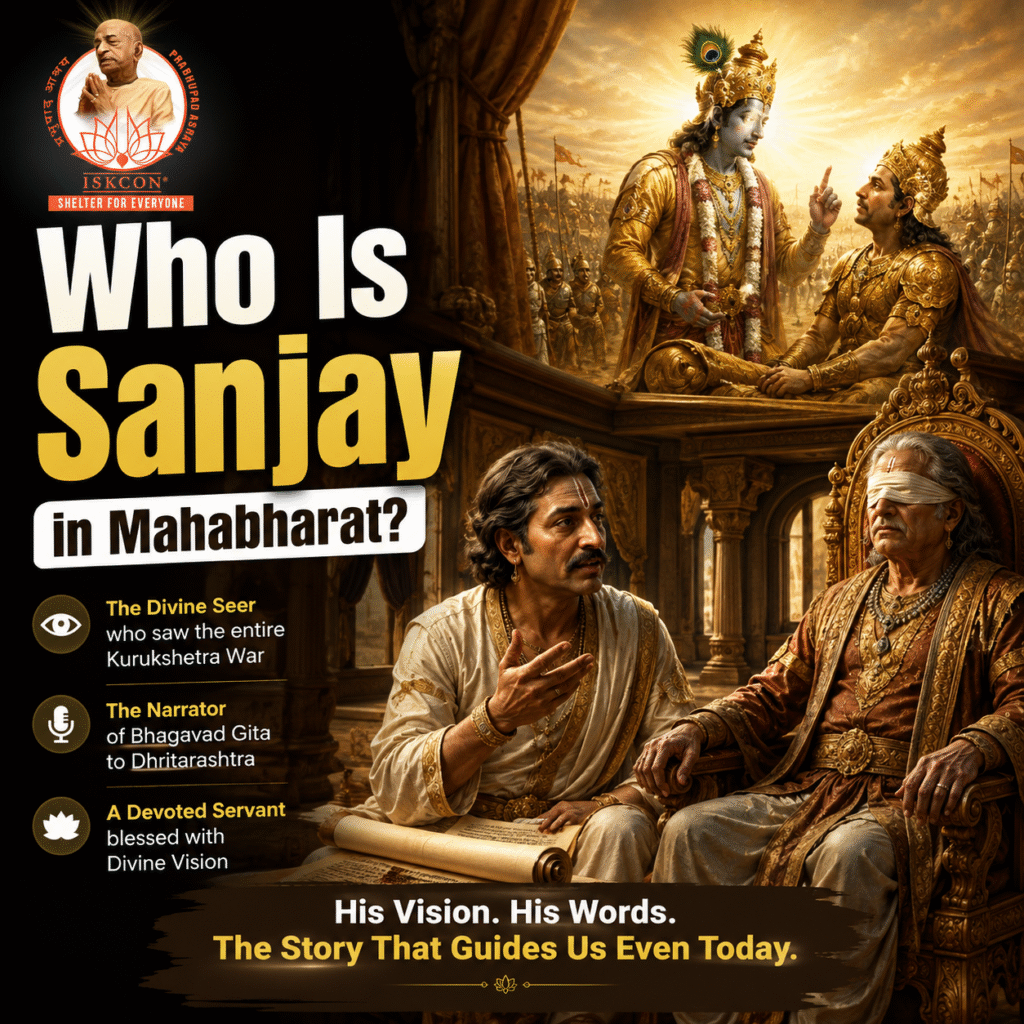
Sanjay was an important character in the Mahabharat, but his significance was not merely that of a messenger or a storyteller. He was granted a special divine vision by Maharishi Vyasa, through which he could directly see the events unfolding in Kurukshetra and describe them to Dhritarashtra.
And through this extraordinary ability, we come to know the dialogue of the Bhagavad Gita.
Let’s understand Sanjay’s story in a simple way.
Who Was Sanjay in the Mahabharat?
Sanjay was King Dhritarashtra’s trusted advisor and charioteer. He was connected to the royal court of Hastinapur and was very close to Dhritarashtra.
Dhritarashtra was blind from birth. Therefore, when the great war between the Kauravas and the Pandavas was about to begin in Kurukshetra, it was impossible for him to see the battlefield.
This is where Sanjay’s role becomes extremely important.
Maharishi Vyasa granted Sanjay divya drishti, or divine vision. Because of this special vision, Sanjay could observe the activities of the war without physically being present on the battlefield.
Think about it: today, through live streaming, we can watch an event happening thousands of kilometers away. In Sanjay’s case, rather than technology, the concept of spiritual power is explained.
Who Gave Sanjay Divine Vision?
Sanjay received divine vision from Maharishi Vyasa.
At the beginning of the Mahabharat war, Dhritarashtra could not see the battlefield. Vyasa offered to grant divine sight to Dhritarashtra as well, but Dhritarashtra declined it.
Following this, Vyasa bestowed that extraordinary ability upon Sanjay.
Its purpose was not merely to satisfy curiosity. The goal was for Sanjay to continuously describe the important events occurring on the battlefield to Dhritarashtra, making his role essential to the story.
This is the reason why Sanjay holds a unique position in the Mahabharat’s war narrative.
How Did Sanjay Hear the Bhagavad Gita?
Now comes the most interesting part.
Sanjay was perceiving the conversation taking place between Lord Krishna and Arjuna on the battlefield of Kurukshetra through his divine vision.
Dhritarashtra asked Sanjay:
“Dharma-kshetre kuru-kshetre…”
Meaning, what did the Pandavas and my sons do at Kurukshetra?
In response to this question, Sanjay began giving a description of the battlefield.
When Krishna was imparting spiritual knowledge of the Bhagavad Gita to Arjuna, Sanjay was perceiving that conversation as well.
Because of this, the dialogue of the Bhagavad Gita is conveyed to us in the Mahabharat through Sanjay’s narration.
Think about it — if Sanjay had not possessed divine vision, how would Dhritarashtra have directly received information about the events on the battlefield and the Krishna-Arjuna conversation?
Sanjay Was Not Just a Reporter
Understanding Sanjay merely as an ancient reporter would be somewhat incomplete.
His narration possessed an important quality — clarity.
He explained the situations taking place on the battlefield to Dhritarashtra. However, another crucial aspect of Sanjay’s character is his spiritual understanding.
Toward the end of the Mahabharat, Sanjay is deeply affected upon recalling the dialogue between Krishna and Arjuna.
In the final chapter of the Bhagavad Gita, Sanjay’s words reveal that Krishna’s teachings left a profound impact on his consciousness as well.
Here lies a beautiful lesson:
Sometimes we hear spiritual knowledge meant for someone else, but if we listen sincerely, that knowledge can transform our own life too.
The Relationship Between Sanjay and Dhritarashtra
Sanjay was Dhritarashtra’s loyal advisor.
Dhritarashtra was emotionally deeply attached to his sons, especially Duryodhana. Because of this attachment, his judgment was affected in many situations.
Sanjay used to explain the reality of the battlefield to him with complete honesty.
This relationship is relatable in modern life too.
Sometimes we need a friend who doesn’t just say what we want to hear, but instead shows us reality.
Sanjay’s role was somewhat similar — he was presenting the reality of the battlefield to Dhritarashtra, even if that reality was uncomfortable.
What Did Sanjay Say at the End of the Mahabharat?
In the final verses of the Bhagavad Gita, Sanjay expresses his feelings while remembering the conversation between Krishna and Arjuna.
He repeatedly recalls the extraordinary dialogue between Lord Krishna and Arjuna, experiencing profound spiritual joy.
The most famous statement appears in Bhagavad Gita 18.78:
“Yatra yogeshvarah krishno yatra partho dhanur-dharah…”
The central message of this verse is that wherever there are Krishna and Arjuna, there will be victory, prosperity, strength, and righteousness.
For Sanjay, the combination of Krishna and Arjuna was not merely battlefield strategy; he saw something spiritually significant in it.
What Can We Learn from Sanjay in Modern Life?
Sanjay’s story is not just for interest in ancient history or mythology. It contains practical lessons as well.
1. Listening to Right Knowledge Attentively
Sanjay was not a warrior on the battlefield, yet he listened sincerely to the Krishna-Arjuna conversation.
Today we have unlimited information — YouTube, Instagram, podcasts, books.
However, information and wisdom are not the same thing.
The Bhagavad Gita does not just give us information; it provides us with a spiritual framework to understand life.
2. Running Away from Reality Is Not the Solution
Dhritarashtra could not physically see the battlefield, but Sanjay kept telling him the reality.
In modern life, we too prefer to ignore uncomfortable realities.
Whether it is a career problem, a relationship issue, or a problem with our habits — ignoring it does not make the problem disappear.
First, reality has to be accepted.
3. Spiritual Knowledge Can Transform the Listener Too
Sanjay was not the direct recipient of Krishna and Arjuna’s conversation. Yet, listening to Krishna’s teachings left a deep impact on his consciousness.
This can be understood from the perspective of Krishna Consciousness as well.
When we listen to spiritual knowledge in a sincere mood, our priorities gradually begin to change.
Connection Between Sanjay and the Bhagavad Gita
If you read the Bhagavad Gita, remember that the Gita’s dialogue is part of the larger narrative of the Mahabharat.
Arjuna was confused on the battlefield.
Standing before him were his relatives, teachers, and friends. His mind was completely disturbed.
Krishna explained to him about Dharma, Karma, Atma, Bhakti, Yoga, and spiritual realization.
Sanjay perceived this conversation and narrated it to Dhritarashtra.
Therefore, Sanjay becomes an important link:
Krishna → Arjuna → Sanjay → Dhritarashtra → Readers
Today, thousands of years later, we too are receiving spiritual wisdom from this very same dialogue.
Frequently Asked Questions
Who is Sanjay in Mahabharat?
Sanjay was Dhritarashtra’s trusted advisor and charioteer. Maharishi Vyasa granted him divine vision so he could remotely perceive the Kurukshetra war.
Who gave Sanjay divine vision?
Maharishi Vyasa bestowed divya drishti (divine vision) upon Sanjay.
Did Sanjay see the Bhagavad Gita?
Yes. According to the Mahabharat’s narrative, Sanjay was perceiving the conversation between Krishna and Arjuna through his divine vision.
Why was Sanjay important in Mahabharat?
Sanjay described the events of the Kurukshetra war to Dhritarashtra. Through his narration, the Krishna-Arjuna dialogue is preserved in the Mahabharat.
Was Sanjay a warrior?
Sanjay’s primary role was not that of a warrior. He was associated as an advisor and charioteer to Dhritarashtra.
What did Sanjay say about Krishna and Arjuna?
In the final chapter of the Bhagavad Gita, Sanjay expresses great spiritual joy upon recalling the divine conversation between Krishna and Arjuna.
What can we learn from Sanjay?
Sanjay’s story teaches us the importance of sincere listening, accepting the truth, and taking spiritual knowledge seriously.
Why Is It Important to Understand Sanjay’s Story?
Often, we view the Mahabharat merely as the story of the Pandavas, the Kauravas, and the Kurukshetra war.
However, when we closely study characters like Sanjay, a deeper dimension of the story becomes clear.
Sanjay was a witness.
He heard a dialogue that was not merely an answer to Arjuna’s confusion. The message of the Bhagavad Gita addresses fundamental questions of human life — who am I, what is my duty, how should I understand suffering, and what is the ultimate purpose of life?
Perhaps this is why Sanjay’s character remains relevant today.
We are not on a physical battlefield, but we face daily battles in our lives.
Career pressure, relationships, anxiety, expectations, and uncertainty about the future — amidst all of these, we too need guidance.
And Sanjay’s story serves as a simple reminder:
Sometimes to change our life, we first have to listen sincerely to the right knowledge.
If you want to understand the Bhagavad Gita and Krishna Consciousness in a simple, practical, and authentic way, you can explore spiritual learning on Prabhupad Ashraya.
Hare Krishna.
Kya aapko iss translation mein SEO meta description, titles ya keywords customize karwane hain?