Have you ever wondered what is the real name of Mahabharat? We have known it by the name “Mahabharat” since childhood, but was this its original name?
The interesting thing is that the name of the Mahabharata changed through different stages of history. Therefore, if you want to understand its original name and its meaning, the story becomes quite fascinating.
The Mahabharata is not just the story of the Kurukshetra war. Within it, you find deep lessons on Dharma, Karma, politics, family relationships, devotion, and human nature. And within this very epic comes the Bhagavad Gita, where Lord Krishna imparts spiritual wisdom to Arjuna.
Let’s understand in simple language what the real name of the Mahabharata was and how this name evolved.
What Was the Real Name of the Mahabharata?
If we look at traditional Sanskrit sources, the name of the Mahabharata was not exactly “Mahabharata” from the very beginning.
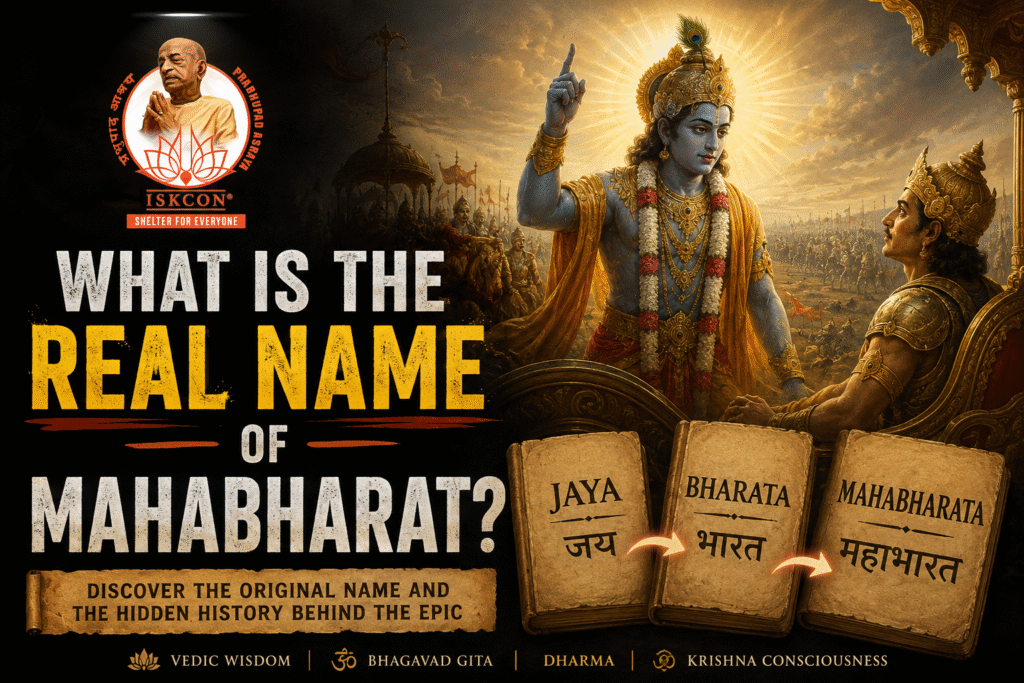
According to tradition, Maharishi Vyas originally named this work “Jaya”.
“Jaya” simply means victory or triumph.
This name represented the broader idea of the Kurukshetra conflict and the victory of Dharma.
Later, it became known as “Bharata” and eventually as “Mahabharata”.
Therefore, when someone asks, “What is the real name of Mahabharat?”, giving the answer in just a single word would be a bit incomplete.
In traditional understanding, the development of its name is explained in the form of Jaya → Bharata → Mahabharata.
How Did “Jaya” Become “Bharata” and “Mahabharata”?
Now, this is where a slightly interesting history comes in.
According to tradition, the original composition was comparatively short and was called Jaya. Over time, different stories, teachings, genealogies, and philosophical discussions kept getting added to this narrative.
This expanded work came to be called Bharata.
Later, when its scope became even more extensive, it was called Mahabharata.
“Mahā” means great or vast, and “Bhārata” has a connection to the Bharata dynasty and the lineage of King Bharata.
Thus, “Mahabharata” can be broadly understood in the sense of “the great history of the Bharata dynasty.”
This was not just the story of a family war. Many dimensions of human life are discussed within it.
What Is the Connection to the Name “Bharata”?
Now a common confusion arises — where exactly did the name “Bharata” come from?
The tradition of the Mahabharata is closely connected to the Bharata dynasty.
The name of King Bharata is very important in the Indian tradition, and it is from this lineage that the Kuru dynasty and the story of the Pandavas and Kauravas develop later on.
Therefore, “Bharata” is not just a geographical identity. In the context of the epic, it also has a strong connection to the Bharata dynasty.
If you view the Mahabharata from a family tree perspective, the scope of the story becomes quite large through the generations.
This is why the name of the epic also gradually reflects its larger identity.
Was the Original Name of the Mahabharata “Jaya”?
Yes, in traditional accounts, Jaya is considered the earliest form of the Mahabharata.
However, it is essential to understand an important point here.
Understanding “Jaya” simply like the “first title” of a modern book might be a bit simplistic. The textual history of the Mahabharata is complex, and traditional descriptions and modern academic studies can explain this development in different ways.
When we understand the Mahabharata from the perspective of Prabhupad Ashraya, it is important to take the traditional Vedic presentation seriously.
Here, the focus is not just on historical curiosity, but also on the knowledge that the epic provides us.
Where Does the Bhagavad Gita Appear in the Mahabharata?
If you consider the Mahabharata to be just a war story, you might miss a very important part of it.
On the Kurukshetra battlefield, Arjuna becomes deeply confused upon seeing his relatives, teachers, and friends standing on the opposite side.
It was not a simple question in his mind. His entire understanding of duty, relationships, and life was shaken.
This is where Lord Krishna imparts the transcendental knowledge of the Bhagavad Gita to him.
Krishna explains to Arjuna that life is not just a name for temporary situations and emotional attachments.
It is also necessary for us to understand our Dharma, Karma, and spiritual identity.
Even in today’s time, this situation feels surprisingly relatable.
Whether it is making a career decision, family pressure, relationship confusion, or anxiety about the future — sometimes we too feel confused just like Arjuna.
The Bhagavad Gita teaches us to look at this very confusion from a spiritual perspective.
The Mahabharata Is Not Just a Story of War
On social media, the Mahabharata is often presented merely in the form of a war between the Pandavas and the Kauravas.
However, the actual scope of the epic is much wider.
Subjects like kingship, morality, Dharma, family responsibilities, Karma, devotion, politics, and human psychology are discussed within it.
The characters are also not completely one-dimensional.
From Yudhishthira, we get questions on Dharma and truth.
From Arjuna, we get the opportunity to understand duty and emotional conflict.
From Bhishma, the complex dimensions of commitment and responsibility are understood.
And from Krishna’s teachings, we get a deeper perspective of spiritual wisdom.
For this reason, considering the Mahabharata to be merely an ancient war narrative would mean underestimating its depth.
Why Is the Mahabharata Relevant for Today’s Young Generation?
Have you ever noticed that modern problems feel very new, but emotions are surprisingly old?
Today there is social media, smartphones, career competition, and the pressure of relationships.
However, confusion, jealousy, attachment, fear, ambition, and family conflicts — these human emotions are not new.
The Mahabharata explores these emotions through extremely powerful situations.
For example, Arjuna was confused on the battlefield.
Today, a student might be confused at the crossroads of their career.
A professional might struggle between job and family responsibilities.
There could be a conflict between attachment and duty in a relationship.
The situation is different, but the inner conflict is familiar.
This is why reading the Mahabharata is not just about understanding the past. It can be a way to better understand your own mind and decisions as well.
Mahabharata and Krishna Consciousness
A beautiful aspect of understanding the Mahabharata is Krishna Consciousness.
In the Mahabharata, Lord Krishna appears as the central spiritual personality.
In the Bhagavad Gita, Krishna does not just give Arjuna a solution to a temporary problem. He gives him knowledge about the soul, Dharma, Karma, Bhakti, and the Supreme Reality.
The core idea of Bhakti Yoga is also understood right here — reconnecting life with Krishna.
Srila Prabhupada presented the teachings of the Bhagavad Gita and Krishna Consciousness to a modern audience in a simple and practical way.
Therefore, if curiosity started with the name of the Mahabharata, exploring the Bhagavad Gita can be the natural next step in that journey.
What Does the Name of the Mahabharata Teach Us?
Behind a simple name, there is also a deeper lesson.
Jaya reminds us of victory.
Bharata points toward lineage and history.
And Mahabharata gives us an idea of the vast scope of the epic.
However, the most important question is — whose victory is it actually?
When reading the Mahabharata from a spiritual perspective, it becomes clear that real victory is not just winning a battlefield.
Gaining control over one’s mind, understanding Dharma, transcending selfish attachments, and applying Krishna’s teachings in life is also a type of victory.
And perhaps this is why the Mahabharata continues to attract people even thousands of years later.
Frequently Asked Questions
What is the real name of Mahabharat?
According to traditional understanding, the earliest form of the Mahabharata is associated with the name Jaya. Its expanded forms came to be called Bharata and eventually Mahabharata.
Who wrote Mahabharata?
The Mahabharata is traditionally attributed to Maharishi Vyas, or Veda Vyasa. In tradition, he is considered the compiler and narrator of the epic.
Why is it called Mahabharata?
“Mahā” means great or vast, while “Bharata” is connected to the Bharata dynasty. Therefore, the Mahabharata can be broadly understood as the great epic history of the Bharata dynasty.
Was Mahabharata originally called Jaya?
In traditional accounts, the earliest form of the Mahabharata is said to be Jaya. Later, the work expanded into Bharata and Mahabharata.
Is Bhagavad Gita part of Mahabharata?
Yes. The Bhagavad Gita is a part of the Mahabharata, specifically presented in the Bhishma Parva section in the form of a dialogue between Krishna and Arjuna.
Is Mahabharata only about the Kurukshetra war?
No. War is a major event in it, but the Mahabharata also features extensive discussions on Dharma, Karma, politics, relationships, morality, devotion, and spiritual wisdom.
What can young people learn from Mahabharata?
Young people can learn important lessons on decision-making, responsibility, Dharma, relationships, emotional control, and spiritual understanding from the Mahabharata. The Bhagavad Gita specifically teaches how to view difficult situations from a clearer perspective.
Final Thought
So if someone asks you, “What is the real name of Mahabharat?”, you can simply say “Jaya” and end the conversation — but the complete picture is a bit more interesting.
In traditional understanding, its development is explained in the form of Jaya → Bharata → Mahabharata.
And perhaps the most beautiful thing is that the real value of the Mahabharata does not lie merely in its name.
Its real value lies in the questions it places before us:
Who am I? What is my Dharma? What should I do in difficult situations? And what is the real purpose of life?
Exploring these questions is what genuinely makes the spiritual journey of the Mahabharata and the Bhagavad Gita meaningful.
If you want to understand authentic Vedic wisdom, the Bhagavad Gita, and Krishna Consciousness in a simple and practical way, you can explore more spiritual insights on Prabhupad Ashraya.
Hare Krishna.