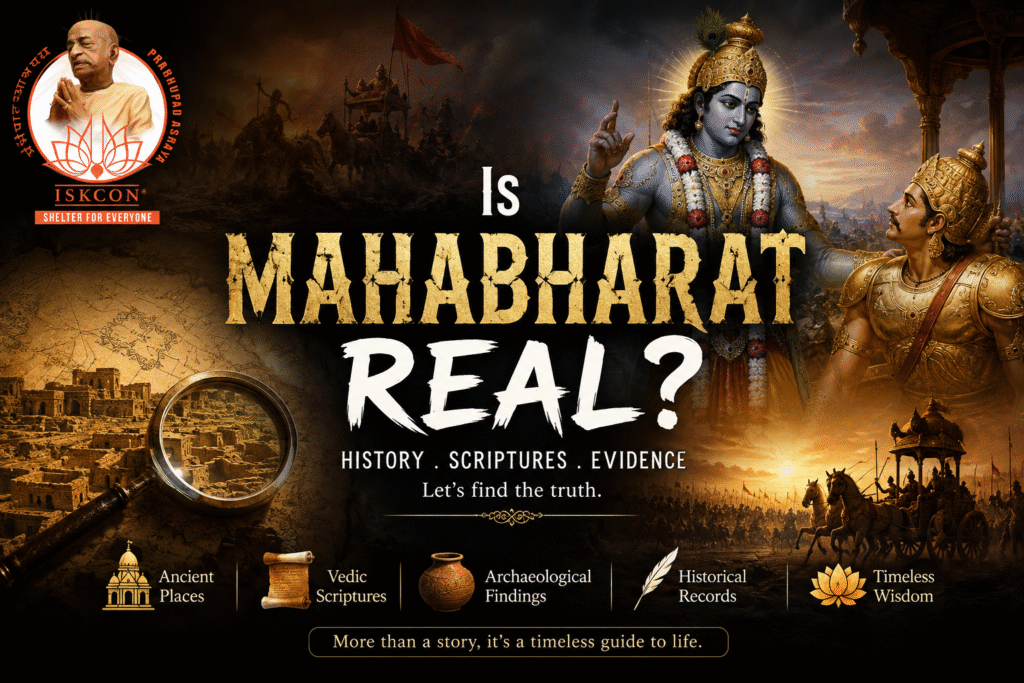
If you have ever read the Mahabharata or watched it on TV, a question naturally comes to mind — was the Mahabharata actually real, or is it just an ancient story?
Especially in today’s time, when someone on social media says that the Mahabharata is completely fictional, and someone else claims that its every detail has been scientifically proven, feeling confused is completely normal.
So the simple question is: Is Mahabharat real?
The short answer is — calling the Mahabharata just a fictional story is not historically accurate, but proving its every event and supernatural detail using modern science is also not possible.
This is where a deeper understanding becomes necessary.
What Is the Mahabharata?
The Mahabharata is not just a war story.
It is an enormous Sanskrit epic of ancient India, containing central elements such as the Kuru dynasty, Pandavas, Kauravas, Shri Krishna, Kurukshetra War, and the Bhagavad Gita.
According to tradition, Vedavyasa is considered the author of the Mahabharata.
It contains family politics, friendship, betrayal, the conflict of dharma, and spiritual wisdom.
If you view it merely as a “war between the Pandavas and the Kauravas,” you will miss the actual depth of the Mahabharata.
Actually, its biggest question is this:
When the decision between right and wrong in life is not clear, what should a person do?
A profound answer to this very question is found in the Bhagavad Gita.
Was the Mahabharata a Real Historical Event?
Now coming to the main point.
The Mahabharata has traditionally been viewed as Itihasa. In the Sanskrit tradition, the basic sense of “Itihasa” is — “so it indeed happened.”
Therefore, the Hindu tradition does not simply place the Mahabharata in the category of ordinary mythology or imaginary fiction.
However, the method of modern history is slightly different.
Historians look at factors like archaeological evidence, inscriptions, textual layers, chronology, and independent evidence to establish an event.
And this is where the picture becomes complicated.
The locations described in the story of the Mahabharata — such as Hastinapura, Kurukshetra, Indraprastha, and Mathura — are connected to ancient Indian geography.
Archaeological remains have also been found at sites like Hastinapura.
However, finding archaeological remains does not automatically prove that the complete narrative of the Mahabharata was historically documented in that exact form.
Understanding this distinction is important.
Did the Kurukshetra War Actually Happen?
This is one of the most interesting questions related to the Mahabharata.
According to the traditional account, the great war between the Pandavas and the Kauravas took place in Kurukshetra.
Even today, Kurukshetra in Haryana is an important pilgrimage destination and is strongly associated with the Mahabharata tradition.
But has modern archaeology proven that exact 18-day war?
No.
As of now, conclusive archaeological evidence is not available to independently prove the complete account of the Mahabharata war according to modern historical standards.
However, the opposite is also not automatically true.
The absence of evidence simply does not establish that the event never happened.
Reconstructing events that occurred thousands of years ago is extremely difficult.
Think about it: if records of an important event from today were destroyed thousands of years later, how difficult would it be for future historians to reconstruct that event exactly?
For this reason, different levels of certainty exist in ancient history.
Hastinapura and the Connection to Ancient India
In the Mahabharata, Hastinapura was the major center of the Kuru dynasty.
In today’s Uttar Pradesh, a place named Hastinapur exists, and archaeological excavations have also taken place there.
Archaeology has revealed remains of ancient settlements, showing that this region has been part of human habitation for thousands of years.
However, there is an important point.
Archaeology does not automatically identify an ancient settlement with the exact characters of the Mahabharata.
This means that the existence of the ancient location named Hastinapura is interesting evidence, but by itself, it does not scientifically prove the historical existence of the Pandavas or Kauravas.
Similarly, Indraprastha is traditionally associated with the modern Delhi area, but there has been discussion among scholars regarding its exact historical identification.
Therefore, the sensible approach is to neither exaggerate nor completely ignore the evidence.
Was Shri Krishna a Real Historical Person?
Now for the most important character of the Mahabharata — Shri Krishna.
Viewing Krishna merely as a character of the Mahabharata is also an incomplete picture.
In the Indian tradition, Krishna’s connection is found not only in the Mahabharata but also in the Bhagavata tradition, Harivamsa, and multiple ancient texts.
Scholars have been studying ancient references and traditions related to Krishna from different historical perspectives.
However, the same principle applies here as well.
Based on modern historical research, scientifically verifying every detail of Krishna’s life is not possible.
And the question of spirituality is also slightly different from history.
If a person considers Krishna as God (Bhagavan), their basis is not just archaeology.
In it, scriptural evidence, guru-parampara, spiritual practice, and personal realization also play important roles.
Understanding this difference is crucial.
Is the Bhagavad Gita Part of the Mahabharata?
Yes.
The Bhagavad Gita is a part of the Mahabharata itself, specifically the dialogue between Krishna and Arjuna in the Bhishma Parva.
Imagine — there is a massive battlefield.
Arjuna sees his own relatives, teachers, and friends standing on the opposite side.
The Gandiva almost slips from his hand.
He is confused:
“Should I fight against my own people?”
It is right here that Shri Krishna explains to him about Dharma, Karma, Atma, Yoga, Bhakti, and spiritual reality.
Therefore, reading the Gita only in the context of war limits its teaching.
Even today, when a person is confused in career, relationships, family pressure, or life decisions, Arjuna’s situation can feel surprisingly relatable.
The only difference is that Arjuna’s battlefield was Kurukshetra.
Our battlefields are sometimes our offices, sometimes our relationships, and sometimes our own mind.
So Is the Mahabharata Real or Mythology?
This is where the most balanced answer is found.
If “real” means:
“Has modern science proven every character, event, and supernatural description of the Mahabharata?”
Then the answer is — no.
If “real” means:
“Is the Mahabharata a completely modern fictional novel created by a writer purely out of imagination?”
Then this conclusion would also oversimplify the historical and cultural evidence.
The Mahabharata is an ancient text tradition that has had an enormous impact on India’s history, culture, philosophy, literature, and religious tradition.
Its geographical references, ancient traditions, and archaeological context have been subjects of serious study.
However, debate exists among scholars regarding exact dating, historical characters, and details of the Kurukshetra War.
So, the intellectually honest answer is:
Reducing the historicity of the Mahabharata to either extreme — a completely proven fact or a completely fictional story — is not correct.
What Is the Best Way to Understand the Mahabharata?
If you genuinely want to understand the Mahabharata, don’t get stuck just in trying to prove in which exact year the war took place.
Ask another important question:
“What is the Mahabharata teaching me?”
Because the real power of the Mahabharata lies not just in its history, but also in its wisdom.
From Duryodhana, we understand the consequences of uncontrolled desire and envy.
From Yudhishthira, we understand the struggle for truth and Dharma.
From Arjuna, we understand the conflict between confusion and responsibility.
And from Shri Krishna, we understand how consciousness can be elevated in difficult situations.
These lessons are relevant even in Gen Z life today.
From social media comparison to career anxiety, from relationships to identity crises — the basic struggles of the human mind have not completely changed over thousands of years.
Technology has changed.
The problems of the mind are surprisingly similar.
Mahabharata and Krishna Consciousness
The Bhagavad Gita is a spiritual conversation within the Mahabharata, but its teaching goes far beyond the battlefield.
Shri Krishna does not just tell Arjuna to “fight.”
He explains Dharma, Karma, Atma, Yoga, and Bhakti to him.
The central idea of Krishna Consciousness is also that human life should not be kept limited only to material achievements.
Career is important.
Family is important.
Relationships are important.
However, amidst all of these, it is also important to understand — who am I actually?
The Bhagavad Gita explores this deeper identity.
And perhaps that is why the Mahabharata feels relevant even thousands of years later.
Frequently Asked Questions
Is Mahabharata a true story?
The Mahabharata is considered Itihasa in the Hindu tradition, but establishing its complete narrative using modern historical standards is not conclusively possible. Scholarly discussion on its historicity is still ongoing.
Did the Mahabharata war really happen?
According to traditional belief, the Kurukshetra War actually took place. However, modern archaeology has not yet established conclusive evidence to independently verify the complete war narrative of the Mahabharata.
Is Kurukshetra mentioned in Mahabharata?
Yes. Kurukshetra is the central location of the Mahabharata, and the dialogue of the Bhagavad Gita also takes place on the Kurukshetra battlefield between Krishna and Arjuna.
Was Shri Krishna a real person?
Krishna is a deeply established figure in Indian religious and literary traditions. Establishing His historical existence and exact chronology using modern historical methods is complex, and different scholars hold different interpretations.
Is Bhagavad Gita part of Mahabharata?
Yes. The Bhagavad Gita is part of the Bhishma Parva of the Mahabharata and is presented in the form of a Krishna-Arjuna dialogue.
Is Mahabharata mythology or history?
It is difficult to keep it simply in one category. The Hindu tradition views it as Itihasa, whereas modern historians study its historicity based on textual, archaeological, and chronological evidence.
Why is Mahabharata still relevant today?
Because it contains timeless questions of human nature — duty, ambition, jealousy, relationships, confusion, responsibility, morality, and spiritual identity. Technology has changed, but these human struggles remain relevant even today.
Final Thought
So, is Mahabharat real?
If you want an honest answer, it would be better to say:
Calling the Mahabharata a completely fictional story is an oversimplification, and so is calling its every detail a scientifically proven historical fact.
Its historical layers, ancient traditions, geographical references, and archaeological context are important. However, there are different levels of certainty regarding exact events and chronology.
And perhaps the most beautiful way to understand the Mahabharata is that we don’t just ask:
“Did this really happen?”
Rather, we also ask:
“If Krishna gave this wisdom to Arjuna, what should I understand in the Kurukshetra of my life?”
This is where the Mahabharata moves from being an ancient story to becoming living spiritual wisdom.
If you want to understand the Bhagavad Gita and Krishna Consciousness in a simple, logical, and practical way, you can explore more spiritual insights on Prabhupad Ashraya.
Hare Krishna.
Kya aapko iss translation mein koi specific SEO adjustments, meta tags, ya call-to-action options edit karwane hain?