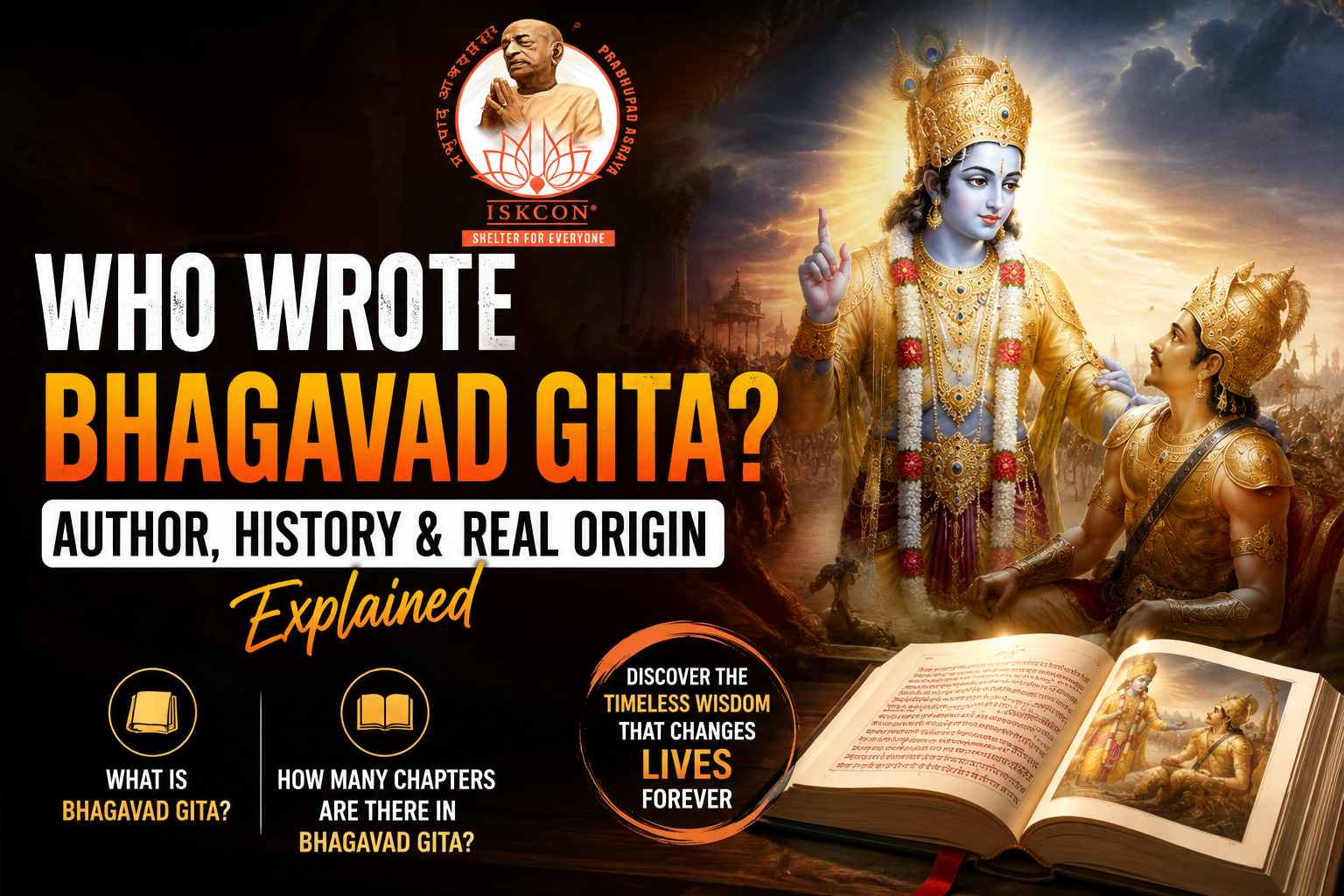
Anyone who ever read the Bhagavad Gita is familiar with the profound change that takes place in the reader’s mind after reading these 700 verses. However, when people enter this ancient masterpiece for the first time that question is one of the ones that almost invariably arises: who wrote bhagavad gita? It won’t be as easy as reading a book cover today. The genesis of the Gita is an intriguing blend of divine wisdom, ancient oral stories and legendary scribers. Lord Krishna uttered these eternal words on the battlefield, but it is believed that Lord Ganesha was the sacred scribe who composed this literary work and Lord Ved Vyasa was the Maharishi who wrote it. The process by which this spiritual dialogue was transformed from a chaotic battlefield to a written manuscript offers insight as to the reason why it is one of the greatest treasures of humanity. Three Roles Behind Its Creation To understand the authorship of the Gita, it helps to understand the three roles that were present behind its creation: The Legacy of Maharishi Ved Vyasa From the historical and literary point of view, when scholars ask the question, who wrote the bhagavad gita, the answer is Maharishi Ved Vyasa. He was born as Krishna Dvaipayana and became known as “Vyasa” (or “Compiler” or “Arranger”) because he compiled the vast, scattered Vedic knowledge into the four structured Vedas. Vyasa did not merely observe in the distance, but was himself very much an active observer during that time. His aspiration was to present the deep philosophy of the Upanishads in human terms that would be accessible to the common people. Origins and Setting The Gita is very relatable because of its setting. It was not preached in a quiet mountain top nor in a peaceful monastery. It was in the middle of two gigantic military forces set up to wage a devastating civil war. Arjuna was completely demoralized because he was fighting his own kin, teachers, and friends. He put down his bow, subdued by his paralyzing grief and sorrow for the wrong done. In response, Krishna gives 700 verses on duty (dharma), action without attachment (Karma Yoga) and devotion (Bhakti). Based on historical evidence, the text was compiled in written form between the 5th and 2nd centuries BCE, while traditional India suggests that the events of the text occurred more than 5,000 years ago at the start of the Kali Yuga. Written Manuscripts How did a conversation on a battlefield get recorded so accurately? There is another important person involved in the story: Sanjaya. Another important person in the story is Sanjaya. Sage Vyasa blessed Sanjaya with Divine sight (Divya Drishti), thus enabling him to see and hear everything on a far off battlefield in real time. The conversation was conducted in real time and Sanjaya brought the narration to the palace of the blind King Dhritarashtra. The text was maintained for centuries after by means of oral transmission (Shruti) with intricate Sanskrit poetic metres like Anushthubh, in which not a single syllable could be lost. It was later recorded on palm-leaf manuscripts and spread throughout Asia and eventually to the rest of the world. Why the Authorship Matters Today The Authorship Matters Today, to better understand the multilayered nature of bhagavad gita, we need to know who wrote it. It takes the divine angle of Krishna, the literary genius of Vyasa and the struggles of an ordinary human being in Arjuna. When making decisions and facing crises, it can help the mind to remain clear. It can help the mind to remain clear during moments of intense decision making and crisis. It is free from dogma and emphasizes service, selflessness and inner peace. Its pages have inspired Adi Shankara to Thoreau and Einstein. Conclusion So, what is the name of the author of bhagavad gita? It is the gift of Lord Krishna’s divine wisdom, MahaRishi Ved Vyasa, who composed it and Lord Ganesha, who recorded it. They developed together a manual for life that remains relevant to millions of men and women’s personal warfare every day today. Frequently Asked Questions 1. The Bhagavad Gita was written in what language? The original work is in classical Sanskrit in traditional poetic metres. 2. Is the Bhagavad-gītā a book on its own? No, it is a 700-verse section, which is a part of the larger epic, Mahabharata, which has 4000 verses and 700 verses of Shantidev. No, it’s a 700-verse section that’s a part of the 4000-verse epic, Mahabharata, which has 700 verses of Shantidev.
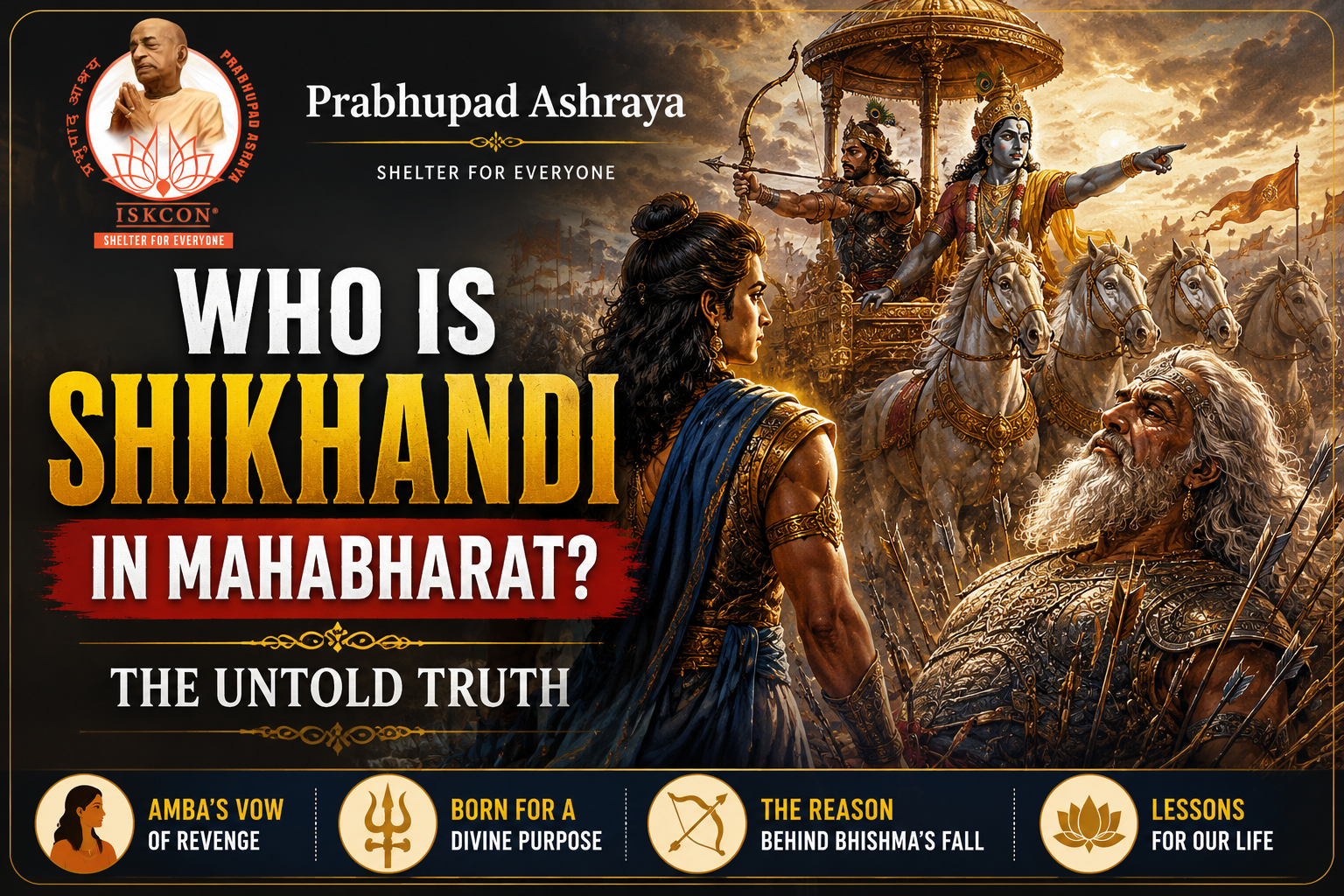
Who Is Shikhandi in Mahabharat? How Krishna Used Karma to Defeat Bhishma
If you look closely at the Kurukshetra war, it wasn’t just won with physical strength, divine weapons, or sheer army numbers. It was won in the quiet, psychological spaces where moral codes clashed. Nowhere is this clearer than on the tenth day of the battle, when the invincible patriarch Bhishma finally fell. To understand how the unstoppable commander of the Kaurava army was brought down, one must ask a fundamental question: who is shikhandi in mahabharat? Shikhandi was not the strongest warrior on the battlefield, nor did he possess game-changing celestial weapons. Yet, Lord Krishna knew that Shikhandi held the key to neutralizing a warrior whom no god or mortal could defeat. By placing Shikhandi at the center of the strategy, Krishna orchestrated a masterclass in cosmic justice, leveraging the inescapable power of karma to bring about Bhishma’s downfall. The Origin: Princess Amba’s Vow of Vengeance To understand the character, we first have to travel back decades before the war broke out. Before being born as a prince of Panchala, this soul was Princess Amba, the eldest daughter of the King of Kashi. Amba’s life took a tragic turn when Bhishma abducts her alongside her sisters from their swayamvara to marry them off to his stepbrother, Vichitravirya. Amba revealed that she was already in love with King Shalva. Respecting her wishes, Bhishma let her go. However, Shalva rejected her, citing the dishonor of her being carried off by another man. When Amba returned to Bhishma demanding that he marry her instead, Bhishma refused, bound by his strict vow of lifelong celibacy (Brahmacharya). Left without a home, a husband, or societal standing, Amba’s grief transformed into a cold, burning rage. She undertook extreme austerities and prayed to Lord Shiva, securing a divine boon: she would be the cause of Bhishma’s death in her next life. To hasten that fate, she walked into a sacrificial fire. Rebirth and Transformation: From Shikhandini to Shikhandi Amba was reborn as Shikhandini, the daughter of King Drupada of Panchala. Raised as a male prince and trained in statecraft and war, Shikhandini later exchanged her gender with a forest spirit named Sthulakarana (a Yaksha) to become a complete man named Shikhandi. Despite the transformation, the core of Amba’s soul remained. While the world saw a Panchala prince, Bhishma—with his deep knowledge of spiritual truths—knew exactly who is shikhandi in mahabharat: the reincarnation of the woman whose life he had inadvertently ruined. The Dilemma: Bhishma’s Code of Chivalry By the tenth day of the Kurukshetra war, the Pandavas were desperate. Bhishma was decimating thousands of their troops daily. Because Bhishma possessed the boon of Iccha-Mrityu (the ability to choose the exact moment of his own death), no arrow could kill him as long as he fought back. However, Bhishma operated under a strict personal code of honor. He had taken a solemn oath never to raise his weapons against: Knowing this, the grand patriarch’s strength became his ultimate trap. His moral code was the only weakness in an otherwise impenetrable armor. Krishna’s Masterstroke: Leveraging Karma on Day 10 This brings us to the tactical genius of Lord Krishna. Krishna understood that brute strength could not defeat Bhishma, but Dharma and Karma could. On the morning of the tenth day, Krishna positioned Shikhandi right at the front of Arjuna’s chariot. When Bhishma faced the chariot, he saw Shikhandi standing tall. Recognizing the spirit of Amba, Bhishma lowered his bow, refusing to attack. Taking advantage of this split second, Arjuna—standing directly behind Shikhandi—fired a relentless barrage of arrows. Blocked by his own oath, Bhishma could not defend himself. Arrow after arrow pierced his body until he fell from his chariot, resting on a bed formed entirely of arrows. Krishna didn’t cheat; he simply ensured that the wheel of karma turned. Bhishma’s past decision to abduct Amba had created a karmic debt. Decades later, that debt was collected through the very person he had wronged. Core Lessons from Shikhandi’s Story Lesson What the Mahabharata Teaches Us Karma is Absolute Even a righteous, invincible figure like Bhishma cannot escape the consequences of past actions. Strategy Over Force Krishna showed that intellect and an understanding of human psychology can overcome raw power. Destiny Finds a Way Amba’s resolve lived on across lifetimes, proving that intent and determination shape history. Conclusion So, who is shikhandi in mahabharat? More than just a warrior or a prince, Shikhandi represents the living embodiment of cause and effect. Through Shikhandi, the Mahabharata reminds us that true victory isn’t always about wielding the heaviest sword, but about aligning oneself with cosmic justice. Krishna didn’t defeat Bhishma with magic; he allowed Bhishma’s own past to catch up with him. Frequently Asked Questions 1. Did Shikhandi personally kill Bhishma? No. While Shikhandi shot arrows at Bhishma, it was Arjuna’s arrows from behind Shikhandi that truly felled the patriarch. However, without Shikhandi’s presence, Arjuna would never have had the opening to shoot. 2. Why didn’t Bhishma fight back against Shikhandi? Bhishma was bound by his oath never to strike a woman or anyone born female. Since he knew Shikhandi was born as Princess Shikhandini (and was Amba reincarnated), he chose to lower his weapons.
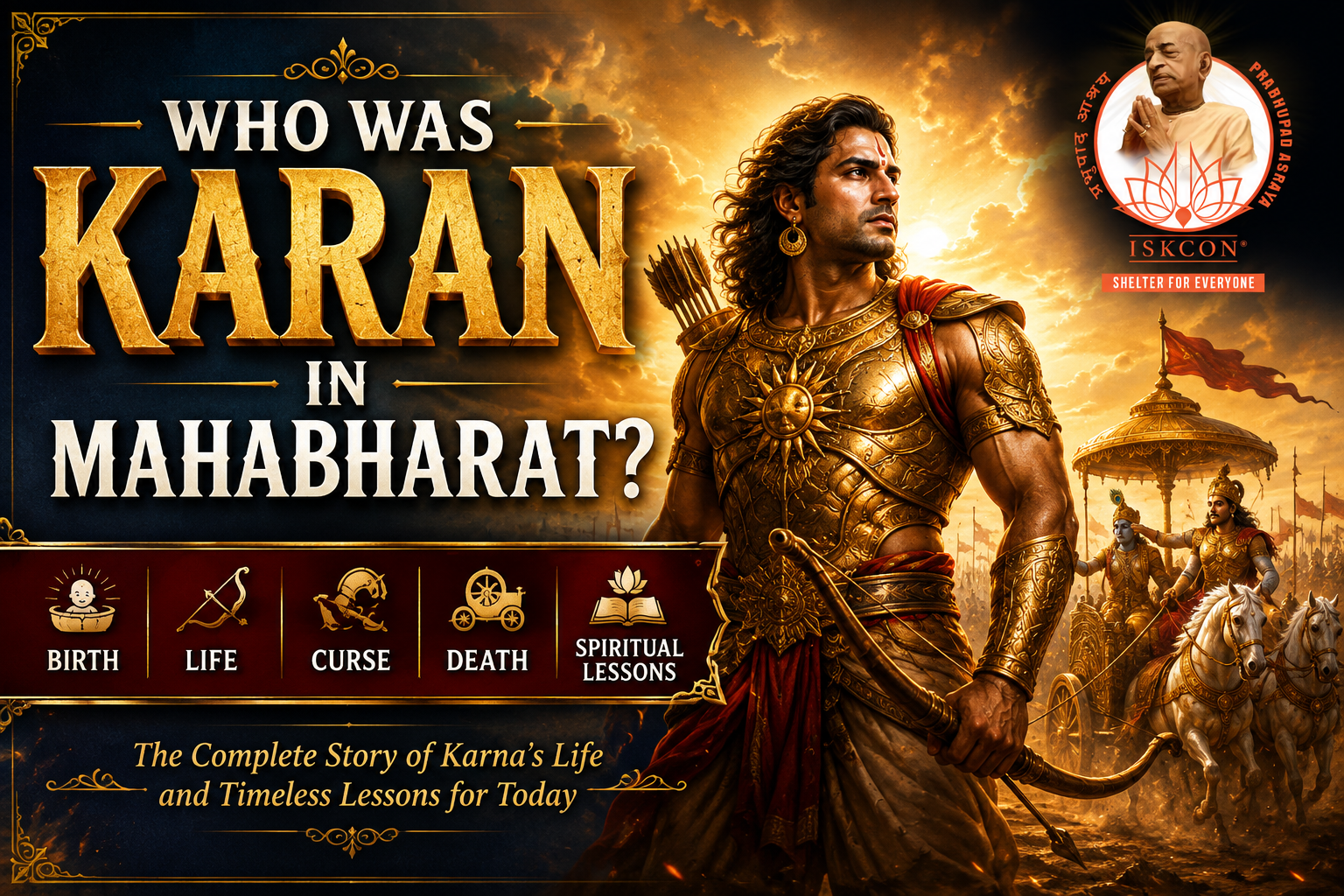
Who Was Karan in Mahabharat? Karna’s Complete Story, Birth, Life, Curse, Death & Spiritual Lessons
Karna is considered the most mysterious and emotionally powerful character in the Mahabharat. Many people search “who was karan in mahabharat” because his life was a unique combination of sacrifice, loyalty, courage, and tragedy. Some view him as the greatest warrior of the Mahabharat, while others believe he made the biggest mistake of his life by choosing the wrong side. But what is the true reality? In this article, we will understand the complete story of Karna — how he was born, why he was called Sut Putra, his friendship with Duryodhana, the proposal given to him by Lord Krishna, the mystery of his death, and most importantly, the spiritual lessons from his life understood in the light of the Bhagavad Gita and Krishna Consciousness. Who Was Karan in Mahabharat? (Direct Answer) To answer simply, Karna in the Mahabharat was the son of Kunti and Surya Dev (the Sun God). He was the eldest brother of the Pandavas, but immediately after his birth, he was abandoned in a basket in the river Ganga. Later, he was raised by Adhiratha and Radha, which is why the world knew him as a Sut Putra (son of a charioteer). Karna was an extraordinary archer, a great giver (Danveer), and a fearless warrior. Throughout his life, he struggled for respect and identity. His loyalty towards Duryodhana was so strong that even after learning the truth, he did not leave the Kauravas in Kurukshetra. This is what makes Karna’s story the most emotional chapter of the Mahabharat. Karna’s Birth Story – Son of Kunti and Surya Dev According to the Mahabharat, Princess Kunti received a divine mantra from Sage Durvasa. With this mantra, she could invoke any deity and receive a child from him. Out of curiosity, Kunti invoked Surya Dev. Surya Dev appeared, and through his blessings, Karna was born. Karna was born wearing a divine armor (Kavach) and earrings (Kundal), which served as his natural protection. However, Kunti was unmarried at the time. Fearing societal judgment, she placed the newborn child in a basket and set him afloat on the river. This single decision changed the entire direction of Karna’s life. Spiritual Reflection: Sometimes, the consequences of a single decision can reach across generations. The Mahabharat teaches us that karma and its fruits run very deep. Why Was Karna Called Sut Putra? The child floating in the river was adopted by Adhiratha, a charioteer of Hastinapur, and his wife Radha. They raised Karna as their own son. This is why people also called Karna Radheya, meaning the son of Radha. From here, his identity was forged — Sut Putra. Society judged him by his birth identity rather than his talent. This insult became a permanent part of Karna’s personality. Karna Faced Constant Humiliation Dronacharya rejected him in the competition. He was mocked in the royal assembly (Rajsabha). He was stopped from participating in Draupadi’s Swayamvar. All these insults bred in him an intense desire for recognition and respect. Karna’s Education and the Curse of Parashurama Karna wanted to become the greatest warrior in the world. However, Dronacharya refused to teach him the Brahmastra. Then Karna went to Lord Parashurama, presenting himself as a Brahmin. Parashurama taught him the lore of divine weapons. The Famous Curse One day, Parashurama was sleeping with his head in Karna’s lap. A bug bit into Karna’s thigh and started burrowing into it. Despite excruciating pain, Karna did not move so as not to disturb his guru’s sleep. When Parashurama woke up and saw the blood, he realized that no ordinary Brahmin could endure such pain; only a Kshatriya could. Enraged by the deceit, Parashurama cursed Karna that when he needed the divine knowledge the most, he would forget all of it. This curse proved true in Kurukshetra. Karna and Duryodhana – Friendship or Attachment? This is the most debated relationship in the Mahabharat. When Duryodhana saw Karna being humiliated at the arena, he immediately crowned him the King of Anga (Anga Desh). For the first time in his life, someone had shown Karna respect. Karna never forgot this favor. Why Did Karna Support Duryodhana? Reasons: Gratitude Friendship Recognition Identity However, from the perspective of Krishna Consciousness, gratitude can never be a valid justification to support adharma (unrighteousness). The Bhagavad Gita repeatedly teaches that dharma is greater than any individual personality or relationship. Karna vs Arjuna – The Greatest Rivalry Arjuna and Karna were both extraordinary archers. Their rivalry was not just about archery skills; it represented two contrasting paths: Arjuna Karna On the path of Dharma On the path of personal loyalty Under Krishna’s guidance Trapped in his promises and emotions Divine surrender Struggle for self-respect Lord Krishna gave spiritual wisdom to Arjuna. Karna respected Krishna in his life, but he never surrendered to Him. This difference became the ultimate turning point of the Mahabharat. Krishna’s Secret Meeting with Karna Before the Kurukshetra war, Lord Krishna met Karna in secret. Krishna revealed the truth to him: “You are the eldest son of Kunti. You are the eldest brother of the Pandavas.” Krishna offered him: Become the King of the Pandavas. The war can be avoided. Everyone will accept you. Why Did Karna Refuse Krishna? Karna said: Duryodhana supported me during my most difficult times. I cannot abandon him now. I will not break my loyalty to him. This shows both Karna’s greatness and his tragedy. He accepted the truth, but he failed to choose dharma. Karna’s Curses That Changed the War In the Mahabharat, Karna carried multiple curses: Parashurama’s Curse: Forgetting the Brahmastra mantra at the crucial moment. Brahmin’s Curse: Accidentally killing a cow; cursed that his chariot wheel would get stuck in the earth during battle. Mother Earth’s Curse: According to some traditions, Earth cursed him that she would grab his chariot wheel in battle. All these curses activated simultaneously on the battlefield of Kurukshetra. Why Did Karna Die in Mahabharat? On the 17th day of the Kurukshetra war, the final battle between Karna and
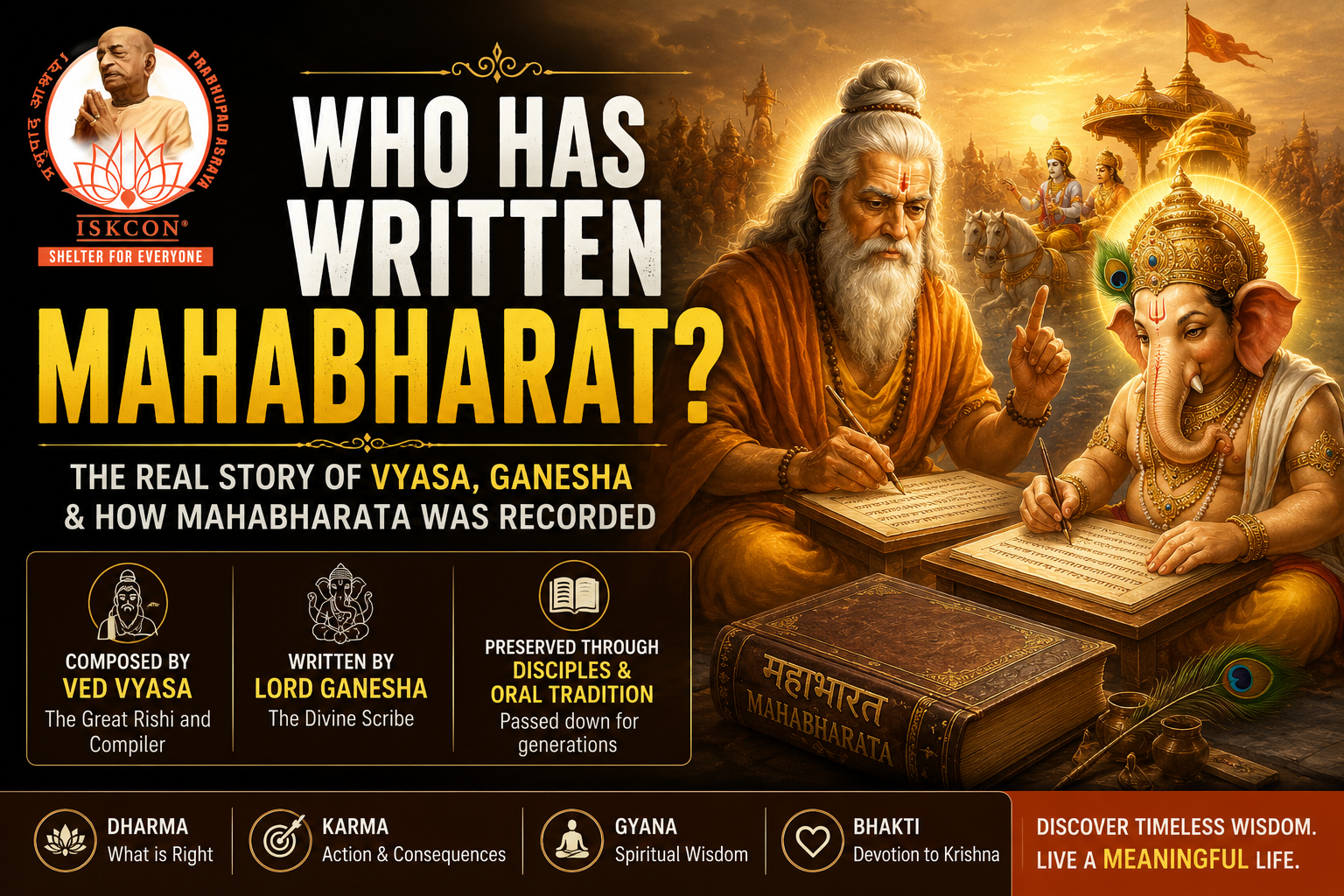
Who Has Written Mahabharat? The Real Story of Vyasa, Ganesha & How Mahabharata Was Recorded
If you search on Google “who has written Mahabharat?”, you get the simplest answer — Maharishi Ved Vyasa. However, an interesting question arises here: if the Mahabharata was written by Vyasa, then why does Lord Ganesha’s name appear as the writer of the Mahabharata? And did Vyasa write the Mahabharata himself, or did he dictate it to someone? This exact point is a bit confusing. Let’s understand this in simple language — without unnecessary myths or complicated terminology. Who Has Written Mahabharat? According to traditional Vedic understanding, the author of the Mahabharata is considered to be Maharishi Krishna-Dvaipayana Vyasa, also known as Ved Vyasa. In the Adi Parva of the Mahabharata as well, Vyasa is described as the composer of this great history. Within the text, the Mahabharata is described as Vyasa’s composition, and its recitation by his disciple Vaishampayana is also explained. Therefore, if someone asks, “Who wrote Mahabharata?”, the traditional answer is: Maharishi Ved Vyasa wrote and composed the Mahabharata. However, it is necessary to understand the word “written” carefully. Today we understand writing as typing words on a laptop, notebook, or keyboard. In ancient India, the transmission of sacred knowledge largely occurred through oral tradition. Therefore, the story of the Mahabharata cannot be completely explained merely by asking “who wrote it with a pen?”. Who Was Ved Vyasa? Now naturally the question arises — who was Ved Vyasa? In the Mahabharata, his name is also found as Krishna-Dvaipayana. “Dvaipayana” is associated with his birth on an island, whereas “Vyasa” is understood to be related to arrangement or compilation. In the Adi Parva of the Mahabharata, there are descriptions of his arrangement of the Vedas and his connection to the compilation of the Bharata. In the Vedic tradition, Vyasa is viewed as an extraordinarily learned Rishi. His connection is not limited to the Mahabharata alone. In traditional accounts, he is also associated with the arrangement of Vedic knowledge and the compilation of Puranic literature. In simple language, Vyasa is considered a major compiler and transmitter of sacred knowledge in ancient India’s spiritual and literary tradition. And the Mahabharata is one of his most famous compositions. Did Ved Vyasa Actually Write Mahabharata Himself? This is where the story becomes even more interesting. According to the traditional story of the Mahabharata, Vyasa composed the Mahabharata, but Lord Ganesha was made the scribe for its writing. In the Adi Parva, there is a description that Vyasa, after guidance from Brahma, requested Ganesha to write down the Mahabharata. Ganesha placed a condition — his writing must proceed continuously without stopping. Vyasa also placed an intelligent condition. He said that Ganesha should not write anything ahead until he completely understood the meaning of the verse. Think about it — an ancient version of a “writer vs speaker” collaboration was taking place. Vyasa was composing and dictating, and Ganesha was writing it down. So, Did Ganesha Write Mahabharata? According to the traditional story, Ganesha acted as the scribe, while Vyasa was the composer. This distinction is very important. Today, if an author dictates their book to an assistant and the assistant types it out, the assistant does not become the author of the book. In the exact same way, in the traditional Mahabharata narrative: Vyasa = Composer / Author Ganesha = Scribe / Divine Recorder This episode between Vyasa and Ganesha is explicitly described in the Adi Parva of the Mahabharata. Therefore, saying “Ganesha wrote Mahabharata” is incomplete. A better explanation is that Vyasa composed the Mahabharata and Ganesha is traditionally described as its divine scribe. How Was Mahabharata Passed Down? Now another important question. If Vyasa composed it and Ganesha wrote it, then how did the Mahabharata reach the people? The Mahabharata itself describes multiple stages of recitation. Vyasa taught the Mahabharata to his disciples. Vaishampayana recited it in the context of King Janamejaya’s snake sacrifice. Later, Sauti narrated this history in an assembly of sages. Therefore, understanding the Mahabharata merely as a “book” is somewhat incomplete. It was also a living tradition of narration, memorization, and transmission. Imagine — across generations, stories, teachings, genealogies, and philosophical discussions were being carefully preserved. Today we share files on Google Drive. In ancient India, knowledge was preserved through memory, recitation, and discipleship. Why Is Mahabharata Also Called Bharata? Often people use “Mahabharata” and “Bharata” as interchangeable terms. In the Adi Parva of the Mahabharata, the name Bharata is also found repeatedly. According to traditional accounts, Vyasa first composed a relatively concise form of Bharata, and later in the tradition, its much larger form developed and was transmitted. The Adi Parva itself gives descriptions of different forms and sizes of the composition. Therefore, when you see both terms — Bharata or Mahabharata — in ancient texts, understanding the context is important. The basic sense of “Mahabharata” itself is broadly connected to “the great Bharata”. Is Mahabharata Just a Story About the Kurukshetra War? This is also a common misunderstanding. If you view the Mahabharata merely as a war story of Pandavas vs Kauravas, you are missing a massive portion of it. Within it lies: Politics Family relationships Difficult decisions of Dharma Friendship Leadership Human psychology And most importantly — the Bhagavad Gita is also a part of this very Mahabharata. On the battlefield of Kurukshetra, Arjuna’s confusion was not merely a personal problem of a warrior. His questions are surprisingly relatable: “What should I do?” “What is the right decision?” “What to do when there is a conflict between duty and emotions?” Today, a college student might be confused about their career. A professional might struggle between job demands and personal values. A person in a relationship might make a wrong decision due to emotional attachment. Arjuna’s crisis is ancient, but his psychology feels surprisingly modern. This is why the Bhagavad Gita feels relevant even today. What Does Mahabharata Teach Us Today? The real value of the Mahabharata is not merely knowing “who has written Mahabharat?” The bigger question is — “Why was this
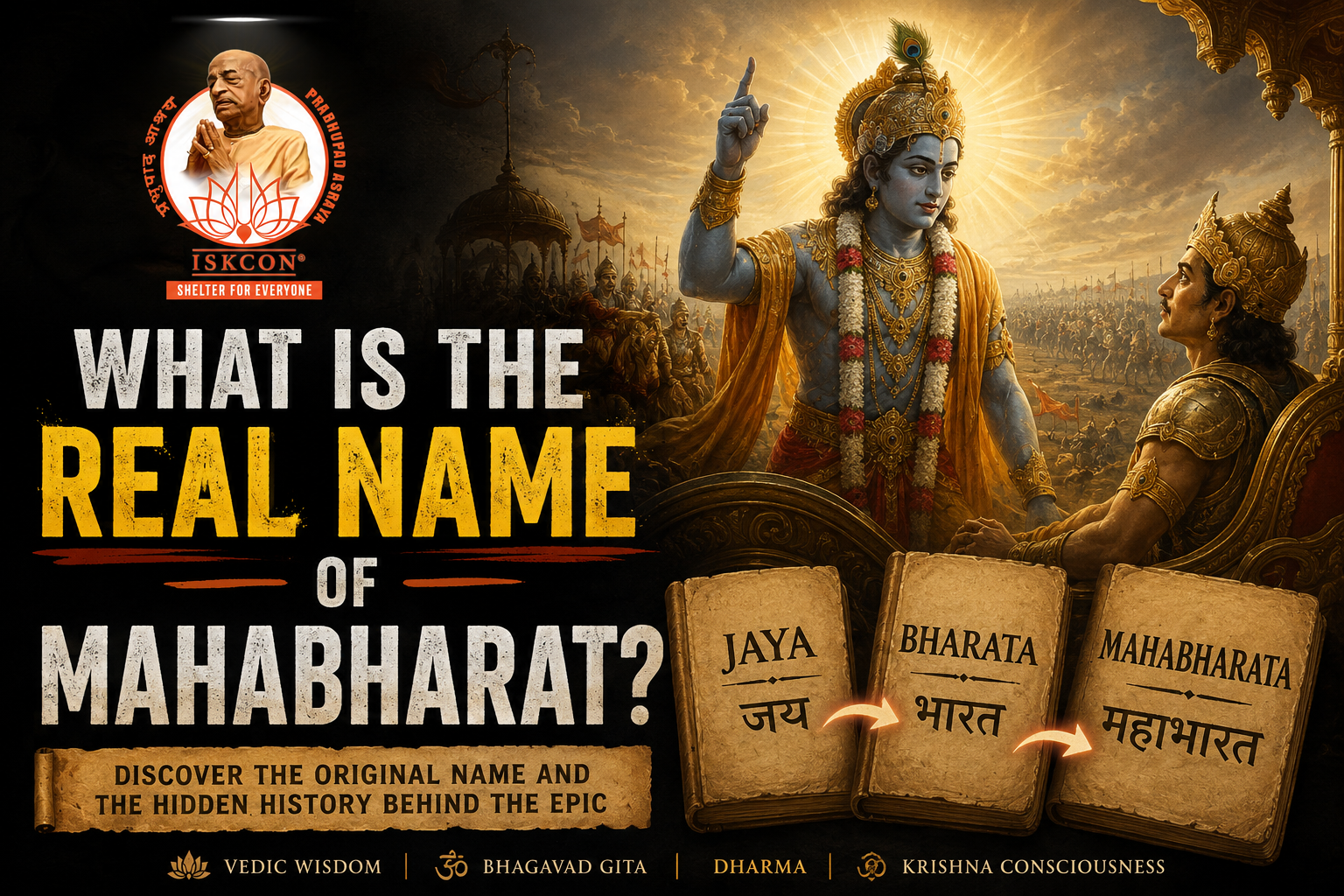
What Is the Real Name of Mahabharat? Understanding the Original Name of the Epic
Have you ever wondered what is the real name of Mahabharat? We have known it by the name “Mahabharat” since childhood, but was this its original name? The interesting thing is that the name of the Mahabharata changed through different stages of history. Therefore, if you want to understand its original name and its meaning, the story becomes quite fascinating. The Mahabharata is not just the story of the Kurukshetra war. Within it, you find deep lessons on Dharma, Karma, politics, family relationships, devotion, and human nature. And within this very epic comes the Bhagavad Gita, where Lord Krishna imparts spiritual wisdom to Arjuna. Let’s understand in simple language what the real name of the Mahabharata was and how this name evolved. What Was the Real Name of the Mahabharata? If we look at traditional Sanskrit sources, the name of the Mahabharata was not exactly “Mahabharata” from the very beginning. According to tradition, Maharishi Vyas originally named this work “Jaya”. “Jaya” simply means victory or triumph. This name represented the broader idea of the Kurukshetra conflict and the victory of Dharma. Later, it became known as “Bharata” and eventually as “Mahabharata”. Therefore, when someone asks, “What is the real name of Mahabharat?”, giving the answer in just a single word would be a bit incomplete. In traditional understanding, the development of its name is explained in the form of Jaya → Bharata → Mahabharata. How Did “Jaya” Become “Bharata” and “Mahabharata”? Now, this is where a slightly interesting history comes in. According to tradition, the original composition was comparatively short and was called Jaya. Over time, different stories, teachings, genealogies, and philosophical discussions kept getting added to this narrative. This expanded work came to be called Bharata. Later, when its scope became even more extensive, it was called Mahabharata. “Mahā” means great or vast, and “Bhārata” has a connection to the Bharata dynasty and the lineage of King Bharata. Thus, “Mahabharata” can be broadly understood in the sense of “the great history of the Bharata dynasty.” This was not just the story of a family war. Many dimensions of human life are discussed within it. What Is the Connection to the Name “Bharata”? Now a common confusion arises — where exactly did the name “Bharata” come from? The tradition of the Mahabharata is closely connected to the Bharata dynasty. The name of King Bharata is very important in the Indian tradition, and it is from this lineage that the Kuru dynasty and the story of the Pandavas and Kauravas develop later on. Therefore, “Bharata” is not just a geographical identity. In the context of the epic, it also has a strong connection to the Bharata dynasty. If you view the Mahabharata from a family tree perspective, the scope of the story becomes quite large through the generations. This is why the name of the epic also gradually reflects its larger identity. Was the Original Name of the Mahabharata “Jaya”? Yes, in traditional accounts, Jaya is considered the earliest form of the Mahabharata. However, it is essential to understand an important point here. Understanding “Jaya” simply like the “first title” of a modern book might be a bit simplistic. The textual history of the Mahabharata is complex, and traditional descriptions and modern academic studies can explain this development in different ways. When we understand the Mahabharata from the perspective of Prabhupad Ashraya, it is important to take the traditional Vedic presentation seriously. Here, the focus is not just on historical curiosity, but also on the knowledge that the epic provides us. Where Does the Bhagavad Gita Appear in the Mahabharata? If you consider the Mahabharata to be just a war story, you might miss a very important part of it. On the Kurukshetra battlefield, Arjuna becomes deeply confused upon seeing his relatives, teachers, and friends standing on the opposite side. It was not a simple question in his mind. His entire understanding of duty, relationships, and life was shaken. This is where Lord Krishna imparts the transcendental knowledge of the Bhagavad Gita to him. Krishna explains to Arjuna that life is not just a name for temporary situations and emotional attachments. It is also necessary for us to understand our Dharma, Karma, and spiritual identity. Even in today’s time, this situation feels surprisingly relatable. Whether it is making a career decision, family pressure, relationship confusion, or anxiety about the future — sometimes we too feel confused just like Arjuna. The Bhagavad Gita teaches us to look at this very confusion from a spiritual perspective. The Mahabharata Is Not Just a Story of War On social media, the Mahabharata is often presented merely in the form of a war between the Pandavas and the Kauravas. However, the actual scope of the epic is much wider. Subjects like kingship, morality, Dharma, family responsibilities, Karma, devotion, politics, and human psychology are discussed within it. The characters are also not completely one-dimensional. From Yudhishthira, we get questions on Dharma and truth. From Arjuna, we get the opportunity to understand duty and emotional conflict. From Bhishma, the complex dimensions of commitment and responsibility are understood. And from Krishna’s teachings, we get a deeper perspective of spiritual wisdom. For this reason, considering the Mahabharata to be merely an ancient war narrative would mean underestimating its depth. Why Is the Mahabharata Relevant for Today’s Young Generation? Have you ever noticed that modern problems feel very new, but emotions are surprisingly old? Today there is social media, smartphones, career competition, and the pressure of relationships. However, confusion, jealousy, attachment, fear, ambition, and family conflicts — these human emotions are not new. The Mahabharata explores these emotions through extremely powerful situations. For example, Arjuna was confused on the battlefield. Today, a student might be confused at the crossroads of their career. A professional might struggle between job and family responsibilities. There could be a conflict between attachment and duty in a relationship. The situation is different, but the inner conflict is familiar. This is why reading the Mahabharata
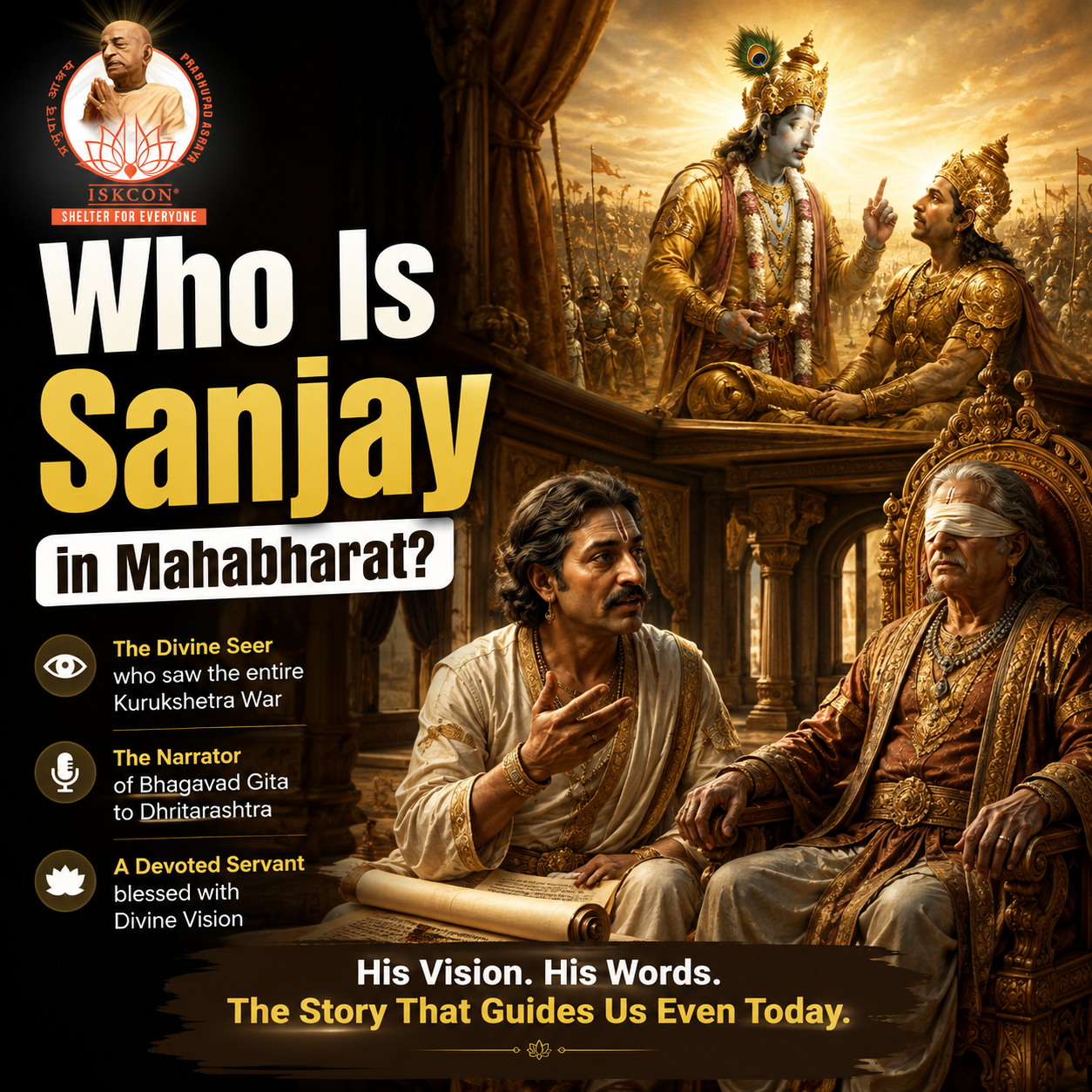
Who Is Sanjay in Mahabharat? The Divine Narrator Who Saw the Kurukshetra War
If you have read the Mahabharat or the Bhagavad Gita, you must have definitely heard Sanjay’s name. However, the interesting question is — who is Sanjay in the Mahabharat, and how was he able to see the Kurukshetra battlefield while sitting in Hastinapur beside Dhritarashtra? Sanjay was an important character in the Mahabharat, but his significance was not merely that of a messenger or a storyteller. He was granted a special divine vision by Maharishi Vyasa, through which he could directly see the events unfolding in Kurukshetra and describe them to Dhritarashtra. And through this extraordinary ability, we come to know the dialogue of the Bhagavad Gita. Let’s understand Sanjay’s story in a simple way. Who Was Sanjay in the Mahabharat? Sanjay was King Dhritarashtra’s trusted advisor and charioteer. He was connected to the royal court of Hastinapur and was very close to Dhritarashtra. Dhritarashtra was blind from birth. Therefore, when the great war between the Kauravas and the Pandavas was about to begin in Kurukshetra, it was impossible for him to see the battlefield. This is where Sanjay’s role becomes extremely important. Maharishi Vyasa granted Sanjay divya drishti, or divine vision. Because of this special vision, Sanjay could observe the activities of the war without physically being present on the battlefield. Think about it: today, through live streaming, we can watch an event happening thousands of kilometers away. In Sanjay’s case, rather than technology, the concept of spiritual power is explained. Who Gave Sanjay Divine Vision? Sanjay received divine vision from Maharishi Vyasa. At the beginning of the Mahabharat war, Dhritarashtra could not see the battlefield. Vyasa offered to grant divine sight to Dhritarashtra as well, but Dhritarashtra declined it. Following this, Vyasa bestowed that extraordinary ability upon Sanjay. Its purpose was not merely to satisfy curiosity. The goal was for Sanjay to continuously describe the important events occurring on the battlefield to Dhritarashtra, making his role essential to the story. This is the reason why Sanjay holds a unique position in the Mahabharat’s war narrative. How Did Sanjay Hear the Bhagavad Gita? Now comes the most interesting part. Sanjay was perceiving the conversation taking place between Lord Krishna and Arjuna on the battlefield of Kurukshetra through his divine vision. Dhritarashtra asked Sanjay: “Dharma-kshetre kuru-kshetre…” Meaning, what did the Pandavas and my sons do at Kurukshetra? In response to this question, Sanjay began giving a description of the battlefield. When Krishna was imparting spiritual knowledge of the Bhagavad Gita to Arjuna, Sanjay was perceiving that conversation as well. Because of this, the dialogue of the Bhagavad Gita is conveyed to us in the Mahabharat through Sanjay’s narration. Think about it — if Sanjay had not possessed divine vision, how would Dhritarashtra have directly received information about the events on the battlefield and the Krishna-Arjuna conversation? Sanjay Was Not Just a Reporter Understanding Sanjay merely as an ancient reporter would be somewhat incomplete. His narration possessed an important quality — clarity. He explained the situations taking place on the battlefield to Dhritarashtra. However, another crucial aspect of Sanjay’s character is his spiritual understanding. Toward the end of the Mahabharat, Sanjay is deeply affected upon recalling the dialogue between Krishna and Arjuna. In the final chapter of the Bhagavad Gita, Sanjay’s words reveal that Krishna’s teachings left a profound impact on his consciousness as well. Here lies a beautiful lesson: Sometimes we hear spiritual knowledge meant for someone else, but if we listen sincerely, that knowledge can transform our own life too. The Relationship Between Sanjay and Dhritarashtra Sanjay was Dhritarashtra’s loyal advisor. Dhritarashtra was emotionally deeply attached to his sons, especially Duryodhana. Because of this attachment, his judgment was affected in many situations. Sanjay used to explain the reality of the battlefield to him with complete honesty. This relationship is relatable in modern life too. Sometimes we need a friend who doesn’t just say what we want to hear, but instead shows us reality. Sanjay’s role was somewhat similar — he was presenting the reality of the battlefield to Dhritarashtra, even if that reality was uncomfortable. What Did Sanjay Say at the End of the Mahabharat? In the final verses of the Bhagavad Gita, Sanjay expresses his feelings while remembering the conversation between Krishna and Arjuna. He repeatedly recalls the extraordinary dialogue between Lord Krishna and Arjuna, experiencing profound spiritual joy. The most famous statement appears in Bhagavad Gita 18.78: “Yatra yogeshvarah krishno yatra partho dhanur-dharah…” The central message of this verse is that wherever there are Krishna and Arjuna, there will be victory, prosperity, strength, and righteousness. For Sanjay, the combination of Krishna and Arjuna was not merely battlefield strategy; he saw something spiritually significant in it. What Can We Learn from Sanjay in Modern Life? Sanjay’s story is not just for interest in ancient history or mythology. It contains practical lessons as well. 1. Listening to Right Knowledge Attentively Sanjay was not a warrior on the battlefield, yet he listened sincerely to the Krishna-Arjuna conversation. Today we have unlimited information — YouTube, Instagram, podcasts, books. However, information and wisdom are not the same thing. The Bhagavad Gita does not just give us information; it provides us with a spiritual framework to understand life. 2. Running Away from Reality Is Not the Solution Dhritarashtra could not physically see the battlefield, but Sanjay kept telling him the reality. In modern life, we too prefer to ignore uncomfortable realities. Whether it is a career problem, a relationship issue, or a problem with our habits — ignoring it does not make the problem disappear. First, reality has to be accepted. 3. Spiritual Knowledge Can Transform the Listener Too Sanjay was not the direct recipient of Krishna and Arjuna’s conversation. Yet, listening to Krishna’s teachings left a deep impact on his consciousness. This can be understood from the perspective of Krishna Consciousness as well. When we listen to spiritual knowledge in a sincere mood, our priorities gradually begin to change. Connection Between Sanjay and the Bhagavad Gita If you read the
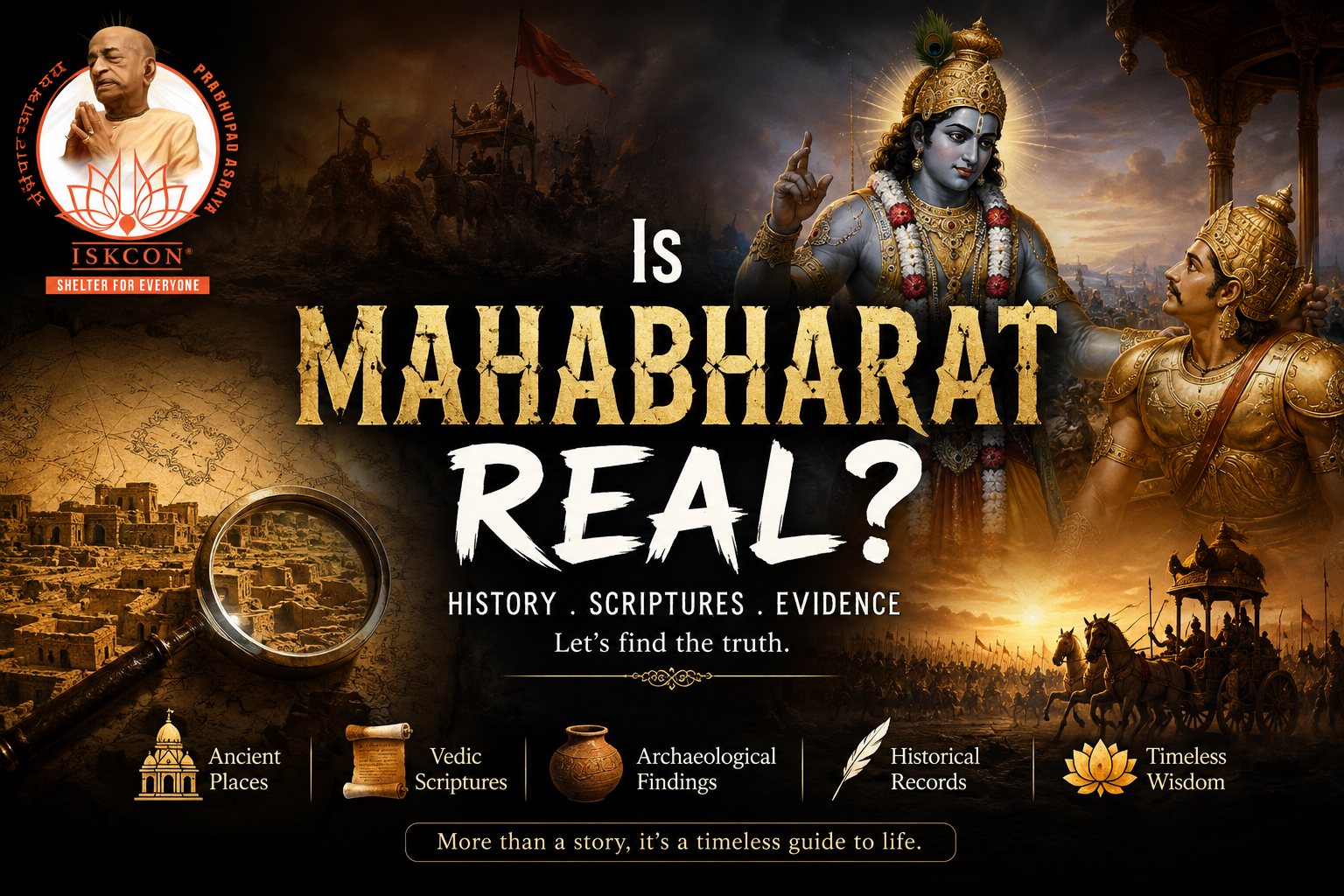
Is Mahabharat Real? Did the Mahabharata Really Happen?
If you have ever read the Mahabharata or watched it on TV, a question naturally comes to mind — was the Mahabharata actually real, or is it just an ancient story? Especially in today’s time, when someone on social media says that the Mahabharata is completely fictional, and someone else claims that its every detail has been scientifically proven, feeling confused is completely normal. So the simple question is: Is Mahabharat real? The short answer is — calling the Mahabharata just a fictional story is not historically accurate, but proving its every event and supernatural detail using modern science is also not possible. This is where a deeper understanding becomes necessary. What Is the Mahabharata? The Mahabharata is not just a war story. It is an enormous Sanskrit epic of ancient India, containing central elements such as the Kuru dynasty, Pandavas, Kauravas, Shri Krishna, Kurukshetra War, and the Bhagavad Gita. According to tradition, Vedavyasa is considered the author of the Mahabharata. It contains family politics, friendship, betrayal, the conflict of dharma, and spiritual wisdom. If you view it merely as a “war between the Pandavas and the Kauravas,” you will miss the actual depth of the Mahabharata. Actually, its biggest question is this: When the decision between right and wrong in life is not clear, what should a person do? A profound answer to this very question is found in the Bhagavad Gita. Was the Mahabharata a Real Historical Event? Now coming to the main point. The Mahabharata has traditionally been viewed as Itihasa. In the Sanskrit tradition, the basic sense of “Itihasa” is — “so it indeed happened.” Therefore, the Hindu tradition does not simply place the Mahabharata in the category of ordinary mythology or imaginary fiction. However, the method of modern history is slightly different. Historians look at factors like archaeological evidence, inscriptions, textual layers, chronology, and independent evidence to establish an event. And this is where the picture becomes complicated. The locations described in the story of the Mahabharata — such as Hastinapura, Kurukshetra, Indraprastha, and Mathura — are connected to ancient Indian geography. Archaeological remains have also been found at sites like Hastinapura. However, finding archaeological remains does not automatically prove that the complete narrative of the Mahabharata was historically documented in that exact form. Understanding this distinction is important. Did the Kurukshetra War Actually Happen? This is one of the most interesting questions related to the Mahabharata. According to the traditional account, the great war between the Pandavas and the Kauravas took place in Kurukshetra. Even today, Kurukshetra in Haryana is an important pilgrimage destination and is strongly associated with the Mahabharata tradition. But has modern archaeology proven that exact 18-day war? No. As of now, conclusive archaeological evidence is not available to independently prove the complete account of the Mahabharata war according to modern historical standards. However, the opposite is also not automatically true. The absence of evidence simply does not establish that the event never happened. Reconstructing events that occurred thousands of years ago is extremely difficult. Think about it: if records of an important event from today were destroyed thousands of years later, how difficult would it be for future historians to reconstruct that event exactly? For this reason, different levels of certainty exist in ancient history. Hastinapura and the Connection to Ancient India In the Mahabharata, Hastinapura was the major center of the Kuru dynasty. In today’s Uttar Pradesh, a place named Hastinapur exists, and archaeological excavations have also taken place there. Archaeology has revealed remains of ancient settlements, showing that this region has been part of human habitation for thousands of years. However, there is an important point. Archaeology does not automatically identify an ancient settlement with the exact characters of the Mahabharata. This means that the existence of the ancient location named Hastinapura is interesting evidence, but by itself, it does not scientifically prove the historical existence of the Pandavas or Kauravas. Similarly, Indraprastha is traditionally associated with the modern Delhi area, but there has been discussion among scholars regarding its exact historical identification. Therefore, the sensible approach is to neither exaggerate nor completely ignore the evidence. Was Shri Krishna a Real Historical Person? Now for the most important character of the Mahabharata — Shri Krishna. Viewing Krishna merely as a character of the Mahabharata is also an incomplete picture. In the Indian tradition, Krishna’s connection is found not only in the Mahabharata but also in the Bhagavata tradition, Harivamsa, and multiple ancient texts. Scholars have been studying ancient references and traditions related to Krishna from different historical perspectives. However, the same principle applies here as well. Based on modern historical research, scientifically verifying every detail of Krishna’s life is not possible. And the question of spirituality is also slightly different from history. If a person considers Krishna as God (Bhagavan), their basis is not just archaeology. In it, scriptural evidence, guru-parampara, spiritual practice, and personal realization also play important roles. Understanding this difference is crucial. Is the Bhagavad Gita Part of the Mahabharata? Yes. The Bhagavad Gita is a part of the Mahabharata itself, specifically the dialogue between Krishna and Arjuna in the Bhishma Parva. Imagine — there is a massive battlefield. Arjuna sees his own relatives, teachers, and friends standing on the opposite side. The Gandiva almost slips from his hand. He is confused: “Should I fight against my own people?” It is right here that Shri Krishna explains to him about Dharma, Karma, Atma, Yoga, Bhakti, and spiritual reality. Therefore, reading the Gita only in the context of war limits its teaching. Even today, when a person is confused in career, relationships, family pressure, or life decisions, Arjuna’s situation can feel surprisingly relatable. The only difference is that Arjuna’s battlefield was Kurukshetra. Our battlefields are sometimes our offices, sometimes our relationships, and sometimes our own mind. So Is the Mahabharata Real or Mythology? This is where the most balanced answer is found. If “real” means: “Has modern science proven every character, event, and supernatural
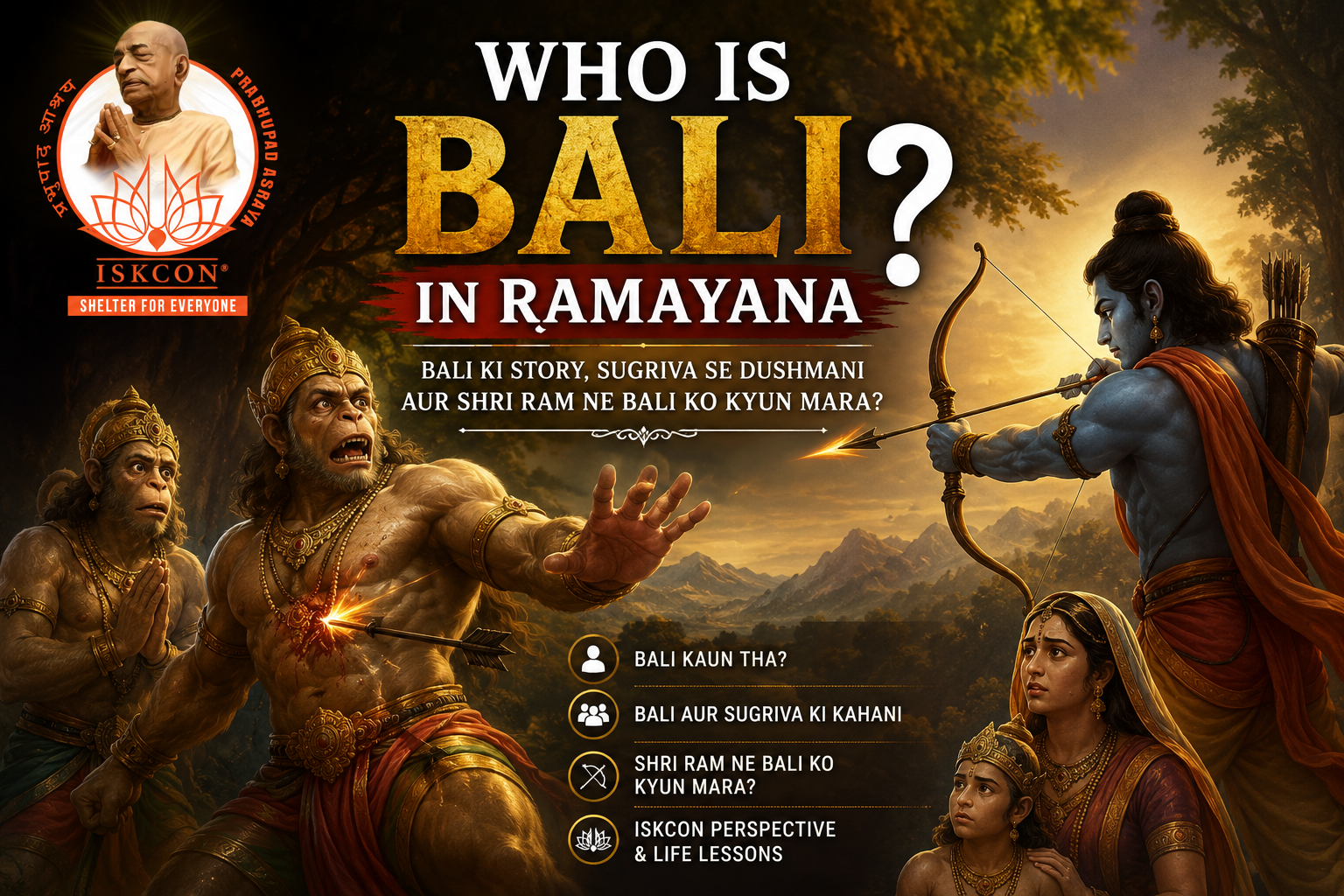
Who Is Bali in Ramayana? Bali’s Story, Enmity with Sugriva, and Why Shri Ram Killed Bali
If you have read or watched the Ramayana, you must have heard the name of one character — Bali, who is also called Vali in the Valmiki Ramayana. Bali was no ordinary vanara. He was the powerful king of Kishkindha and his strength was so extraordinary that even great warriors thought twice before fighting him. However, Bali’s story is not just a story of his power. Within it lies a connection to friendship, misunderstanding, ego, dharma, karma, and a very important decision made by Shri Ram. The biggest question of all is — if Shri Ram stood on the side of dharma, why did he kill Bali by hiding instead of fighting him face-to-face? Let’s understand the entire story in a simple way. Who Was Bali in the Ramayana? Bali, also known as Vali, was the vanara king of Kishkindha. He was the elder brother of Sugriva, and both were initially part of the same kingdom and family. Bali was extraordinarily powerful and famous for his physical strength. Bali’s wife was named Tara, who is one of the important and intelligent characters in the Ramayana. Bali’s son was Angada, who later plays an important role in Shri Ram’s Lanka campaign. Bali possessed tremendous strength, but his story also shows us that having power alone and correctly understanding dharma are not the same thing. This is where Bali’s story becomes interesting. What Happened Between Bali and Sugriva? Bali and Sugriva were brothers, but one incident completely changed their relationship. A powerful asura, Mayavi, came to challenge Bali. Bali pursued him to a cave. Sugriva accompanied him as well. Bali told Sugriva to wait outside and went inside the cave himself. A lot of time passed. Sugriva saw blood and heard terrifying sounds coming from inside the cave. He felt that Bali had perhaps been killed. Considering the situation, Sugriva blocked the entrance to the cave and returned to Kishkindha. His intention was not to steal Bali’s kingdom; he genuinely thought his brother was dead. However, Bali was not dead. When Bali eventually emerged from the cave and saw the entrance blocked, he interpreted the situation in a completely different way. He felt that Sugriva had conspired against him. And from here, the misunderstanding between the brothers turned into a serious conflict. Why Did Bali Banish Sugriva? Bali felt that Sugriva had intentionally trapped him inside the cave. Therefore, Bali punished Sugriva and banished him from Kishkindha. Sugriva fled for his life to Rishyamukha Mountain. The interesting thing is that Bali could not directly attack Sugriva on Rishyamukha Mountain due to a curse associated with that place. It was at this location that Sugriva met Shri Ram and Lakshmana. And then, the story of the Ramayana took a completely new direction. How Did the Friendship Between Shri Ram and Sugriva Happen? While Shri Ram was searching for Sita Ji, he met Sugriva and Hanuman Ji. Hanuman Ji introduced Shri Ram and Sugriva to each other. Sugriva told Shri Ram his entire story — what happened with Bali, how he was banished from the kingdom, and how he was separated from his wife. Shri Ram promised to help Sugriva. In return, Sugriva promised to help Shri Ram in searching for Sita Ji. Here an important principle is understood: Spiritual life does not mean that friendship or practical relationships disappear. Rather, properly utilizing relationships on the basis of dharma is also important. How Was Bali So Powerful? Bali’s extraordinary strength is a major part of the Ramayana’s story. It is said that he possessed a special boon: whichever warrior faced him in direct combat, a portion of that opponent’s strength would be transferred to Bali. For this reason, defeating Bali was extremely difficult. Sugriva was naturally afraid to fight Bali. Shri Ram understood the situation and asked Sugriva to challenge Bali. However, in the first fight, Shri Ram did not kill Bali. Why? Because Bali and Sugriva were very similar in appearance, and Shri Ram could not clearly distinguish between the two. Therefore, for the second confrontation, Sugriva was given an identification mark. Now Shri Ram clearly knew who Bali was. Why Did Shri Ram Kill Bali by Hiding? This is the most controversial and commonly asked question in the Ramayana. People often think: “Shri Ram was the protector of dharma. Then why did he not fight Bali face-to-face?” Casually dismissing this question is not the right approach. In fact, in the Valmiki Ramayana, there is a detailed conversation between Bali and Shri Ram on this point. Bali asks Shri Ram why he attacked him without a direct confrontation. Shri Ram explains his reasoning. Bali had forcefully taken Sugriva’s wife, Ruma, under his control. From Shri Ram’s perspective, this was a severe violation of dharma. Shri Ram also explained that Bali had not conducted himself appropriately toward his younger brother. Therefore, Bali’s issue was no longer just a personal disagreement with Sugriva; it had reached the question of dharma versus adharma. But an Important Point To understand this incident, simply saying that “Bali was a bad guy, so Ram killed him” would be a superficial explanation. The Ramayana shows us Bali’s strength, intelligence, family relationships, and mistakes — everything. This is why Bali’s character does not feel black-and-white. He possessed greatness within him as well as serious mistakes. And perhaps that is why his story is so relevant. What Happened Before Bali’s Death? When Shri Ram’s arrow struck Bali, Bali questioned Shri Ram. Shri Ram explained his actions and his violations of dharma. Gradually, Bali came to understand Shri Ram’s position and reasoning. He expressed concern about the future of his son Angada and his wife Tara. After Bali’s death, Sugriva was made the king of Kishkindha. Angada was given an important position. Tara is also remembered in the story of the Ramayana for her intelligence and maturity. Here the story gives an interesting lesson: Power and position are temporary, but no one can escape the consequences of their actions. What Do
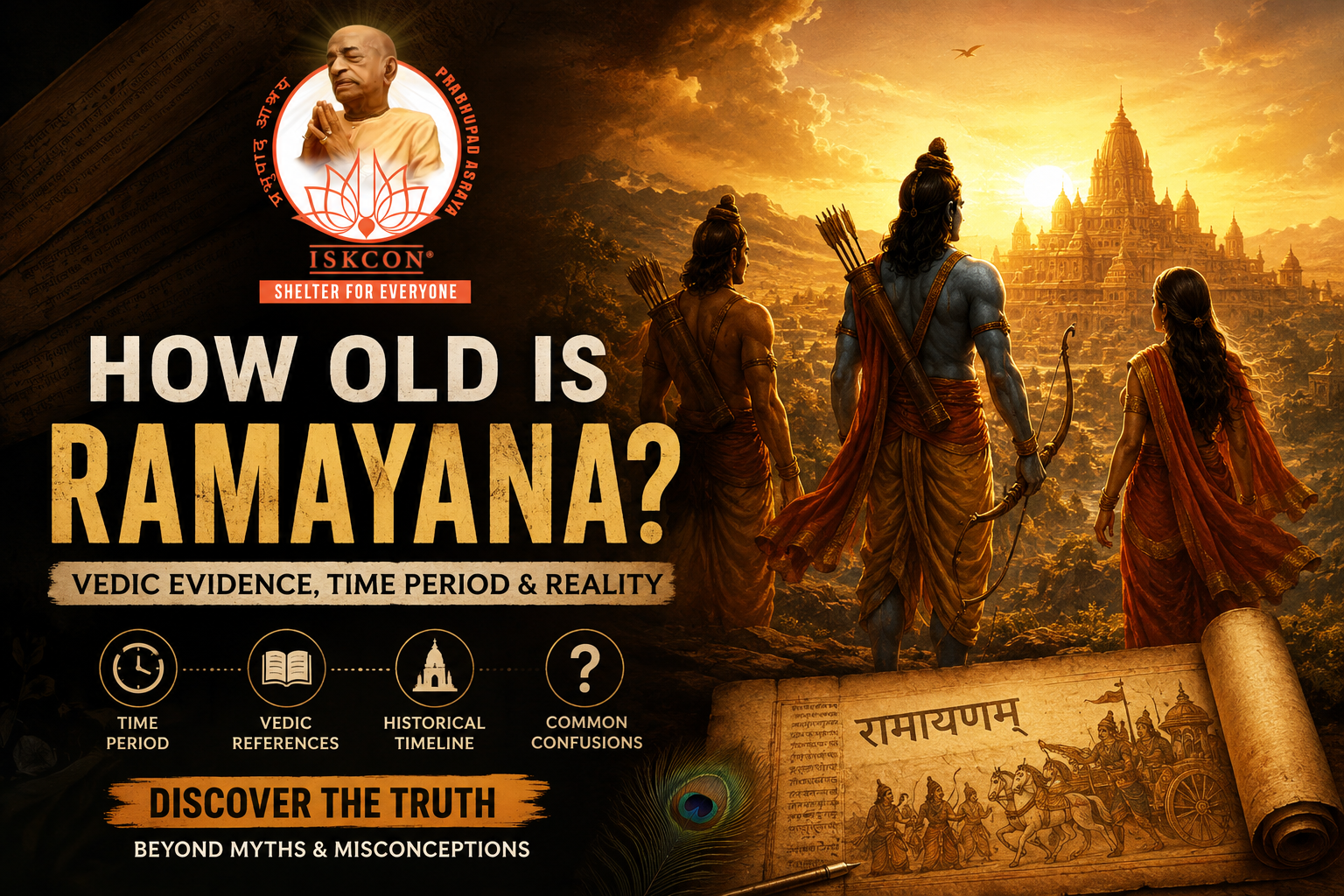
How Old Is Ramayana? The Amazing Age of the World’s Timeless Epic
Introduction: A Question That Comes Up Often Often when people read about the Ramayana or watch videos about it, a question definitely arises — how old is Ramayana? Is it just a story from a few thousand years ago, or is its history far older than that? This exact confusion is also widely seen on social media. Some people label the Ramayana as mythology, while others consider it an actual historical event. So what is the truth? Let’s understand this in simple language. No unnecessary debates, no complicated terms. Just Vedic understanding, historical estimates, and a practical perspective. How Old Is Ramayana According to Vedic Tradition? If a direct answer is to be given, according to the Vedic tradition, the events of the Ramayana took place in the Treta Yuga, which was long before the present Kali Yuga. According to the traditional Vedic timeline, Lord Ram’s appearance occurred lakhs of years ago. According to many Vedic scholars and Puranic calculations, this is considered to be approximately 8.7 lakh (870,000+) years ago. This is why when someone asks “How old is Ramayana?”, the Vedic answer does not give a timeline of just a few thousand years, but rather one of lakhs of years. It is essential to understand this point: this calculation is not based on modern archaeology, but on Vedic chronology. Then When Did Maharishi Valmiki Write the Ramayana? This is where the most confusion occurs. The events of the Ramayana and the time of writing the Ramayana are not the same thing. Maharishi Valmiki is called the Adi Kavi (the first poet). According to the Vedic tradition, he composed the Ramayana during the time of Lord Ram Himself. This means that as the events were taking place, his scripture was written during those very times. Later, the teachings of this original Valmiki Ramayana reached different languages and cultures. Does Archaeology Confirm the Exact Age of the Ramayana? The simple fact is… Modern archaeology has not yet been able to scientifically confirm the exact age of the Ramayana. Some researchers study astronomical references, ancient geography, and archaeological findings. Some people discuss the Ram Setu in satellite images as evidence. However, there are still differing opinions within the scientific community on this. Because of this, the responsible approach is for us to understand both the Vedic tradition and modern research in their respective contexts. Why Does the Vedic Timeline Seem So Different? If you look at modern history books, their timeline is generally detailed only up to a few thousand years. However, Vedic literature looks at time from a different perspective. According to Vedic philosophy, creation cycles are immense. Satya Yuga, Treta Yuga, Dvapara Yuga, and Kali Yuga together form one Mahayuga. In this framework, Lord Ram’s appearance is described in the Treta Yuga. This is why the age of the Ramayana appears much older than modern historical timelines. Why Does the Age of Ramayana Matter? Think about it… If the Ramayana were just an old book, perhaps crores of people would not be following it in their daily lives today. The real value of the Ramayana is not merely in its age. Its value lies in its timeless principles. Such as: Standing by the truth Fulfilling family responsibilities Maintaining humility in leadership Following Dharma even in difficult situations Developing self-control and compassion These lessons are just as relevant today as they were before. Just as there is pressure in college or stress in the office, similarly, life’s challenges exist in every generation. The Ramayana tells us how values can be maintained even in difficult situations. Bhagavad Gita and Ramayana Connection The interesting thing is that the central message of both the Ramayana and the Bhagavad Gita is to lead human beings toward spiritual growth. The Ramayana gives a practical example of how to live Dharma in life. The Bhagavad Gita explains how to control the mind, how to understand Karma, and how to develop one’s relationship with Lord Krishna. Bhakti Yoga makes this very understanding even more practical. When a person progresses in devotional service, scriptures do not remain just stories, but become guides for daily life. Different Views About the Age of Ramayana If you search on the internet, you will find multiple estimates. Generally, three perspectives are seen: Traditional Vedic View: The events of the Ramayana occurred approximately 8.7 lakh years ago or around that time. Historical Researchers: Some researchers propose different dates based on astronomical calculations. Academic View: Many historians study it as ancient epic literature and do not consider there to be a consensus on an exact historical date. Every perspective has its own methodology. Therefore, understanding the context is important. Why Is the Ramayana Still So Popular Today? This question might also come to your mind. Despite being such an old book, how does the Ramayana inspire every generation? The reason is simple. Human problems have changed, but human nature has not changed much. Today there is social media distraction. Earlier there were different distractions. Today relationships are complicated. Earlier too, the emotions were the same. Because of this, the principles of the Ramayana feel relevant in every generation. Frequently Asked Questions How old is Ramayana according to Hindu tradition? According to traditional Vedic calculations, the events of the Ramayana are considered to have occurred approximately 870,000 years ago or even earlier in the Treta Yuga. Is Ramayana older than Mahabharata? Yes. According to Vedic chronology, the Ramayana is an event of the Treta Yuga, whereas the Mahabharata occurred at the end of the Dvapara Yuga. Who wrote Ramayana? The original Ramayana was composed by Maharishi Valmiki. For this reason, it is also called the Valmiki Ramayana. Is there scientific proof of Ramayana’s age? As of now, there is no exact consensus in the scientific community. Archaeological and astronomical studies have been ongoing, but universally accepted proof is not available. Why is Ramayana still important today? Because it teaches timeless principles like leadership, family values, Dharma, compassion, and self-discipline that are practical even
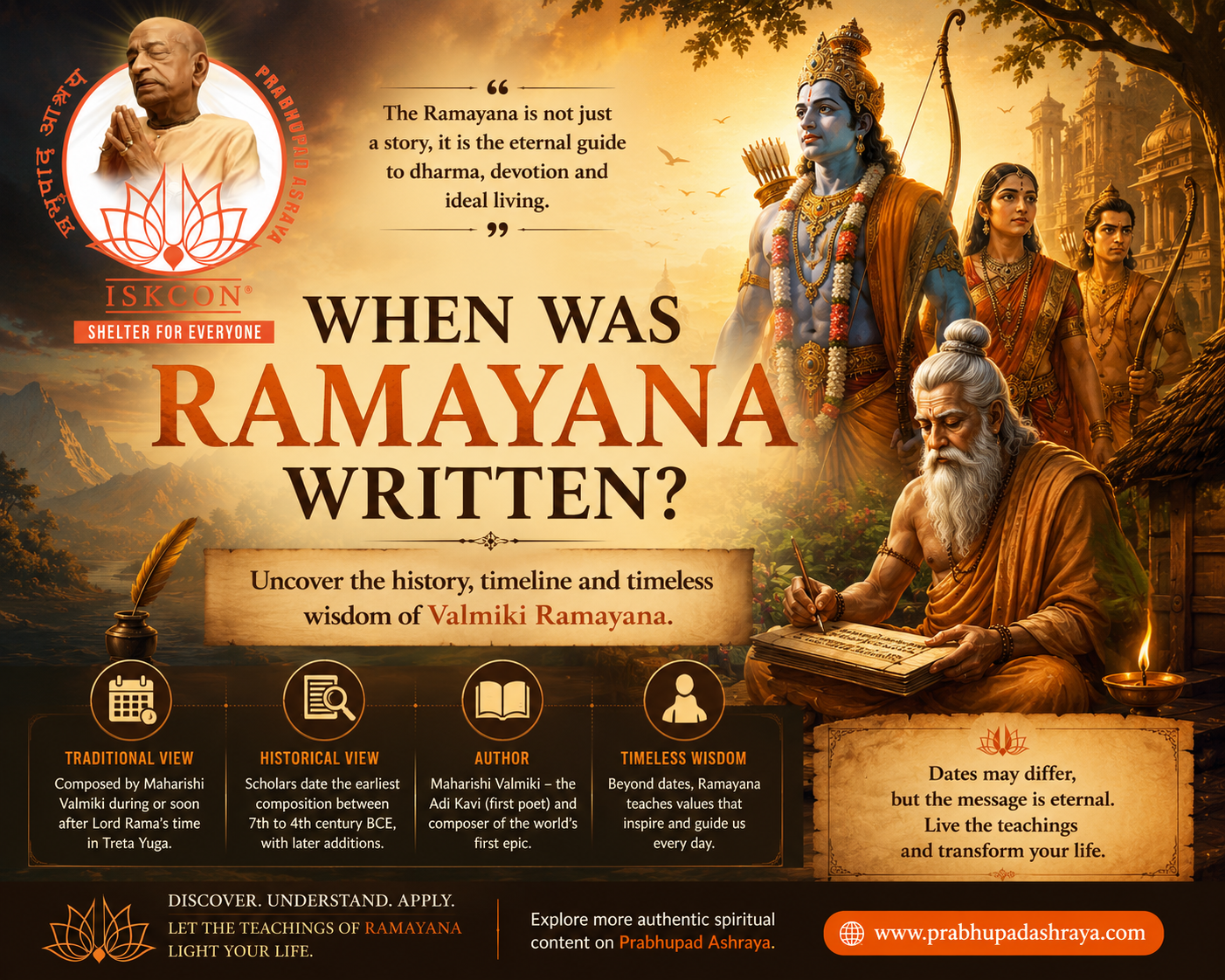
When Was Ramayana Written? Ramayana Kab Likhi Gayi Thi Aur Iska Asli Itihas Kya Hai?
Introduction: A Question Many Wonder About Often a question definitely comes to people’s minds — when was Ramayana written? Was it written thousands of years ago? Or was it compiled by someone later? And is the Ramayana we read today the original one? This confusion increases even more due to social media, YouTube debates, and various articles. The simple truth is — if we want to understand the Ramayana, we have to understand not just its story, but also its history. Let’s look at step-by-step what scriptures, traditional Vedic understanding, and modern historical research say about this topic. What Is Ramayana? First of all, it is essential to understand that the Ramayana is not just a story. The Ramayana is a great Sanskrit historical scripture (Itihasa) considered to be composed by Maharishi Valmiki. It contains a beautiful description of Lord Sri Rama’s life, His ideal character, dharma, family values, and leadership. For this reason, the Valmiki Ramayana is also called the world’s first epic (Mahakavya). Today, many regional versions of the Ramayana are found across the world, but the most ancient and authentic scripture is considered to be the Valmiki Ramayana. When Was Ramayana Written? This is where the most confusion occurs. There is no single universally accepted answer to this question. Two major viewpoints are found. Traditional Vedic View According to the Vedic tradition, Maharishi Valmiki wrote the Ramayana at the time when Lord Sri Rama was performing His divine pastimes (lilas) on this earth, or immediately after. According to this understanding, the Ramayana is based on the events of the Treta Yuga. Therefore, for devotees and traditional acharyas, the Ramayana is not just historical literature, but a divine history (divya itihaas). Historical and Academic View Modern historians and Sanskrit scholars generally believe that the earliest composition of the Valmiki Ramayana began roughly between the 7th and 4th century BCE, and editorial additions occurred in subsequent centuries. There is no complete agreement among scholars on the exact date. This is why you see different timelines in different books. Understanding this point is crucial. Academic dating is based on manuscript tradition, language analysis, and textual comparison, whereas traditional dating is based on the Vedic tradition and the guru-shishya (teacher-disciple) succession. The foundations of both approaches are different. Did Maharishi Valmiki Write Ramayana During Lord Rama’s Lifetime? According to traditional understanding, the answer to this is considered yes. In the Ramayana, Maharishi Valmiki’s direct connection with Lord Sri Rama’s life is depicted. When Mother Sita resided in the forest, she gave birth to Lava and Kusha in Valmiki’s ashram. Later, Maharishi Valmiki also taught both of them the singing of the Ramayana. This episode is a very important part of the traditional narration. Why Do Different Sources Mention Different Dates? If you search on Google, every website may tell a different date. The reason for this is simple. Different sources use different methods: And the Vedic tradition considers the guru-parampara and scriptural evidence (shastriya praman) as the primary authority. Therefore, seeing a difference in dates is a normal thing. Is the Ramayana We Read Today the Original Version? The interesting thing is that many versions of the Ramayana are available. Such as: All of these hold their own spiritual and literary importance. However, when it comes to the original Sanskrit composition, the Valmiki Ramayana is named first. The purpose of each version is also slightly different: some are written from a devotional perspective, and some are written to make devotion accessible in regional languages. Why Does the Date Matter? Now the question arises… Is merely knowing the date enough? Probably not. Think about it… If a student only knows when the Bhagavad Gita was spoken, but never applies its teachings, what will be the real benefit of that knowledge? Similarly, the greatness of the Ramayana lies not just in when it was written. Its real value lies in its timeless lessons. Sri Rama teaches us: In today’s time of stress, career pressure, relationships, and social media distractions, these principles are just as relevant. This is the reason why the Ramayana continues to inspire people even after thousands of years. Ramayana and Bhagavad Gita Connection You might be wondering what the connection between the Ramayana and the Bhagavad Gita is. The central message of both scriptures is to lead us toward God. The Ramayana beautifully demonstrates dharma and ideal conduct in practical life. The Bhagavad Gita explains that very same principle with philosophical depth. And when these teachings are practiced through Bhakti Yoga, spirituality doesn’t remain just a theory, but becomes a part of daily life. This is also the practical essence of Krishna Consciousness. Common Misconceptions About When Ramayana Was Written FAQs 1. When was Ramayana written exactly? The exact date is not universally accepted. Traditional and historical viewpoints present different timelines. 2. Who wrote the original Ramayana? The original Sanskrit Ramayana is considered to be composed by Maharishi Valmiki. 3. Is Ramayana older than Mahabharata? In traditional understanding, the events of the Ramayana belong to the Treta Yuga, whereas those of the Mahabharata belong to the Dvapara Yuga. 4. How old is Valmiki Ramayana? Historical scholars generally date it to the early centuries BCE, whereas traditional understanding associates it with the Treta Yuga. 5. Why are there many versions of Ramayana? Different languages, cultures, and devotional traditions presented the Ramayana for their respective readers. 6. Which Ramayana should beginners read? If you want to understand the original source, the Valmiki Ramayana can be a good start. Reading it with simple explanations will be even more helpful. Final Thoughts When people ask “when was Ramayana written”, naturally their focus is on the date. However, the biggest strength of the Ramayana is not merely its age, but its timeless wisdom. Whether you explore historical research or follow traditional Vedic understanding, one thing is clearly visible — the Ramayana has given inspiration for dharma, compassion, courage, and devotion to countless generations. If we start applying its teachings in our daily lives, that