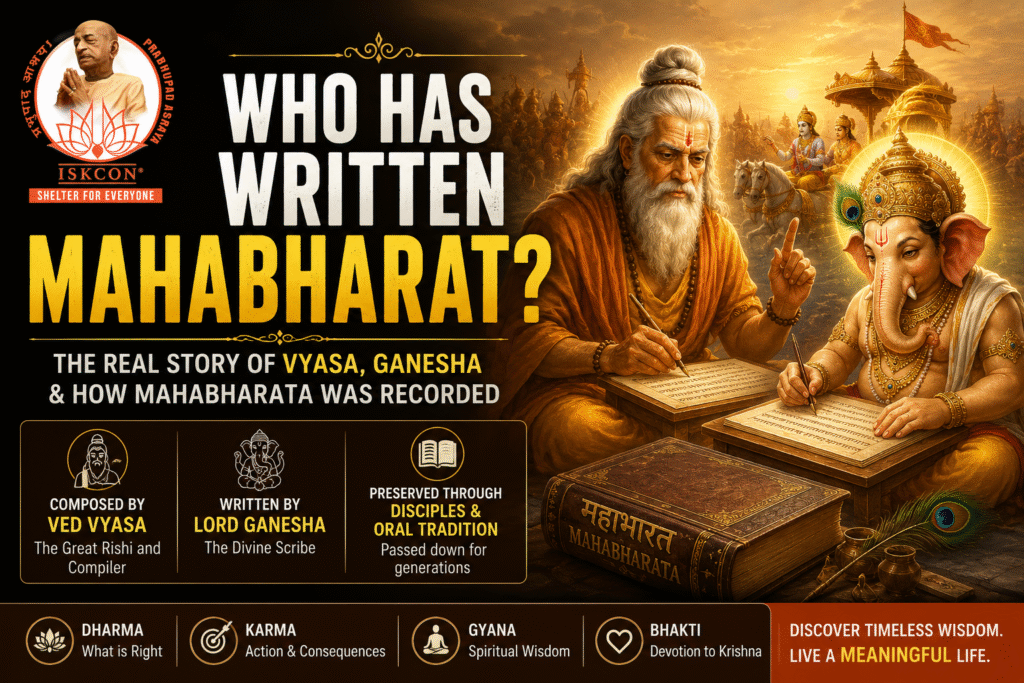
Agar aap Google par search karein “who has written Mahabharat?”, toh sabse simple answer milta hai — Maharishi Ved Vyasa.
Lekin yahan ek interesting question aata hai: agar Mahabharata ko Vyasa ne likha tha, toh phir Lord Ganesha ka naam Mahabharata likhne wale ke roop mein kyun aata hai?
Aur kya Vyasa ne Mahabharata ko khud likha tha, ya kisi ko dictate kiya tha?
Yahi point thoda confusing hai. Chaliye isko simple Hinglish mein samajhte hain — bina unnecessary mythology aur complicated language ke.
Who Has Written Mahabharat?
Traditional Vedic understanding ke according, Mahabharata ke rachayita Maharishi Krishna-Dvaipayana Vyasa, yaani Ved Vyasa, maane jaate hain.
Mahabharata ke Adi Parva mein bhi Vyasa ko is great history ka composer bataya gaya hai. Text mein Mahabharata ko Vyasa ki composition ke roop mein describe kiya gaya hai, aur unke disciple Vaishampayana ke dwara isse recite kiya jaana bhi explain hota hai.
Isliye agar koi pooche, “Who wrote Mahabharata?”, toh traditional answer hai:
Maharishi Ved Vyasa wrote and composed the Mahabharata.
Lekin “written” word ko thoda carefully samajhna zaroori hai.
Aaj hum writing ka matlab laptop, notebook ya keyboard par words type karna samajhte hain. Ancient India mein sacred knowledge ka transmission largely oral tradition ke through hota tha.
Isliye Mahabharata ki story sirf “kisne pen se likhi?” wale question se completely explain nahi hoti.
Who Was Ved Vyasa?
Ab naturally question aata hai — Ved Vyasa kaun the?
Mahabharata mein unka naam Krishna-Dvaipayana bhi milta hai. “Dvaipayana” unke island-born hone se associated hai, jabki “Vyasa” ka sambandh arrangement ya compilation se samjha jaata hai. Mahabharata ke Adi Parva mein unke Vedas ko arrange karne aur Bharata ki compilation se jude hone ka description milta hai.
Vedic tradition mein Vyasa ko ek extraordinarily learned Rishi ke roop mein dekha jaata hai.
Unka connection sirf Mahabharata tak limited nahi hai. Traditional accounts mein unhe Vedic knowledge ke arrangement aur Puranic literature ke compilation se bhi associate kiya jaata hai.
Yaani simple language mein bolein toh, Vyasa ko ancient India ki spiritual aur literary tradition mein ek major compiler and transmitter of sacred knowledge maana jaata hai.
Aur Mahabharata unki sabse famous compositions mein se ek hai.
Did Ved Vyasa Actually Write Mahabharata Himself?
Yahin par story aur interesting ho jaati hai.
Mahabharata ki traditional story ke according, Vyasa ne Mahabharata ko compose kiya, lekin uski writing ke liye Lord Ganesha ko scribe banaya gaya.
Adi Parva mein description milta hai ki Vyasa ne Brahma ki guidance ke baad Ganesha ko Mahabharata likhne ke liye request kiya. Ganesha ne ek condition rakhi — unki writing continuously chalti rehni chahiye.
Vyasa ne bhi ek intelligent condition rakhi.
Unhone kaha ki Ganesha tab tak aage na likhein jab tak woh verse ka meaning completely understand na kar lein.
Socho, ek ancient version of “writer vs speaker” collaboration chal raha hai.
Vyasa compose aur dictate kar rahe hain, aur Ganesha usse write kar rahe hain.
So, Did Ganesha Write Mahabharata?
Traditional story ke according, Ganesha acted as the scribe, while Vyasa was the composer.
Ye distinction bahut important hai.
Aaj agar koi author apni book kisi assistant ko dictate karta hai aur assistant usse type karta hai, toh book ka author assistant nahi ho jaata.
Exactly isi tarah traditional Mahabharata narrative mein:
Vyasa = Composer / Rachayita
Ganesha = Scribe / Lekhak ke roop mein recorder
Mahabharata ke Adi Parva mein Vyasa aur Ganesha ke beech ye episode explicitly described hai.
Isliye “Ganesha wrote Mahabharata” kehna incomplete hai. Better explanation ye hai ki Vyasa composed the Mahabharata and Ganesha is traditionally described as its divine scribe.
How Was Mahabharata Passed Down?
Ab ek aur important question.
Agar Vyasa ne composition ki aur Ganesha ne usse write kiya, toh phir Mahabharata logon tak kaise pahunchi?
Mahabharata khud multiple stages of recitation ko describe karta hai.
Vyasa ne apne disciples ko Mahabharata teach kiya. Vaishampayana ne ise King Janamejaya ke snake sacrifice ke context mein recite kiya. Baad mein Sauti ne sages ke assembly mein is history ko narrate kiya.
Isliye Mahabharata ko sirf ek “book” ki tarah samajhna thoda incomplete hai.
Ye ek living tradition of narration, memorization and transmission bhi thi.
Imagine karo — ek generation se doosri generation tak stories, teachings, genealogies aur philosophical discussions carefully preserve kiye ja rahe hain.
Aaj hum Google Drive par files share karte hain.
Ancient India mein knowledge ko memory, recitation and discipleship ke through preserve kiya jaata tha.
Why Is Mahabharata Also Called Bharata?
Aksar log “Mahabharata” aur “Bharata” ko interchangeable terms ki tarah use karte hain.
Mahabharata ke Adi Parva mein Bharata naam bhi repeatedly milta hai.
Traditional account ke according, Vyasa ne pehle Bharata ki relatively concise form compose ki, aur later tradition mein iska much larger form developed and transmitted hua. Adi Parva itself different forms and sizes of the composition ka description deta hai.
Isliye jab aap ancient texts mein Bharata ya Mahabharata dono terms dekhte hain, toh context samajhna important hai.
“Mahabharata” ka basic sense hi broadly “the great Bharata” se connected hai.
Is Mahabharata Just a Story About the Kurukshetra War?
Ye bhi ek common misunderstanding hai.
Agar aap Mahabharata ko sirf Pandavas vs Kauravas ki war story samajhte ho, toh aap uske bahut bade portion ko miss kar rahe ho.
Isme politics hai.
Family relationships hain.
Dharma ke difficult decisions hain.
Friendship hai.
Leadership hai.
Human psychology hai.
Aur sabse important — Bhagavad Gita bhi isi Mahabharata ka part hai.
Kurukshetra ke battlefield par Arjuna ka confusion sirf ek warrior ka personal problem nahi tha.
Uske questions bahut relatable hain:
“Mujhe kya karna chahiye?”
“Sahi decision kya hai?”
“Duty aur emotions ke beech conflict ho toh kya karein?”
Aaj college student career ko lekar confused ho sakta hai.
Ek professional job aur personal values ke beech struggle kar sakta hai.
Kisi relationship mein person emotionally attached hoke wrong decision le sakta hai.
Arjuna ka crisis ancient hai, lekin uski psychology surprisingly modern feel hoti hai.
Isi liye Bhagavad Gita aaj bhi relevant lagti hai.
What Does Mahabharata Teach Us Today?
Mahabharata ki real value sirf ye jaan lena nahi hai ki “who has written Mahabharat?”
Bigger question hai — “Why was this knowledge preserved for us?”
Story ke characters perfect superheroes nahi hain.
Unke decisions, mistakes, attachments, ambitions aur consequences hume human nature samajhne ka opportunity dete hain.
Duryodhana ki jealousy ho, Yudhishthira ka dharma-conflict ho, Arjuna ka confusion ho, ya Krishna ka guidance — har layer mein human behaviour ka ek lesson milta hai.
Agar aap dhyan se dekho, toh modern life bhi kuch alag nahi hai.
Social media comparison se jealousy aa sakti hai.
Career race se ego develop ho sakta hai.
Relationships mein attachment decision-making ko affect kar sakti hai.
Aur pressure mein hum bhi Arjuna ki tarah confused ho sakte hain.
Yahi reason hai ki Mahabharata ko sirf ancient history ke lens se padhna zaroori nahi.
Isse self-understanding aur dharma ke lens se bhi padha ja sakta hai.
Mahabharata and Bhagavad Gita Connection
Mahabharata ko samajhne ka ek beautiful entry point Bhagavad Gita hai.
Kurukshetra battlefield mein Arjuna apne relatives, teachers aur friends ko saamne dekhkar deeply disturbed ho jaate hain.
Unka mind kehta hai — “Main ye war kaise kar sakta hoon?”
Krishna unhe sirf battlefield strategy nahi batate.
Woh unhe karma, dharma, consciousness, self, devotion aur spiritual knowledge ke deeper principles samjhate hain.
Yahin se Bhakti Yoga aur Krishna Consciousness ke important principles ko samajhne ka path bhi open hota hai.
Srila Prabhupada ne Bhagavad Gita ko practical spiritual wisdom ke roop mein present kiya, jahan Krishna ko samajhna aur unki service ki direction mein life ko develop karna central hai.
Toh agar aap Mahabharata ko sirf story ke roop mein dekhte aaye hain, ek baar Bhagavad Gita ke perspective se bhi dekhiye.
Ho sakta hai aapko wahi story ek completely different depth ke saath samajh aaye.
Frequently Asked Questions
Who has written Mahabharat?
Traditional Vedic understanding ke according, Maharishi Ved Vyasa, also known as Krishna-Dvaipayana Vyasa, is the composer of the Mahabharata. Mahabharata itself repeatedly attributes the composition to Vyasa.
Did Lord Ganesha write the Mahabharata?
Traditional Mahabharata narrative mein Lord Ganesha ko scribe ke roop mein describe kiya gaya hai. Vyasa composed and dictated the work, while Ganesha wrote it down.
Who is Ved Vyasa?
Ved Vyasa, traditionally known as Krishna-Dvaipayana, is a revered Rishi associated with the composition of Mahabharata and the organization of Vedic knowledge.
Is Bhagavad Gita part of Mahabharata?
Haan. Bhagavad Gita Mahabharata ka part hai, specifically the Bhishma Parva, where Krishna gives spiritual instructions to Arjuna on the battlefield of Kurukshetra.
Why is Mahabharata called a great history?
Mahabharata contains the history and stories of the Bharata dynasty along with teachings on Dharma, Artha, Kama and Moksha. It combines narrative, philosophy, ethics, spirituality and discussions of human life.
Was Mahabharata originally written in Sanskrit?
Traditional Mahabharata is a Sanskrit epic. The text has been transmitted through manuscripts and recitation traditions, while many translations are available today in different languages.
What can young people learn from Mahabharata?
Young people can explore questions around decision-making, relationships, ambition, duty, leadership, attachment and spirituality through Mahabharata. Its characters often face situations that are surprisingly relatable even today.
Final Thought
Toh next time koi aapse pooche, “Who has written Mahabharat?”, aap simply keh sakte ho:
“Mahabharata was composed by Maharishi Ved Vyasa. Traditional accounts describe Lord Ganesha as the scribe who wrote down Vyasa’s composition.”
Lekin personally, mujhe lagta hai is question ka deeper answer aur interesting hai.
Mahabharata hume sirf ye nahi batata ki kya hua tha.
Ye hume baar-baar ye sochne par majboor karta hai:
“Agar main us situation mein hota, toh main kya karta?”
Aur shayad isi self-reflection ki wajah se Mahabharata thousands of years later bhi relevant hai.
Agar aap Bhagavad Gita, Bhakti Yoga aur Krishna Consciousness ko simple aur practical way mein samajhna chahte hain, toh Prabhupad Ashraya par aur spiritual insights explore kar sakte hain.
Hare Krishna.