Introduction: A Question Many Wonder About
Often a question definitely comes to people’s minds — when was Ramayana written? Was it written thousands of years ago? Or was it compiled by someone later? And is the Ramayana we read today the original one?
This confusion increases even more due to social media, YouTube debates, and various articles.
The simple truth is — if we want to understand the Ramayana, we have to understand not just its story, but also its history. Let’s look at step-by-step what scriptures, traditional Vedic understanding, and modern historical research say about this topic.
What Is Ramayana?
First of all, it is essential to understand that the Ramayana is not just a story.
The Ramayana is a great Sanskrit historical scripture (Itihasa) considered to be composed by Maharishi Valmiki. It contains a beautiful description of Lord Sri Rama’s life, His ideal character, dharma, family values, and leadership.
For this reason, the Valmiki Ramayana is also called the world’s first epic (Mahakavya).
Today, many regional versions of the Ramayana are found across the world, but the most ancient and authentic scripture is considered to be the Valmiki Ramayana.
When Was Ramayana Written?
This is where the most confusion occurs.
There is no single universally accepted answer to this question.
Two major viewpoints are found.
Traditional Vedic View
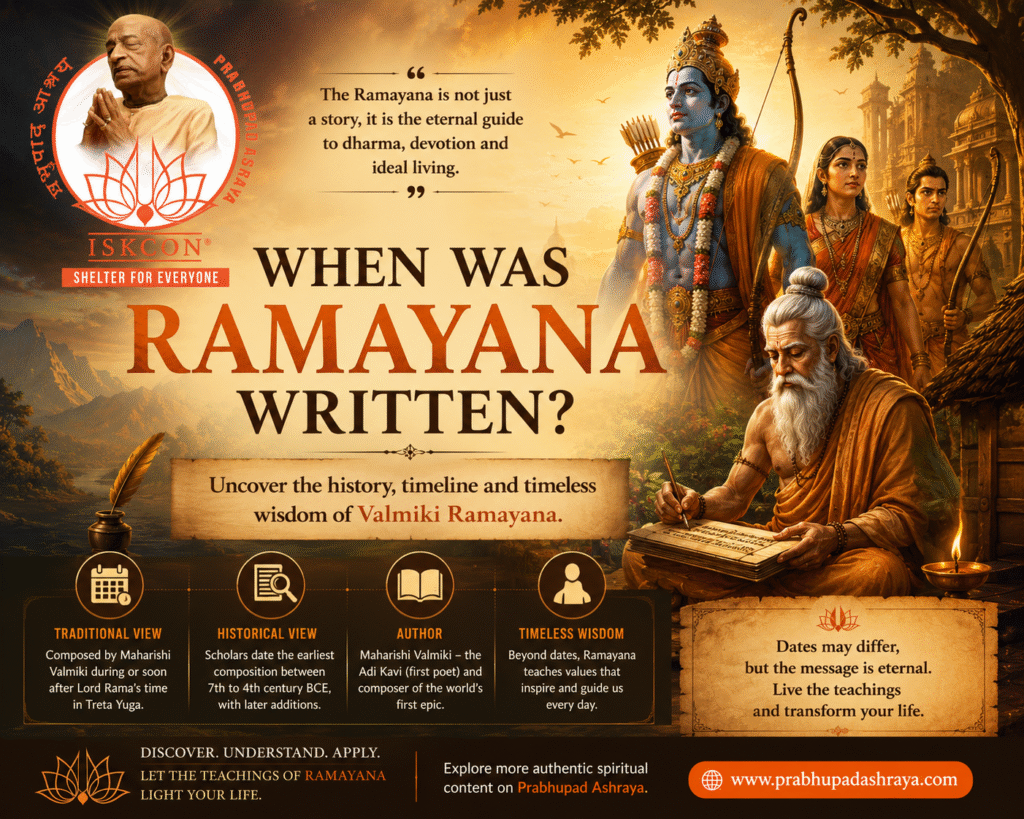
According to the Vedic tradition, Maharishi Valmiki wrote the Ramayana at the time when Lord Sri Rama was performing His divine pastimes (lilas) on this earth, or immediately after.
According to this understanding, the Ramayana is based on the events of the Treta Yuga.
Therefore, for devotees and traditional acharyas, the Ramayana is not just historical literature, but a divine history (divya itihaas).
Historical and Academic View
Modern historians and Sanskrit scholars generally believe that the earliest composition of the Valmiki Ramayana began roughly between the 7th and 4th century BCE, and editorial additions occurred in subsequent centuries.
There is no complete agreement among scholars on the exact date.
This is why you see different timelines in different books.
Understanding this point is crucial.
Academic dating is based on manuscript tradition, language analysis, and textual comparison, whereas traditional dating is based on the Vedic tradition and the guru-shishya (teacher-disciple) succession.
The foundations of both approaches are different.
Did Maharishi Valmiki Write Ramayana During Lord Rama’s Lifetime?
According to traditional understanding, the answer to this is considered yes.
In the Ramayana, Maharishi Valmiki’s direct connection with Lord Sri Rama’s life is depicted.
When Mother Sita resided in the forest, she gave birth to Lava and Kusha in Valmiki’s ashram.
Later, Maharishi Valmiki also taught both of them the singing of the Ramayana.
This episode is a very important part of the traditional narration.
Why Do Different Sources Mention Different Dates?
If you search on Google, every website may tell a different date.
The reason for this is simple.
Different sources use different methods:
- Some look at archaeological evidence.
- Some focus on linguistic studies.
- Some analyze astronomical references.
And the Vedic tradition considers the guru-parampara and scriptural evidence (shastriya praman) as the primary authority.
Therefore, seeing a difference in dates is a normal thing.
Is the Ramayana We Read Today the Original Version?
The interesting thing is that many versions of the Ramayana are available.
Such as:
- Valmiki Ramayana
- Ramcharitmanas by Goswami Tulsidas
- Kamba Ramayanam
- Adhyatma Ramayana
- Anand Ramayana
All of these hold their own spiritual and literary importance.
However, when it comes to the original Sanskrit composition, the Valmiki Ramayana is named first.
The purpose of each version is also slightly different: some are written from a devotional perspective, and some are written to make devotion accessible in regional languages.
Why Does the Date Matter?
Now the question arises…
Is merely knowing the date enough?
Probably not.
Think about it…
If a student only knows when the Bhagavad Gita was spoken, but never applies its teachings, what will be the real benefit of that knowledge?
Similarly, the greatness of the Ramayana lies not just in when it was written.
Its real value lies in its timeless lessons.
Sri Rama teaches us:
- How to follow dharma even in difficult situations.
- How to respect family responsibilities.
- How important humility is in leadership.
- How not to compromise on character amidst challenges.
In today’s time of stress, career pressure, relationships, and social media distractions, these principles are just as relevant.
This is the reason why the Ramayana continues to inspire people even after thousands of years.
Ramayana and Bhagavad Gita Connection
You might be wondering what the connection between the Ramayana and the Bhagavad Gita is.
The central message of both scriptures is to lead us toward God.
The Ramayana beautifully demonstrates dharma and ideal conduct in practical life.
The Bhagavad Gita explains that very same principle with philosophical depth.
And when these teachings are practiced through Bhakti Yoga, spirituality doesn’t remain just a theory, but becomes a part of daily life.
This is also the practical essence of Krishna Consciousness.
Common Misconceptions About When Ramayana Was Written
- “Ramayana is just a mythology.”In traditional Vedic understanding, the Ramayana is considered Itihasa, meaning sacred history.
- “Ramayana was written all at once.”According to historical research, the process of text transmission and preservation continued across many generations.
- “Every Ramayana is exactly the same.”No. Regional versions and devotional adaptations show some differences, but the core story remains largely the same.
FAQs
1. When was Ramayana written exactly?
The exact date is not universally accepted. Traditional and historical viewpoints present different timelines.
2. Who wrote the original Ramayana?
The original Sanskrit Ramayana is considered to be composed by Maharishi Valmiki.
3. Is Ramayana older than Mahabharata?
In traditional understanding, the events of the Ramayana belong to the Treta Yuga, whereas those of the Mahabharata belong to the Dvapara Yuga.
4. How old is Valmiki Ramayana?
Historical scholars generally date it to the early centuries BCE, whereas traditional understanding associates it with the Treta Yuga.
5. Why are there many versions of Ramayana?
Different languages, cultures, and devotional traditions presented the Ramayana for their respective readers.
6. Which Ramayana should beginners read?
If you want to understand the original source, the Valmiki Ramayana can be a good start. Reading it with simple explanations will be even more helpful.
Final Thoughts
When people ask “when was Ramayana written”, naturally their focus is on the date.
However, the biggest strength of the Ramayana is not merely its age, but its timeless wisdom.
Whether you explore historical research or follow traditional Vedic understanding, one thing is clearly visible — the Ramayana has given inspiration for dharma, compassion, courage, and devotion to countless generations.
If we start applying its teachings in our daily lives, that would truly be the beginning of understanding the Ramayana.
Explore More
If you want to understand the Bhagavad Gita, Bhakti Yoga, and Krishna Consciousness in a practical and logical way, you can explore more authentic spiritual blogs and learning resources on Prabhupad Ashraya.
Kya aapko iss translated article ke liye SEO keywords, meta description, ya Call-to-Action adjust karwana hai?