Have you ever wondered how many Kandas are there in the Ramayana? Or perhaps someone has asked you this question, and you became confused about whether there are 6, 7, or some other number?
These days, we see many short videos about the Ramayana on social media, but while they tell us the story, they often do not explain its structure. This is why many people are unclear about this basic question.
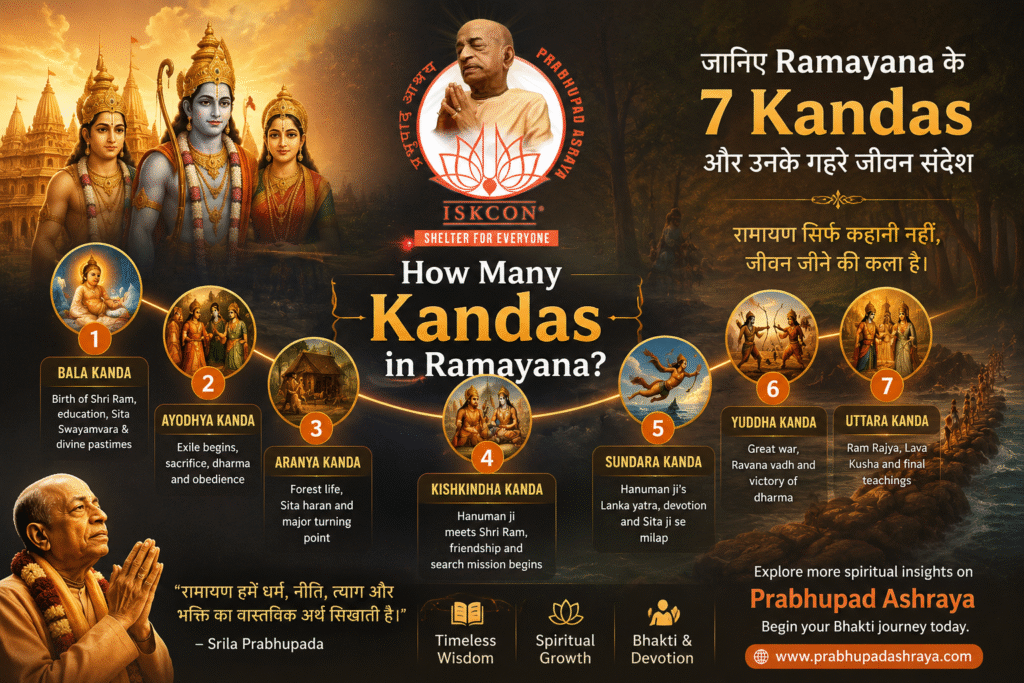
The answer is simple. The Valmiki Ramayana is traditionally divided into 7 Kandas (Books or Sections). Each Kanda explains a different phase of Lord Shri Ram’s life, and each section offers new spiritual and practical lessons.
Let us understand them step by step.
How Many Kandas Are There in the Ramayana?
If you want a direct answer, it is very simple.
There are traditionally 7 Kandas in the Ramayana.
They are:
Bala Kanda
Ayodhya Kanda
Aranya Kanda
Kishkindha Kanda
Sundara Kanda
Yuddha Kanda (Lanka Kanda)
Uttara Kanda
Each Kanda is like a complete chapter that describes a different part of Lord Shri Ram’s journey.
The interesting thing is that the Ramayana is not just a historical narrative. It also contains timeless principles such as Dharma, leadership, relationships, sacrifice, and devotion.
What Does “Kanda” Mean?
You may also have a question in your mind: What does Kanda mean?
The word “Kanda” means a major section or book.
Just as a modern book contains multiple chapters, the Ramayana is divided into larger sections called Kandas.
This makes the story much easier to understand and follow.
1. Bala Kanda – The Divine Appearance of Lord Shri Ram
Bala Kanda is the first section of the Ramayana.
This is where the divine pastimes of Lord Shri Ram begin.
In this Kanda, we learn about:
King Dasharatha’s desire to have children
The appearance of Shri Ram, Lakshman, Bharat, and Shatrughna
The journey to the forest with Vishwamitra Muni
The killing of Tadaka
The deliverance of Ahalya
Sita’s Swayamvara
Breaking Lord Shiva’s bow
The marriage of Shri Ram and Mother Sita
This Kanda represents innocence, education, and ideal upbringing.
When students today read it, they can understand the importance of discipline and the spiritual teacher.
2. Ayodhya Kanda – The Greatest Test of Sacrifice and Dharma
This is where the story takes an emotional turn.
When Lord Shri Ram is about to be crowned king, Queen Kaikeyi asks for two boons.
The result?
Shri Ram is sent into exile for 14 years
Bharat is offered the kingdom
Maharaja Dasharatha suffers separation from his beloved son
Think about it.
If everything were taken away from us one day before receiving a promotion, how would we react?
However, Shri Ram chose Dharma without complaining.
This is one of the reasons He is known as Maryada Purushottam, the supreme example of ideal conduct.
3. Aranya Kanda – Forest Life and a Major Turning Point
In Aranya Kanda, Shri Ram, Mother Sita, and Lakshman live in the forest.
Several important incidents take place here:
Serving the sages and saints
The arrival of Surpanakha
The killing of Khara and Dushana
Maricha appearing as a golden deer
The abduction of Mother Sita by Ravana
Jatayu’s sacrifice
This is where the major conflict of the Ramayana begins.
This Kanda helps us understand how a small distraction can sometimes change the direction of our lives.
It is similar to how mobile addiction or bad company can gradually affect our lives.
4. Kishkindha Kanda – Friendship and Teamwork
This Kanda is famous for the first meeting between Lord Shri Ram and Hanuman Ji.
This section includes:
The introduction of Hanuman Ji
Friendship with Sugriva
The killing of Bali
The organization of the Vanara army
The beginning of the search for Mother Sita
This teaches us how important the right association is in life.
Good friends can bring us closer to God, while the wrong association can take us in the opposite direction.
5. Sundara Kanda – The Great Service of Hanuman Ji
Many people consider Sundara Kanda the heart of the Ramayana.
And there is a beautiful reason for this.
In this Kanda, Hanuman Ji:
Crosses the ocean
Reaches Lanka
Meets Mother Sita
Delivers Lord Shri Ram’s message
Demonstrates extraordinary courage in Lanka
Sets Lanka on fire
This entire Kanda is a perfect example of devotion, faith, and selfless service.
This is why many devotees also regularly recite Sundara Kanda.
6. Yuddha Kanda (Lanka Kanda) – The Victory of Dharma
Now the time for the final battle arrives.
This Kanda includes:
The construction of Ram Setu
The battle of Lanka
The killing of Kumbhakarna
The killing of Meghnad
The killing of Ravana
The liberation of Mother Sita
The return to Ayodhya
The greatest lesson here is that Dharma ultimately triumphs, no matter how great the struggle may be.
7. Uttara Kanda – The Final Teachings
Uttara Kanda is the last section of the Ramayana.
It describes:
The reign of Lord Shri Ram
Lava and Kusha
Maharishi Valmiki’s ashram
The final pastimes of Mother Sita
The conclusion of Lord Shri Ram’s earthly pastimes
Some scholars have different discussions regarding the authorship of Uttara Kanda. However, traditionally, the Valmiki Ramayana is recognized as having a structure of seven Kandas.
Why Are There 7 Kandas?
The purpose is not simply to divide the story into sections.
Each Kanda represents a stage:
Childhood
Responsibility
Challenges
Friendship
Devotion
Victory
Legacy
If you look carefully, these stages also appear in our own lives in one form or another.
This is why the Ramayana continues to feel so relevant even today.
The Connection Between the Ramayana and the Bhagavad Gita
People often consider the Ramayana and the Bhagavad Gita to be separate books.
However, both guide us in the same direction: following Dharma and living according to the will of the Supreme Lord.
Lord Shri Ram demonstrates ideal conduct through His life, while Lord Krishna explains the same Dharma through His words in the Bhagavad Gita.
The essence of Krishna Consciousness and Bhakti Yoga is also to gradually direct our lives toward the service of the Supreme Lord and spiritual growth.
Quick Summary of the 7 Kandas
| Kanda | Main Theme |
|---|---|
| Bala Kanda | Birth and childhood of Shri Ram |
| Ayodhya Kanda | Exile and sacrifice |
| Aranya Kanda | Forest life and Sita’s abduction |
| Kishkindha Kanda | Meeting Hanuman and forming an alliance |
| Sundara Kanda | Hanuman’s journey to Lanka |
| Yuddha Kanda | The war with Ravana |
| Uttara Kanda | Final pastimes and Ram Rajya |
Frequently Asked Questions (FAQs)
1. How many Kandas are there in the Ramayana?
Traditionally, there are 7 Kandas in the Ramayana: Bala, Ayodhya, Aranya, Kishkindha, Sundara, Yuddha, and Uttara Kanda.
2. Which Kanda is the longest in the Ramayana?
Yuddha Kanda and Bala Kanda are both quite detailed, although the chapter count may vary slightly between editions.
3. Which Kanda is the most popular among devotees?
Sundara Kanda is very popular because it describes Hanuman Ji’s extraordinary devotion and service.
4. Why is Sundara Kanda considered special?
It beautifully describes Hanuman Ji’s courage, faith, and pure devotion to Lord Shri Ram.
5. Who wrote the Ramayana?
According to traditional understanding, Maharishi Valmiki composed the Valmiki Ramayana in Sanskrit.
6. Is the Ramayana only a story?
No. The Ramayana also teaches us timeless lessons about Dharma, relationships, leadership, compassion, and spiritual living.
7. Can beginners start reading the Ramayana?
Absolutely. Beginners can start with Bala Kanda and gradually read the entire Ramayana in sequence.
Final Thoughts
Now, whenever someone asks you, “How many Kandas are there in the Ramayana?”, you can confidently answer that the Valmiki Ramayana is traditionally divided into 7 Kandas, with each Kanda describing an important phase of Lord Shri Ram’s life.
However, simply remembering their names or order is not enough. When we apply the lessons of these Kandas to our daily lives—whether honesty, sacrifice, friendship, or devotion—the Ramayana truly becomes a part of our lives.
If you want to understand authentic Bhagavad Gita, Bhakti Yoga, and Krishna Consciousness in simple English and explore these teachings more deeply, explore more spiritual blogs on Prabhupad Ashraya and give a new direction to your Bhakti journey.
Hare Krishna!