
Have You Ever Been Confused About This?
Someone may have told you that the Ramayana was written by Valmiki Ji and the Mahabharata by Ved Vyas Ji. But then, someone on social media or YouTube may have claimed that “Lord Ganesha wrote the Mahabharata.” Similarly, many people search for who wrote Ramayana or who wrote Mahabharata, but they do not always find a clear answer.
The simple truth is that confusion arises when we do not understand the difference between “who composed a text” and “who wrote it down.”
Let us understand this from the perspective of Vedic scriptures and authentic tradition.
Who Wrote the Ramayana?
The most straightforward answer is:
The Ramayana was composed by Maharishi Valmiki.
This is why it is also known as the Valmiki Ramayana. It is not merely a story but a profound account of the divine life of Lord Shri Ram, His ideal character, and the practical demonstration of Dharma.
If you look carefully, Maharishi Valmiki was not just the author. He was also a contemporary of Lord Shri Ram and taught Lava and Kusha to recite the Ramayana.
For this reason, the Valmiki Ramayana is traditionally regarded as the earliest and most authoritative version of the Ramayana.
Who Was Maharishi Valmiki?
Many people know only that Valmiki Ji was the author of the Ramayana.
However, his own life is an inspiring spiritual journey.
According to a popular traditional account, his former name was Ratnakara, and he lived as a forest-dweller and robber. His association with Narada Muni transformed his life. Through the chanting of the holy name and austerities, he transformed his consciousness completely.
Think about it.
If a person can undergo such a profound transformation, why can we not bring positive transformation into our own lives?
This is one of the most beautiful messages of Vedic wisdom.
How Many Kandas Are There in the Valmiki Ramayana?
The Valmiki Ramayana is traditionally divided into seven Kandas:
-
Bala Kanda
-
Ayodhya Kanda
-
Aranya Kanda
-
Kishkindha Kanda
-
Sundara Kanda
-
Yuddha Kanda
-
Uttara Kanda
Each Kanda teaches a different lesson about life.
Just as every semester in college has a particular purpose, each Kanda represents a stage in spiritual growth.
Who Wrote the Mahabharata?
Now another question arises.
Who wrote the Mahabharata?
The answer is:
The Mahabharata was composed by Maharishi Ved Vyasa.
However, this is where the greatest confusion often arises.
According to the traditional account, Ved Vyasa recited the Mahabharata, and Lord Ganesha wrote it down.
In other words:
-
Author and composer: Maharishi Ved Vyasa
-
Divine scribe: Lord Ganesha
Both statements are correct within their respective contexts.
The Interesting Story of Ved Vyasa and Lord Ganesha
This is an inspiring traditional story.
Ved Vyasa wanted the Mahabharata to be written down without interruption.
Therefore, he requested Lord Ganesha to act as his scribe.
Lord Ganesha set one condition:
“I will write continuously without stopping.”
Ved Vyasa also set a condition:
“You must understand the meaning of every verse before writing it down.”
As a result, whenever Ved Vyasa needed time to compose the next verse, he would recite a verse with a particularly profound meaning.
Meanwhile, Lord Ganesha would contemplate its meaning, giving Ved Vyasa time to prepare the next verse.
This story offers a beautiful example of teamwork, intelligence, and patience.
What Is the Difference Between the Ramayana and the Mahabharata?
People often consider both epics to be similar in every respect.
However, they explore different aspects of life and Dharma.
| Ramayana | Mahabharata |
|---|---|
| Focuses on the ideal character and life of Lord Shri Ram | Focuses on the Kuru dynasty and complex decisions involving Dharma |
| Teaches simplicity and ideal conduct | Explores difficult moral situations in practical life |
| Provides an ideal example of Maryada, or righteous conduct | Teaches how to apply Dharma amid real-life challenges |
The two epics do not contradict each other.
Rather, they complement each other.
What Is the Connection with the Bhagavad Gita?
Here is an interesting fact.
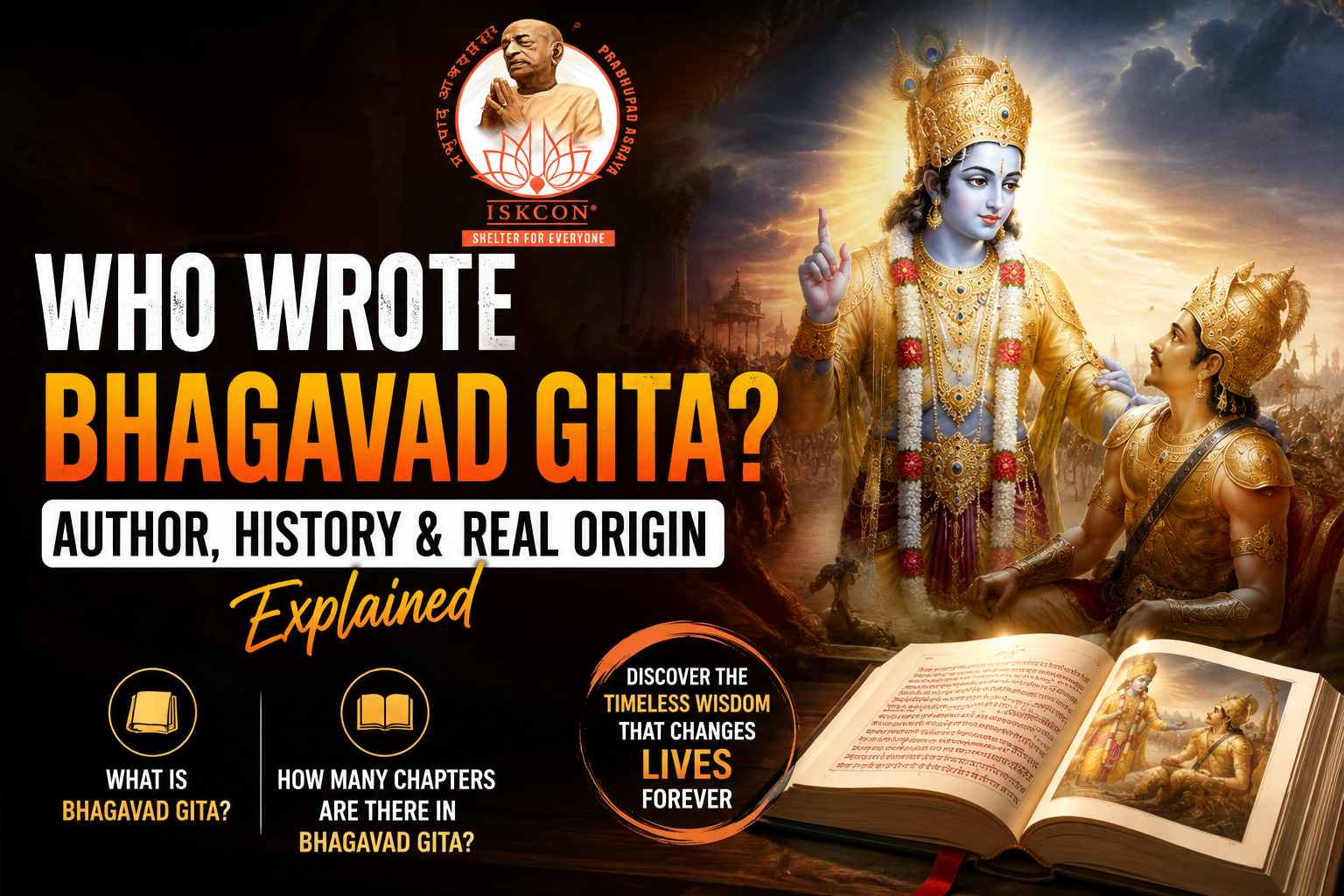
The Bhagavad Gita is an important part of the Mahabharata.
The spiritual guidance that Lord Krishna gave to Arjuna on the battlefield of Kurukshetra is known as the Bhagavad Gita.
If the Ramayana provides an example of an ideal life, the Bhagavad Gita explains how to make decisions when facing confusion in real life.
This is why students, professionals, and young spiritual seekers continue to turn to the Bhagavad Gita for practical guidance.
What Can Today’s Generation Learn from These Epics?
Think about it.
Every day, we face social media distractions, career pressure, relationship issues, and anxiety about the future.
The Ramayana and the Mahabharata do not teach us to escape from life’s challenges.
Instead, they teach us that no matter how difficult our circumstances may be, making decisions guided by Dharma and the right consciousness can make our lives meaningful.
Just as muscles develop through regular practice at the gym, spiritual strength also develops through daily reflection and Bhakti Yoga.
This is why these epics remain relevant even thousands of years later.
Are They Just Stories?
This is another common question.
According to the Vedic tradition, the Ramayana and the Mahabharata are not merely historical narratives. They also serve as practical guides for understanding Dharma, Karma, and human nature.
Every character offers us one lesson or another.
This is why it is important not only to read these epics but also to understand their teachings.
Frequently Asked Questions (FAQs)
1. Who wrote the Ramayana?
The Ramayana was composed by Maharishi Valmiki. This is why it is known as the Valmiki Ramayana.
2. Who wrote the Mahabharata?
The Mahabharata was composed by Maharishi Ved Vyasa, while Lord Ganesha traditionally served as its divine scribe.
3. Is the Valmiki Ramayana the original Ramayana?
The Valmiki Ramayana is traditionally regarded as the earliest and most authoritative version of the Ramayana.
4. Is the Bhagavad Gita part of the Mahabharata?
Yes. The Bhagavad Gita is a sacred part of the Bhishma Parva of the Mahabharata.
5. Why is Valmiki called Adi Kavi?
Maharishi Valmiki is traditionally regarded as the first great poet of Sanskrit literature. Therefore, he is known as Adi Kavi, meaning the first poet.
6. What is the main message of the Ramayana?
The Ramayana provides practical examples of Dharma, sacrifice, compassion, devotion, and ideal character.
7. Why should young people read these epics?
These are not merely ancient stories. They also teach timeless principles for understanding modern challenges involving stress, relationships, leadership, and decision-making.
Final Thoughts
If someone asks you, “Who wrote the Ramayana?”, you can confidently answer that Maharishi Valmiki composed it, which is why it is known as the Valmiki Ramayana.
When it comes to the Mahabharata, Maharishi Ved Vyasa is its composer, while Lord Ganesha traditionally served as its divine scribe.
However, the greatest lesson is not simply remembering the names of the authors.
The real point is that these two great epics show us the path of Dharma, character, responsibility, and devotion to the Supreme Lord. When we apply their teachings to our daily lives, we begin to understand their deeper purpose.
Continue Your Spiritual Journey
If you want to understand the Bhagavad Gita, Bhakti Yoga, and Krishna Consciousness in a simple and practical way, explore more authentic spiritual blogs on Prabhupad Ashraya.
Every small spiritual step can bring about a major positive transformation in life.
Hare Krishna!