Who Wrote the Ramayana? Let’s Clear Up the Confusion First
If you have ever searched for who wrote Ramayana on Google, you may have wondered about this question yourself. Some people say Lord Ganesha wrote it, others mention Tulsidas Ji, while some name Sage Valmiki. So, what is the truth?
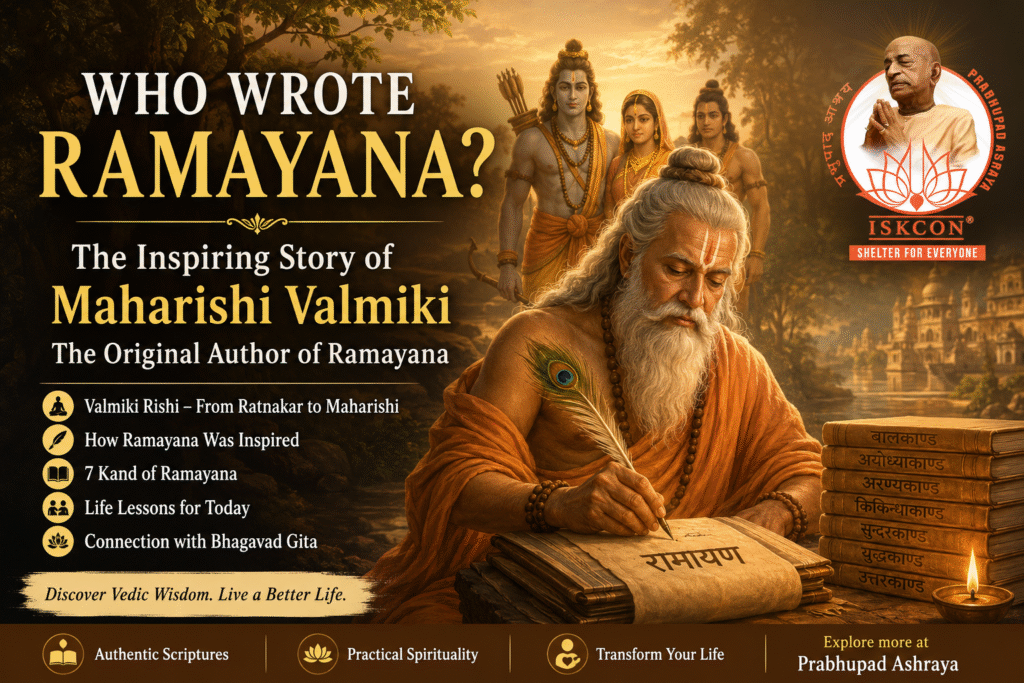
The answer is simple — the original Ramayana was written by Maharishi Valmiki. That is why it is also known as the Valmiki Ramayana.
But there is much more to the story. The most interesting part is that Valmiki Rishi was not always a great saint. His life transformation teaches us that the holy name of the Lord and the association of saintly people can change anyone’s life.
Let’s understand this in detail.
Who Was Maharishi Valmiki?
Today, we know him as Maharishi Valmiki, but his early life was completely different.
According to popular traditional accounts, his original name was Ratnakar. He lived in the forest and supported his family by robbing people.
One day, he met Devarshi Narada. Narada Muni asked him a simple question:
“Will those for whom you are committing sins also share the consequences of your sinful actions?”
When Ratnakar asked his family this question, everyone refused.
This was the turning point of his life.
Narada Muni advised him to chant the holy name of the Lord. Gradually, his heart became purified, and Ratnakar eventually became Maharishi Valmiki.
This transformation teaches us that Bhakti can transform anyone, regardless of their past.
How Did Valmiki Get the Inspiration to Write the Ramayana?
Now the question arises…
What inspired Valmiki Rishi to write the Ramayana?
One day, he saw a pair of krauncha birds in the forest. Suddenly, a hunter killed one of the birds.
The other bird began crying in grief.
Witnessing this scene awakened compassion in Valmiki Rishi’s heart, and a verse spontaneously emerged from his mouth.
This verse is traditionally regarded as the first shloka of Sanskrit poetry.
Later, Lord Brahma blessed Valmiki and inspired him to compose a poetic account of the divine life of Lord Shri Ram.
In this way, the Valmiki Ramayana came into being.
How Many Kandas and Shlokas Are There in the Valmiki Ramayana?
The Valmiki Ramayana is regarded as one of the world’s most ancient epic poems.
It contains:
-
7 Kandas (Books)
-
Approximately 24,000 Sanskrit shlokas
-
More than 500 Sargas (Chapters)
These are the seven Kandas:
-
Bala Kanda
-
Ayodhya Kanda
-
Aranya Kanda
-
Kishkindha Kanda
-
Sundara Kanda
-
Yuddha Kanda
-
Uttara Kanda
Each Kanda describes a different phase of Lord Shri Ram’s life.
Did Tulsidas Ji Also Write the Ramayana?
This is where most of the confusion arises.
Many people think that Tulsidas Ji was the original author of the Ramayana.
Actually, Goswami Tulsidas Ji composed the Ramcharitmanas, which is written in the Awadhi language.
On the other hand, the Valmiki Ramayana was composed in Sanskrit and is regarded as the original Ramayana.
Both scriptures describe the divine pastimes of Lord Shri Ram, but their styles, languages, and presentations are different.
Therefore, when someone asks who wrote Ramayana, the correct answer is — Maharishi Valmiki.
The Ramayana Is Not Just a Story; It Is a Guide to Life
If you look carefully, the Ramayana is not merely a story from an ancient age.
Its characters and teachings are still relatable to our daily lives.
When we face challenges in our careers, Shri Ram teaches us patience and duty.
When misunderstandings arise in relationships, the Ramayana shows us the importance of respect and sacrifice.
When it comes to leadership, Shri Ram’s ideal character serves as an inspiration for every generation.
Just as shortcuts cannot guarantee success in an examination, there is no substitute for righteousness and sincerity in life.
That is why the Ramayana remains relevant to people of every age group.
What Is the Connection Between the Bhagavad Gita and the Ramayana?
You may be wondering what connects the Ramayana and the Bhagavad Gita.
Both scriptures appeared in different ages, but their core messages guide us in the same spiritual direction.
Lord Shri Ram demonstrates the practical application of dharma through His life.
Lord Shri Krishna explains the same principles of dharma and karma in the Bhagavad Gita, providing philosophical clarity.
One teaches us how to live an ideal life.
The other explains how to understand and follow spiritual principles in practice.
Krishna Consciousness and Bhakti Yoga express a common spiritual essence found in the teachings of both scriptures—love and service to the Supreme Lord.
That is why Srila Prabhupada also consistently emphasized applying Vedic wisdom in our practical lives.
What Should We Learn from the Ramayana?
In today’s social media age, information is abundant, but direction is often lacking.
The Ramayana reminds us that true success comes not merely from achievements but from character.
This scripture teaches us that:
-
We should not change our principles of dharma according to our circumstances.
-
Sacrifice is never a sign of weakness.
-
Good relationships are built on trust and service.
-
Pride and arrogance ultimately lead to destruction.
-
Faith in the Lord gives us strength even in the most difficult circumstances.
These teachings remain just as relevant today as they were in Treta Yuga.
Frequently Asked Questions (FAQs)
1. Who originally wrote the Ramayana?
The original Ramayana was composed by Maharishi Valmiki in the Sanskrit language.
2. Who wrote the Ramcharitmanas?
The Ramcharitmanas was composed by Goswami Tulsidas Ji in the Awadhi language.
3. Is the Valmiki Ramayana older than the Ramcharitmanas?
Yes. The Valmiki Ramayana is an ancient scripture, while the Ramcharitmanas was composed many centuries later.
4. How many Kandas are there in the Ramayana?
The Valmiki Ramayana contains seven Kandas.
5. Why is Valmiki called Adi Kavi?
Because the first Sanskrit shloka attributed to him is traditionally regarded as the beginning of the Sanskrit poetic tradition. For this reason, he is known as Adi Kavi, meaning the first poet.
6. Is the Ramayana relevant to modern life?
Absolutely. Principles such as leadership, family values, duty, integrity, and spiritual growth remain equally important in everyone’s life today.
7. What is the main message of the Ramayana?
The Ramayana teaches us that dharma, compassion, humility, and devotion to the Lord are essential for making life truly successful.
Final Thoughts
Now, whenever someone asks who wrote Ramayana, you can confidently answer that the author of the original Ramayana was Maharishi Valmiki.
But something even more important is that the Ramayana is not merely an ancient historical scripture. It is a spiritual guide that inspires every generation to become better human beings.
If we begin applying even a few of Shri Ram’s ideals and the teachings of the Bhagavad Gita to our daily lives, many of life’s confusions can gradually become clearer.
At Prabhupad Ashraya, you can explore more authentic spiritual blogs and learn about the Bhagavad Gita, Bhakti Yoga, and Krishna Consciousness in a practical and relatable way.
Hare Krishna!