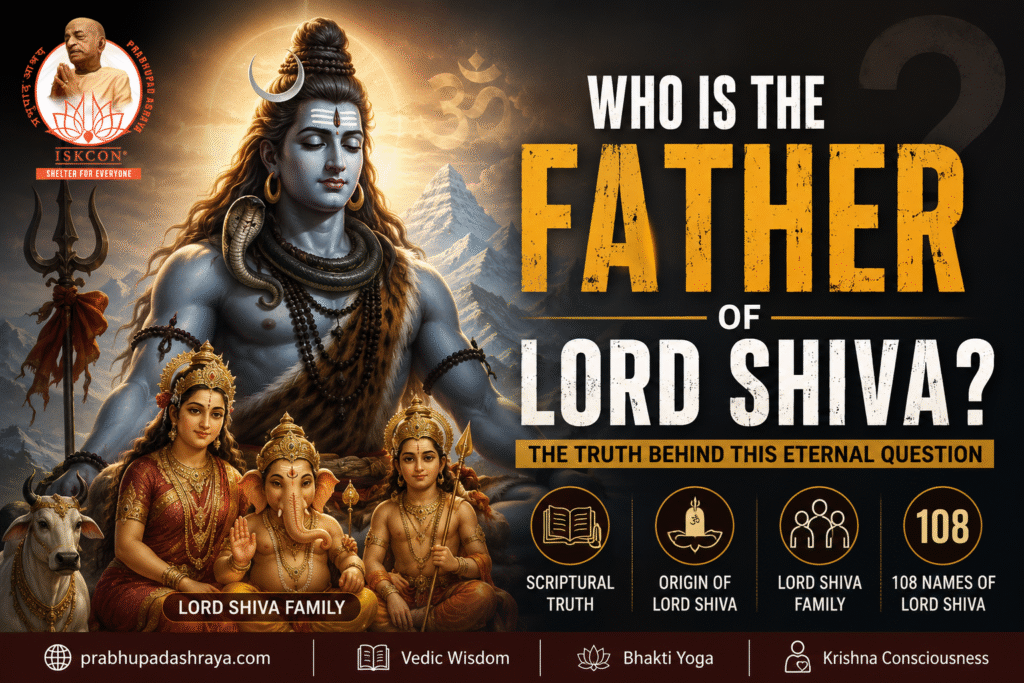
People often search the internet for “Who is the father of Lord Shiva?” Sometimes, they come across a social media reel claiming that a particular deity is Shiva Ji’s father, which only adds to their confusion.
The answer is not as straightforward as many people assume when we carefully study Vedic scriptures.
This is where much of the confusion begins.
Lord Shiva is not an ordinary living being, nor is His position comparable to that of a regular family member within material creation. In this article, we will explore what the scriptures say about whether Lord Shiva has a father, His origin, the Lord Shiva family, and how we can understand this topic in the light of the Bhagavad Gita and Vedic wisdom.
Is Lord Shiva’s Father Really Someone?
First, let us understand an important point.
When we talk about an ordinary human being, we naturally think of their parents.
However, this rule does not apply in the same way to every divine personality.
In Vedic scriptures, Lord Shiva is described as eternal (anadi). This means His existence did not begin through an ordinary human birth.
Therefore, if someone asks:
“Who is the father of Lord Shiva?”
According to the Vaishnava understanding presented here, the answer is:
Lord Shiva does not have a biological father in the ordinary human sense.
He is an eternal divine personality whose existence is not limited to the beginning of material creation.
Then Why Do Some Scriptures Describe Brahma as Shiva’s Father?
Now another question arises…
If Lord Shiva has no father, why does Brahma Ji appear in some accounts of His origin?
This confusion arises because different Puranic narratives describe divine manifestations in different ways.
Some scriptural accounts describe Lord Shiva as appearing from the forehead of Lord Brahma.
However, this does not necessarily mean biological birth in the ordinary sense.
It can be understood as a manifestation.
For example, light emanates from the sun, but that does not mean light becomes the sun’s daughter or son.
Similarly, Shiva’s appearance through Brahma Ji can be understood as a cosmic event rather than an ordinary biological relationship.
The precise interpretation depends on the particular scripture and the tradition through which the account is understood.
What Is the Origin of Lord Shiva?
This is a particularly important point to understand.
According to Vaishnava scriptures such as the Śrīmad-Bhāgavatam and the Brahma-saṁhitā, along with the explanations of Vaishnava acharyas, Lord Shiva’s manifestation is intimately connected with the Supreme Lord.
A famous analogy is often used to explain this relationship:
The analogy of milk and yogurt.
Think about it…
Milk and yogurt are different, yet they share the same source.
Yogurt is made from milk, but milk and yogurt are not exactly the same in their properties.
Similarly, the relationship between Lord Shiva and the Supreme Lord is explained through this analogy.
The Brahma-saṁhitā also describes this distinctive relationship.
This example helps us understand Lord Shiva’s unique position.
He is not an ordinary conditioned living being, nor is His role described as exactly identical to that of Lord Vishnu.
Lord Shiva’s Family: Who Are Its Members?
When people search for Lord Shiva’s family, they usually want to know about His divine household.
The principal personalities associated with His family include:
-
Mata Parvati
-
Lord Ganesha
-
Lord Kartikeya (Skanda)
-
Nandi Maharaj, His divine associate
Mount Kailash is traditionally regarded as His divine abode.
Interestingly, the Shiva family is often seen as a symbol of unity and simplicity.
Each member is associated with particular spiritual qualities.
For example, Lord Ganesha is associated with wisdom, Lord Kartikeya with courage, and Mata Parvati with divine compassion.
What Is the Significance of the 108 Names of Lord Shiva?
Many people also search for the 108 names of Lord Shiva.
Each name describes a particular divine quality, attribute, or aspect associated with Him.
Some well-known names include:
-
Mahadev
-
Shambhu
-
Rudra
-
Neelkanth
-
Pashupati
-
Gangadhar
-
Trilochan
-
Bholenath
-
Shankar
-
Maheshwara
These are not merely titles.
Each name carries spiritual significance and may be associated with a particular divine pastime or quality.
That is why devotees remember and chant these names as part of their devotional practices.
What Does Mahadev Mean?
People often hear the word Mahadev without knowing its meaning.
The simple meaning of Mahadev is:
“The great god” or “the greatest among the devas.”
This title expresses reverence for Lord Shiva’s extraordinary spiritual position.
However, Vedic philosophy also explains that different divine personalities have distinct roles.
For example, in a government, the prime minister, a judge, and an army chief all hold important positions, but their responsibilities differ.
Similarly, Vedic scriptures describe different roles and relationships among divine personalities.
How Does the Bhagavad Gita Help Us Understand This Topic?
When we study the Bhagavad Gita carefully, we encounter a beautiful principle.
The Bhagavad Gita does not focus primarily on family trees or historical details.
Its central emphasis is on understanding our relationship with the Supreme Lord and learning how to revive that relationship through devotion.
For this reason, the central focus of Krishna Consciousness is not genealogy but devotion.
As a person practises Bhakti Yoga, many spiritual doubts can gradually become clearer through proper study and guidance.
Just as we learn the fundamentals of a subject in school before moving on to advanced topics, a strong foundation is essential in spiritual life as well.
What Should We Learn from This Question?
Perhaps your original question was simply:
“Who is the father of Lord Shiva?”
But there is a deeper lesson behind it.
To understand divine personalities, we need the guidance of authentic scriptures and genuine acharyas.
Drawing conclusions only from short videos or random social media posts can sometimes create more confusion.
When we study Vedic wisdom properly, spiritual knowledge becomes more than information.
It can become a means of personal transformation.
Frequently Asked Questions (FAQs)
Who is the father of Lord Shiva?
According to the Vaishnava understanding presented in this article, Lord Shiva is eternal and does not have a biological father in the ordinary human sense.
Was Lord Shiva born from Brahma?
Some Puranic narratives describe Lord Shiva appearing from the forehead of Lord Brahma. This can be understood as a divine manifestation rather than an ordinary biological birth, although interpretations vary across scriptural traditions.
Who are the members of Lord Shiva’s family?
The principal members of Lord Shiva’s family include Mata Parvati, Lord Ganesha, and Lord Kartikeya. Nandi Maharaj is His devoted associate.
Why is Lord Shiva called Mahadev?
Mahadev means “the great god” or “the greatest among the devas.” The title expresses reverence for Lord Shiva’s extraordinary spiritual position.
What are the 108 names of Lord Shiva?
The 108 names describe different divine qualities, attributes, and aspects associated with Lord Shiva. Mahadev, Rudra, Shambhu, Neelkanth, and Gangadhar are among the well-known names.
Is Lord Shiva mentioned in the Bhagavad Gita?
Yes. The Bhagavad Gita mentions Lord Shiva in its broader discussion of divine personalities and Vedic traditions. His position can also be explored through the wider context of Vedic philosophy and Bhakti traditions.
Final Thoughts
The question “Who is the father of Lord Shiva?” is more than a factual question. It gives us an opportunity to explore Vedic philosophy more deeply.
When we study spiritual knowledge under the guidance of authentic scriptures and acharyas, many misconceptions can gradually be cleared.
If you enjoy learning about Lord Shiva, the Bhagavad Gita, Bhakti Yoga, and the authentic teachings of Krishna Consciousness in simple English, explore more spiritual articles on Prabhupad Ashraya and make your journey of Bhakti increasingly meaningful.
Hare Krishna!