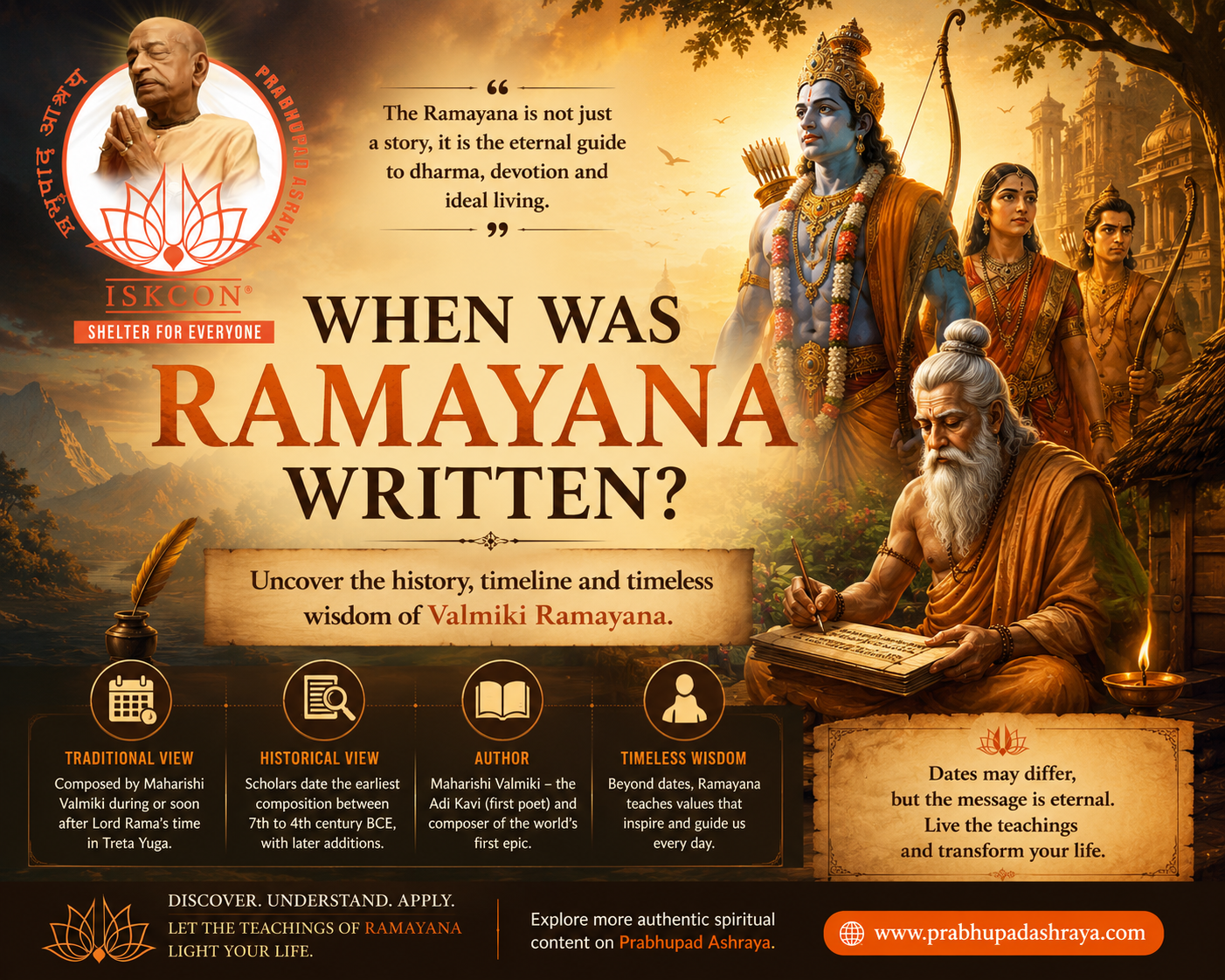
Introduction: A Question Many Wonder About Often a question definitely comes to people’s minds — when was Ramayana written? Was it written thousands of years ago? Or was it compiled by someone later? And is the Ramayana we read today the original one? This confusion increases even more due to social media, YouTube debates, and various articles. The simple truth is — if we want to understand the Ramayana, we have to understand not just its story, but also its history. Let’s look at step-by-step what scriptures, traditional Vedic understanding, and modern historical research say about this topic. What Is Ramayana? First of all, it is essential to understand that the Ramayana is not just a story. The Ramayana is a great Sanskrit historical scripture (Itihasa) considered to be composed by Maharishi Valmiki. It contains a beautiful description of Lord Sri Rama’s life, His ideal character, dharma, family values, and leadership. For this reason, the Valmiki Ramayana is also called the world’s first epic (Mahakavya). Today, many regional versions of the Ramayana are found across the world, but the most ancient and authentic scripture is considered to be the Valmiki Ramayana. When Was Ramayana Written? This is where the most confusion occurs. There is no single universally accepted answer to this question. Two major viewpoints are found. Traditional Vedic View According to the Vedic tradition, Maharishi Valmiki wrote the Ramayana at the time when Lord Sri Rama was performing His divine pastimes (lilas) on this earth, or immediately after. According to this understanding, the Ramayana is based on the events of the Treta Yuga. Therefore, for devotees and traditional acharyas, the Ramayana is not just historical literature, but a divine history (divya itihaas). Historical and Academic View Modern historians and Sanskrit scholars generally believe that the earliest composition of the Valmiki Ramayana began roughly between the 7th and 4th century BCE, and editorial additions occurred in subsequent centuries. There is no complete agreement among scholars on the exact date. This is why you see different timelines in different books. Understanding this point is crucial. Academic dating is based on manuscript tradition, language analysis, and textual comparison, whereas traditional dating is based on the Vedic tradition and the guru-shishya (teacher-disciple) succession. The foundations of both approaches are different. Did Maharishi Valmiki Write Ramayana During Lord Rama’s Lifetime? According to traditional understanding, the answer to this is considered yes. In the Ramayana, Maharishi Valmiki’s direct connection with Lord Sri Rama’s life is depicted. When Mother Sita resided in the forest, she gave birth to Lava and Kusha in Valmiki’s ashram. Later, Maharishi Valmiki also taught both of them the singing of the Ramayana. This episode is a very important part of the traditional narration. Why Do Different Sources Mention Different Dates? If you search on Google, every website may tell a different date. The reason for this is simple. Different sources use different methods: And the Vedic tradition considers the guru-parampara and scriptural evidence (shastriya praman) as the primary authority. Therefore, seeing a difference in dates is a normal thing. Is the Ramayana We Read Today the Original Version? The interesting thing is that many versions of the Ramayana are available. Such as: All of these hold their own spiritual and literary importance. However, when it comes to the original Sanskrit composition, the Valmiki Ramayana is named first. The purpose of each version is also slightly different: some are written from a devotional perspective, and some are written to make devotion accessible in regional languages. Why Does the Date Matter? Now the question arises… Is merely knowing the date enough? Probably not. Think about it… If a student only knows when the Bhagavad Gita was spoken, but never applies its teachings, what will be the real benefit of that knowledge? Similarly, the greatness of the Ramayana lies not just in when it was written. Its real value lies in its timeless lessons. Sri Rama teaches us: In today’s time of stress, career pressure, relationships, and social media distractions, these principles are just as relevant. This is the reason why the Ramayana continues to inspire people even after thousands of years. Ramayana and Bhagavad Gita Connection You might be wondering what the connection between the Ramayana and the Bhagavad Gita is. The central message of both scriptures is to lead us toward God. The Ramayana beautifully demonstrates dharma and ideal conduct in practical life. The Bhagavad Gita explains that very same principle with philosophical depth. And when these teachings are practiced through Bhakti Yoga, spirituality doesn’t remain just a theory, but becomes a part of daily life. This is also the practical essence of Krishna Consciousness. Common Misconceptions About When Ramayana Was Written FAQs 1. When was Ramayana written exactly? The exact date is not universally accepted. Traditional and historical viewpoints present different timelines. 2. Who wrote the original Ramayana? The original Sanskrit Ramayana is considered to be composed by Maharishi Valmiki. 3. Is Ramayana older than Mahabharata? In traditional understanding, the events of the Ramayana belong to the Treta Yuga, whereas those of the Mahabharata belong to the Dvapara Yuga. 4. How old is Valmiki Ramayana? Historical scholars generally date it to the early centuries BCE, whereas traditional understanding associates it with the Treta Yuga. 5. Why are there many versions of Ramayana? Different languages, cultures, and devotional traditions presented the Ramayana for their respective readers. 6. Which Ramayana should beginners read? If you want to understand the original source, the Valmiki Ramayana can be a good start. Reading it with simple explanations will be even more helpful. Final Thoughts When people ask “when was Ramayana written”, naturally their focus is on the date. However, the biggest strength of the Ramayana is not merely its age, but its timeless wisdom. Whether you explore historical research or follow traditional Vedic understanding, one thing is clearly visible — the Ramayana has given inspiration for dharma, compassion, courage, and devotion to countless generations. If we start applying its teachings in our daily lives, that
When Did Ramayana Happen? Ramayana Kis Yug Mein Hui Thi Aur Kitne Saal Pehle?
Introduction: A Question That Captivates Every Heart When we hear the name of Lord Ram, our hearts fill with reverence and devotion. But along with devotion, a natural curiosity often arises in the minds of the modern generation — “When did Ramayana happen? In which Yuga did Ramayana take place, and how many years ago?” In today’s time, when people question history and ancient scriptures, understanding the exact timeline of the Ramayana is not just a matter of history, but a key step toward understanding our rich cultural and spiritual heritage. In this blog, we will explore the timeline of the Ramayana through two distinct perspectives: The Traditional Scriptural (Puranic) Perspective The Modern Scientific & Astronomical Perspective In Which Yuga Did Ramayana Take Place? (Yuga Cycles Explained) According to Vedic tradition, time moves in a cyclical order consisting of four major ages (Yugas): Satya Yuga (The Age of Truth) Treta Yuga (The Age of Righteousness) Dvapara Yuga (The Age of Energy and Dualities) Kali Yuga (The Present Age of Discord) The Traditional Vedic Timeline According to scriptures like the Srimad Bhagavatam and various Puranas, the Ramayana took place during the Treta Yuga. To understand how long ago this was according to Vedic cosmology: The current Kali Yuga began around 3102 BCE (over 5,100 years ago) and lasts for a total of 432,000 years. Prior to Kali Yuga was Dvapara Yuga (when Lord Krishna appeared), which lasted for 864,000 years. Prior to Dvapara Yuga was Treta Yuga (when Lord Ram appeared), which lasted for 1,296,000 years. Lord Ram appeared toward the end of the Treta Yuga in the 24th Mahayuga cycle (or according to some traditions, the end of Treta Yuga in the 28th Mahayuga cycle of the current Vaivasvata Manvantara). According to this cosmological calculation, the events of the Ramayana took place millions of years ago (roughly 1.8 to 2 million years ago in traditional Puranic scale). How Many Years Ago Did Ramayana Happen? (Scientific & Astronomical Perspective) While scripture provides a deep, cosmic timeline, modern researchers, astronomers, and historians have used Planetarium Software and astronomical dating to determine a historical timeline for Lord Ram based on planetary positions mentioned in the Valmiki Ramayana. Astronomical Dating (Maharishi Valmiki’s Planetary References) Maharishi Valmiki was not only a great sage but also a master observer of the cosmos. In the Valmiki Ramayana, he precisely recorded the exact positions of the sun, moon, and planets during key life events of Lord Ram: Lord Ram’s Birth (Navami Tithi, Chaitra Month): Valmiki records that five planets were in their exalted positions (Uchcha Graha), the Sun was in Aries, Moon in Cancer, Jupiter in Cancer with Punarvasu Nakshatra. Exile to the Forest: Planet configurations at the age of 25. Solar Eclipse during the War: Specific planetary alignments described during the battle in Lanka. Findings from Modern Researchers Using modern astronomical software (such as Planetarium Gold and Desktop Planetarium): Dr. P.V. Vartak calculated the birth date of Lord Ram to be around 7323 BCE. Pushkar Bhatnagar (author of Dated: 12209 BC Ramayan) and researchers using astronomical tools derived dates around 5114 BCE or 7100–5000 BCE. According to these scientific and astronomical studies, the events of the Ramayana occurred roughly 7,000 to 9,000 years ago (around 5000 BCE to 7000 BCE). Ram Setu: Physical Evidence of the Ramayana When discussing the reality of the Ramayana, the Ram Setu (Adam’s Bridge) between Dhanushkodi (India) and Mannar Island (Sri Lanka) serves as significant physical evidence. Geological Studies: Carbon dating of the coral and sandstone rocks used in the bridge reveals that while the sand bar underneath is natural, the rocks placed on top are aged between 7,000 to 18,000 years old. Engineering Precision: The arrangement of rocks floating over a sand bed aligns directly with the description in the Yuddha Kanda of the Valmiki Ramayana, where Nala and Neela constructed the bridge. Key Differences: Treta Yuga vs. Modern Perspective Parameter Vedic / Scriptural Perspective Modern Astronomical Perspective Era / Yuga Treta Yuga Ancient Historical Era Calculated Time Millions of Years Ago (Cosmic Scale) ~7,000 to 9,000 Years Ago (~5114 BCE – 7000 BCE) Primary Source Puranas, Srimad Bhagavatam Valmiki Ramayana Planetary Alignments & Archaeo-astronomy Nature of Time Cyclical (Yuga Cycles) Linear Historical Timeline Why Is the Message of Ramayana Timeless? Whether you view the timeline through the cosmic scale of the Puranas or the historical lens of modern astronomy, one truth remains unchanged: The Ramayana is an authentic history (Itihasa), not a work of fiction. Lord Ram is known as Maryada Purushottam — the supreme embodiment of righteousness, ideal duty, and nobility. The teachings of the Ramayana guide us on: Ideal Relationships: Duty as a son, devotion as a brother, loyalty as a friend, and care as a king. Victory of Dharma: Demonstrating that no matter how powerful Adharma (unrighteousness/Ravana) seems, Dharma (righteousness/Lord Ram) always prevails. Surrender and Grace: Showing that sincere devotion and surrender to Lord Ram grants liberation from all fears. Conclusion: Living the Ramayana Today To answer the question: In which Yuga did Ramayana happen? → Treta Yuga How many years ago? → Millions of years ago according to Puranic time-cycles, or ~7,000 to 9,000 years ago according to modern astronomical dating. Beyond numbers and dates, the true essence of the Ramayana lies in embedding the virtues of Lord Ram into our daily lives. Hare Krishna Kya aapko iss translated article mein SEO keywords, meta description ya headings adjust karwani hain?
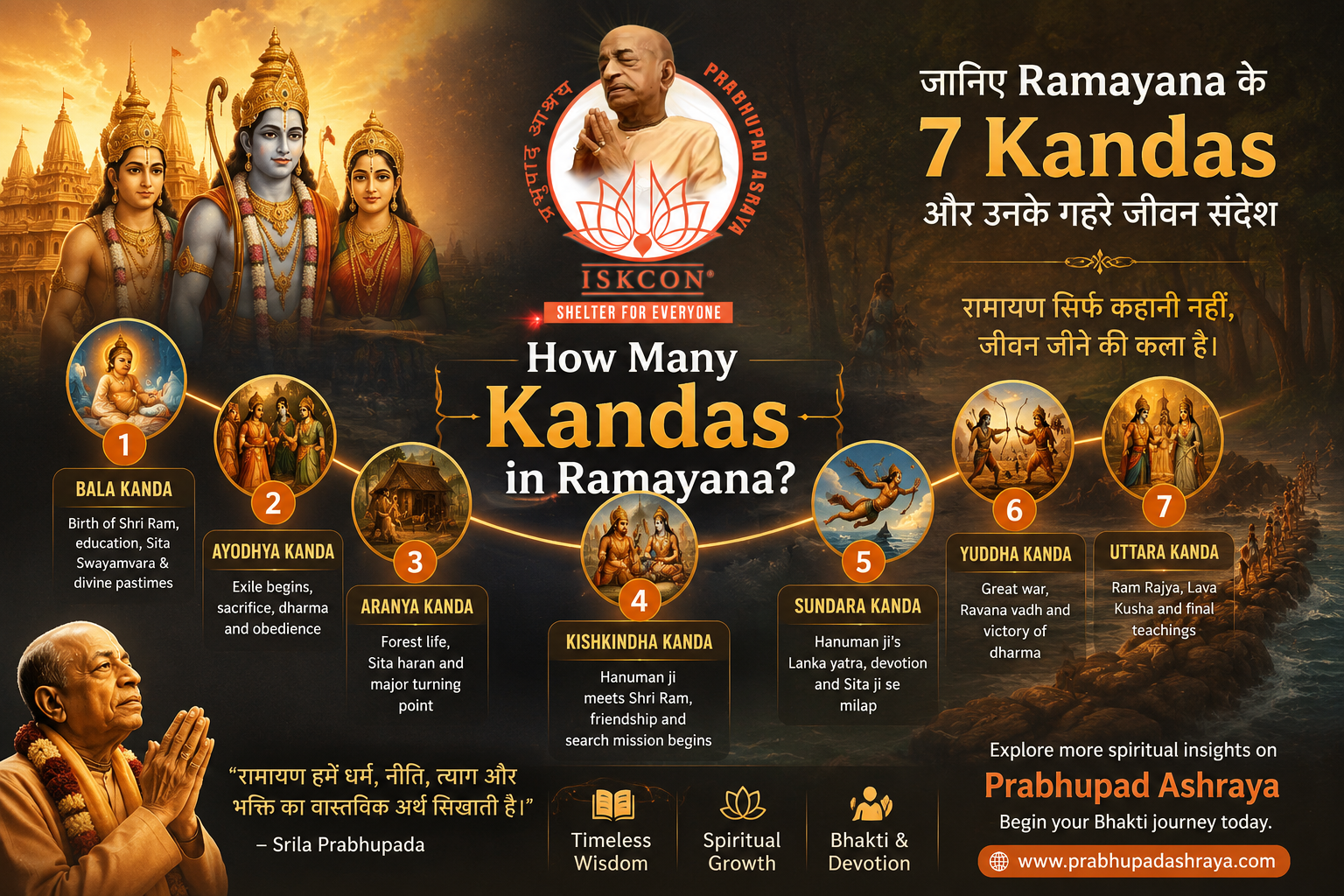
How Many Kandas in Ramayana? Complete Guide to the 7 Kandas of Ramayana
Have you ever wondered how many Kandas are there in the Ramayana? Or perhaps someone has asked you this question, and you became confused about whether there are 6, 7, or some other number? These days, we see many short videos about the Ramayana on social media, but while they tell us the story, they often do not explain its structure. This is why many people are unclear about this basic question. The answer is simple. The Valmiki Ramayana is traditionally divided into 7 Kandas (Books or Sections). Each Kanda explains a different phase of Lord Shri Ram’s life, and each section offers new spiritual and practical lessons. Let us understand them step by step. How Many Kandas Are There in the Ramayana? If you want a direct answer, it is very simple. There are traditionally 7 Kandas in the Ramayana. They are: Bala Kanda Ayodhya Kanda Aranya Kanda Kishkindha Kanda Sundara Kanda Yuddha Kanda (Lanka Kanda) Uttara Kanda Each Kanda is like a complete chapter that describes a different part of Lord Shri Ram’s journey. The interesting thing is that the Ramayana is not just a historical narrative. It also contains timeless principles such as Dharma, leadership, relationships, sacrifice, and devotion. What Does “Kanda” Mean? You may also have a question in your mind: What does Kanda mean? The word “Kanda” means a major section or book. Just as a modern book contains multiple chapters, the Ramayana is divided into larger sections called Kandas. This makes the story much easier to understand and follow. 1. Bala Kanda – The Divine Appearance of Lord Shri Ram Bala Kanda is the first section of the Ramayana. This is where the divine pastimes of Lord Shri Ram begin. In this Kanda, we learn about: King Dasharatha’s desire to have children The appearance of Shri Ram, Lakshman, Bharat, and Shatrughna The journey to the forest with Vishwamitra Muni The killing of Tadaka The deliverance of Ahalya Sita’s Swayamvara Breaking Lord Shiva’s bow The marriage of Shri Ram and Mother Sita This Kanda represents innocence, education, and ideal upbringing. When students today read it, they can understand the importance of discipline and the spiritual teacher. 2. Ayodhya Kanda – The Greatest Test of Sacrifice and Dharma This is where the story takes an emotional turn. When Lord Shri Ram is about to be crowned king, Queen Kaikeyi asks for two boons. The result? Shri Ram is sent into exile for 14 years Bharat is offered the kingdom Maharaja Dasharatha suffers separation from his beloved son Think about it. If everything were taken away from us one day before receiving a promotion, how would we react? However, Shri Ram chose Dharma without complaining. This is one of the reasons He is known as Maryada Purushottam, the supreme example of ideal conduct. 3. Aranya Kanda – Forest Life and a Major Turning Point In Aranya Kanda, Shri Ram, Mother Sita, and Lakshman live in the forest. Several important incidents take place here: Serving the sages and saints The arrival of Surpanakha The killing of Khara and Dushana Maricha appearing as a golden deer The abduction of Mother Sita by Ravana Jatayu’s sacrifice This is where the major conflict of the Ramayana begins. This Kanda helps us understand how a small distraction can sometimes change the direction of our lives. It is similar to how mobile addiction or bad company can gradually affect our lives. 4. Kishkindha Kanda – Friendship and Teamwork This Kanda is famous for the first meeting between Lord Shri Ram and Hanuman Ji. This section includes: The introduction of Hanuman Ji Friendship with Sugriva The killing of Bali The organization of the Vanara army The beginning of the search for Mother Sita This teaches us how important the right association is in life. Good friends can bring us closer to God, while the wrong association can take us in the opposite direction. 5. Sundara Kanda – The Great Service of Hanuman Ji Many people consider Sundara Kanda the heart of the Ramayana. And there is a beautiful reason for this. In this Kanda, Hanuman Ji: Crosses the ocean Reaches Lanka Meets Mother Sita Delivers Lord Shri Ram’s message Demonstrates extraordinary courage in Lanka Sets Lanka on fire This entire Kanda is a perfect example of devotion, faith, and selfless service. This is why many devotees also regularly recite Sundara Kanda. 6. Yuddha Kanda (Lanka Kanda) – The Victory of Dharma Now the time for the final battle arrives. This Kanda includes: The construction of Ram Setu The battle of Lanka The killing of Kumbhakarna The killing of Meghnad The killing of Ravana The liberation of Mother Sita The return to Ayodhya The greatest lesson here is that Dharma ultimately triumphs, no matter how great the struggle may be. 7. Uttara Kanda – The Final Teachings Uttara Kanda is the last section of the Ramayana. It describes: The reign of Lord Shri Ram Lava and Kusha Maharishi Valmiki’s ashram The final pastimes of Mother Sita The conclusion of Lord Shri Ram’s earthly pastimes Some scholars have different discussions regarding the authorship of Uttara Kanda. However, traditionally, the Valmiki Ramayana is recognized as having a structure of seven Kandas. Why Are There 7 Kandas? The purpose is not simply to divide the story into sections. Each Kanda represents a stage: Childhood Responsibility Challenges Friendship Devotion Victory Legacy If you look carefully, these stages also appear in our own lives in one form or another. This is why the Ramayana continues to feel so relevant even today. The Connection Between the Ramayana and the Bhagavad Gita People often consider the Ramayana and the Bhagavad Gita to be separate books. However, both guide us in the same direction: following Dharma and living according to the will of the Supreme Lord. Lord Shri Ram demonstrates ideal conduct through His life, while Lord Krishna explains the same Dharma through His words in the Bhagavad Gita. The essence of Krishna Consciousness and Bhakti Yoga is also to gradually direct
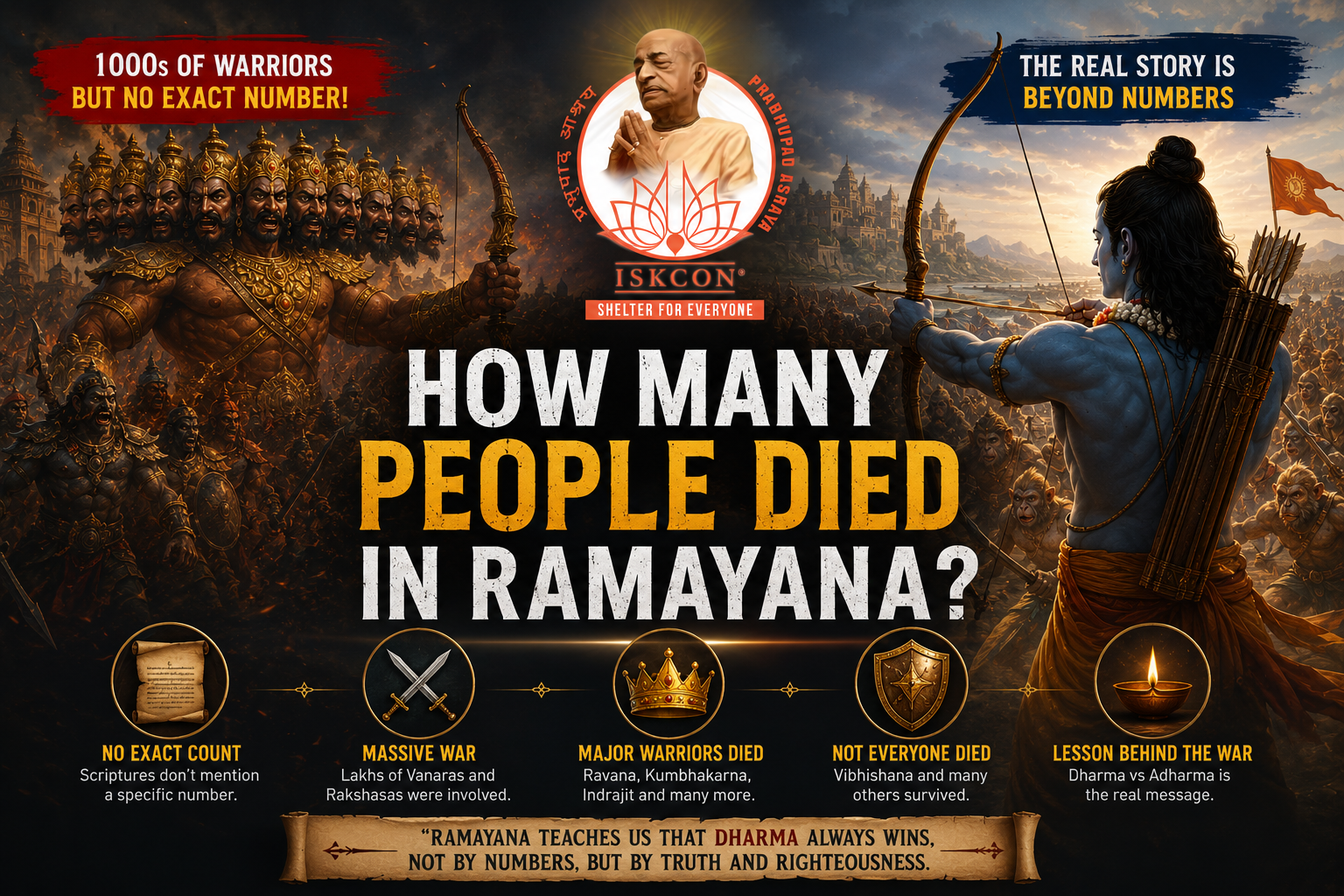
How Many People Died in Ramayana? The Real Numbers Explained with Context
People often search on Google for how many people died in the Ramayana. Sometimes they find one number in a YouTube video and a different claim on social media. This can naturally lead to confusion. The truth is that the exact total number of deaths in the Ramayana is not explicitly stated in the text. However, based on the descriptions in the Valmiki Ramayana and other major scriptures, we can certainly develop a reasonable understanding. Let us explore step by step how many people died in the Ramayana war and what the scriptures tell us about it. Why Is It Difficult to Know Exactly How Many People Died in the Ramayana? This is where most of the confusion arises. Unlike modern wars, there were no official military records or casualty reports maintained in the same way during that time. The primary purpose of the Ramayana was not to provide statistics but to explain the struggle between Dharma and Adharma. For this reason, the scriptures describe major warriors and important events in detail, but they do not provide an exact total number of deaths. The point is simple. If someone asks you about the message of the Mahabharata, you are more likely to remember its lessons than a set of numbers. The Ramayana similarly focuses on spiritual teachings. How Many People Died in the Ramayana War? The Yuddha Kanda of the Valmiki Ramayana describes the great war in Lanka. Two major armies faced each other in this battle: Lord Shri Ram’s Vanara army Ravana’s Rakshasa army The war continued for several days, and the descriptions portray very large numbers of warriors dying during the conflict. The scriptures do not provide an exact figure. However, based on these descriptions, many warriors from both the Vanara and Rakshasa armies lost their lives on the battlefield. Therefore, if someone gives a single fixed number, there is no established scriptural evidence for accepting that figure as the definitive total. Important Characters Who Died in the Ramayana Several famous warriors met their end during the war. Some of the prominent names include: Ravana Kumbhakarna Indrajit (Meghanada) Atikaya Akampana Prahasta Narantaka Devantaka Trishira Mahodara Mahaparshva Virupaksha Many powerful warriors from the Vanara army also lost their lives in battle. However, the interesting point is that the Ramayana focuses not merely on their deaths but also on their actions and choices. Did the Entire Rakshasa Army Die? No. This is a common misconception. Not every Rakshasa died in the war in Lanka. Many Rakshasa warriors were killed on the battlefield, but the entire population was not destroyed. The most prominent example is Vibhishana, Ravana’s younger brother. He supported Dharma and later became the king of Lanka. This is a very important point to understand. The Ramayana is not against any race or community. The conflict was between Dharma and Adharma, not against an entire race. Did All the Vanaras Die? Absolutely not. If you look carefully, several Vanara warriors who fought alongside Shri Ram, including Sugriva, Hanuman Ji, Jambavan, and Angada, survived the war. There is another important incident as well. After the battle, through the grace of the demigods, many Vanara warriors were restored to life. This makes determining the final casualty count even more difficult. For this reason, stating an exact number is not possible based on the available scriptural descriptions. What Does the Ramayana Actually Want Us to Learn? Now the question arises: If the numbers are not the most important thing, what is the main message of the Ramayana? Think about it. Even today, we often chase shocking numbers and sensational facts after seeing headlines on social media. However, we frequently miss the deeper lessons. The Ramayana teaches us that: The end of arrogance is inevitable. Dharma ultimately triumphs. We must face the consequences of our wrong decisions. Good association has a tremendous impact on our lives. Faith in God gives us strength even in difficult situations. These lessons are just as relevant today for students, professionals, and families. The Bhagavad Gita Connection If the Ramayana provides practical examples of living according to Dharma, the Bhagavad Gita explains that Dharma through spiritual knowledge and philosophical reasoning. Lord Krishna explains that every person should understand their duties and actions and live accordingly. The characters in the Ramayana demonstrate these principles through their lives. This is why Krishna Consciousness and Bhakti Yoga are not merely ancient concepts. They can also provide direction when dealing with stress, confusion, and difficult choices in modern life. Common Misconceptions About Deaths in the Ramayana “Exactly 24 lakh people died.” There is no direct scriptural reference establishing this claim as the exact total death count. “Only Rakshasas died.” This is also incorrect. Many warriors from the Vanara army also lost their lives on the battlefield. “Everyone in Lanka was killed.” Absolutely not. Vibhishana and others survived the war. “The Ramayana provides an official death count.” No. The Valmiki Ramayana does not explicitly mention the exact total number of casualties. Frequently Asked Questions (FAQs) How many people died in the Ramayana exactly? The exact number is not mentioned in any established passage of the Ramayana that provides a definitive total casualty count. How many Rakshasas died in the Ramayana? A very large number of Rakshasa warriors were killed, but the exact figure is not available. Did Hanuman die in the Ramayana? No. Hanuman Ji survived the events of the Ramayana and is traditionally regarded as one of the Chiranjeevis, the immortal beings. Did Vibhishana survive the war? Yes. Vibhishana supported Dharma and later became the king of Lanka. Was the entire city of Lanka destroyed? Lanka was not completely destroyed. After the war, the kingdom continued under Vibhishana’s leadership. Why doesn’t the Ramayana mention the total number of deaths? The Ramayana primarily aims to provide spiritual guidance and explain Dharma rather than present a comprehensive statistical record of war casualties. Final Thoughts If your question was “How many people died in the Ramayana?”, the honest answer is that the exact
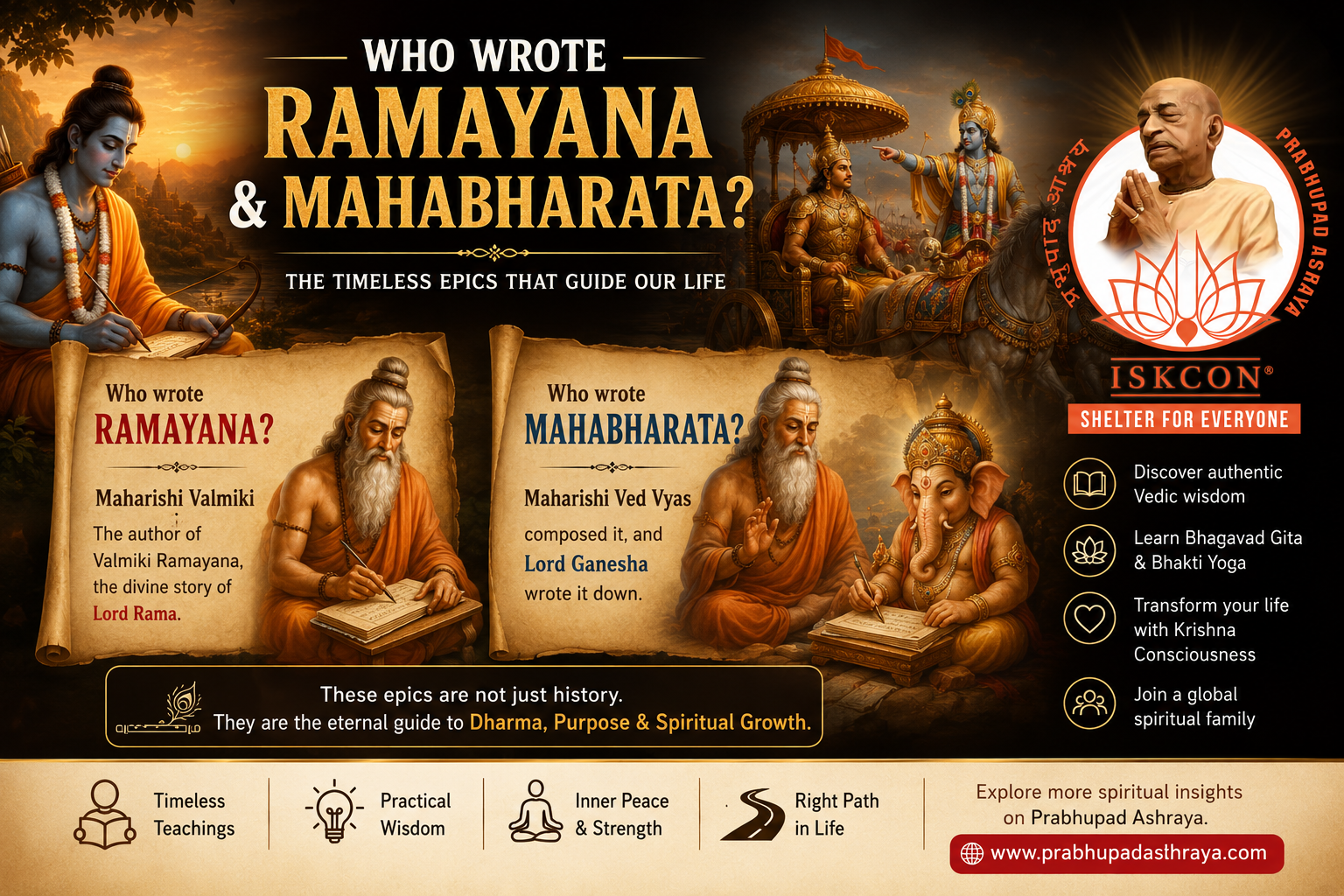
Who Wrote Mahabharata and Ramayana? Who Wrote Ramayana & What Makes These Epics Timeless?
Have You Ever Been Confused About This? Someone may have told you that the Ramayana was written by Valmiki Ji and the Mahabharata by Ved Vyas Ji. But then, someone on social media or YouTube may have claimed that “Lord Ganesha wrote the Mahabharata.” Similarly, many people search for who wrote Ramayana or who wrote Mahabharata, but they do not always find a clear answer. The simple truth is that confusion arises when we do not understand the difference between “who composed a text” and “who wrote it down.” Let us understand this from the perspective of Vedic scriptures and authentic tradition. Who Wrote the Ramayana? The most straightforward answer is: The Ramayana was composed by Maharishi Valmiki. This is why it is also known as the Valmiki Ramayana. It is not merely a story but a profound account of the divine life of Lord Shri Ram, His ideal character, and the practical demonstration of Dharma. If you look carefully, Maharishi Valmiki was not just the author. He was also a contemporary of Lord Shri Ram and taught Lava and Kusha to recite the Ramayana. For this reason, the Valmiki Ramayana is traditionally regarded as the earliest and most authoritative version of the Ramayana. Who Was Maharishi Valmiki? Many people know only that Valmiki Ji was the author of the Ramayana. However, his own life is an inspiring spiritual journey. According to a popular traditional account, his former name was Ratnakara, and he lived as a forest-dweller and robber. His association with Narada Muni transformed his life. Through the chanting of the holy name and austerities, he transformed his consciousness completely. Think about it. If a person can undergo such a profound transformation, why can we not bring positive transformation into our own lives? This is one of the most beautiful messages of Vedic wisdom. How Many Kandas Are There in the Valmiki Ramayana? The Valmiki Ramayana is traditionally divided into seven Kandas: Bala Kanda Ayodhya Kanda Aranya Kanda Kishkindha Kanda Sundara Kanda Yuddha Kanda Uttara Kanda Each Kanda teaches a different lesson about life. Just as every semester in college has a particular purpose, each Kanda represents a stage in spiritual growth. Who Wrote the Mahabharata? Now another question arises. Who wrote the Mahabharata? The answer is: The Mahabharata was composed by Maharishi Ved Vyasa. However, this is where the greatest confusion often arises. According to the traditional account, Ved Vyasa recited the Mahabharata, and Lord Ganesha wrote it down. In other words: Author and composer: Maharishi Ved Vyasa Divine scribe: Lord Ganesha Both statements are correct within their respective contexts. The Interesting Story of Ved Vyasa and Lord Ganesha This is an inspiring traditional story. Ved Vyasa wanted the Mahabharata to be written down without interruption. Therefore, he requested Lord Ganesha to act as his scribe. Lord Ganesha set one condition: “I will write continuously without stopping.” Ved Vyasa also set a condition: “You must understand the meaning of every verse before writing it down.” As a result, whenever Ved Vyasa needed time to compose the next verse, he would recite a verse with a particularly profound meaning. Meanwhile, Lord Ganesha would contemplate its meaning, giving Ved Vyasa time to prepare the next verse. This story offers a beautiful example of teamwork, intelligence, and patience. What Is the Difference Between the Ramayana and the Mahabharata? People often consider both epics to be similar in every respect. However, they explore different aspects of life and Dharma. Ramayana Mahabharata Focuses on the ideal character and life of Lord Shri Ram Focuses on the Kuru dynasty and complex decisions involving Dharma Teaches simplicity and ideal conduct Explores difficult moral situations in practical life Provides an ideal example of Maryada, or righteous conduct Teaches how to apply Dharma amid real-life challenges The two epics do not contradict each other. Rather, they complement each other. What Is the Connection with the Bhagavad Gita? Here is an interesting fact. The Bhagavad Gita is an important part of the Mahabharata. The spiritual guidance that Lord Krishna gave to Arjuna on the battlefield of Kurukshetra is known as the Bhagavad Gita. If the Ramayana provides an example of an ideal life, the Bhagavad Gita explains how to make decisions when facing confusion in real life. This is why students, professionals, and young spiritual seekers continue to turn to the Bhagavad Gita for practical guidance. What Can Today’s Generation Learn from These Epics? Think about it. Every day, we face social media distractions, career pressure, relationship issues, and anxiety about the future. The Ramayana and the Mahabharata do not teach us to escape from life’s challenges. Instead, they teach us that no matter how difficult our circumstances may be, making decisions guided by Dharma and the right consciousness can make our lives meaningful. Just as muscles develop through regular practice at the gym, spiritual strength also develops through daily reflection and Bhakti Yoga. This is why these epics remain relevant even thousands of years later. Are They Just Stories? This is another common question. According to the Vedic tradition, the Ramayana and the Mahabharata are not merely historical narratives. They also serve as practical guides for understanding Dharma, Karma, and human nature. Every character offers us one lesson or another. This is why it is important not only to read these epics but also to understand their teachings. Frequently Asked Questions (FAQs) 1. Who wrote the Ramayana? The Ramayana was composed by Maharishi Valmiki. This is why it is known as the Valmiki Ramayana. 2. Who wrote the Mahabharata? The Mahabharata was composed by Maharishi Ved Vyasa, while Lord Ganesha traditionally served as its divine scribe. 3. Is the Valmiki Ramayana the original Ramayana? The Valmiki Ramayana is traditionally regarded as the earliest and most authoritative version of the Ramayana. 4. Is the Bhagavad Gita part of the Mahabharata? Yes. The Bhagavad Gita is a sacred part of the Bhishma Parva of the Mahabharata. 5. Why is Valmiki called Adi Kavi? Maharishi Valmiki is traditionally regarded
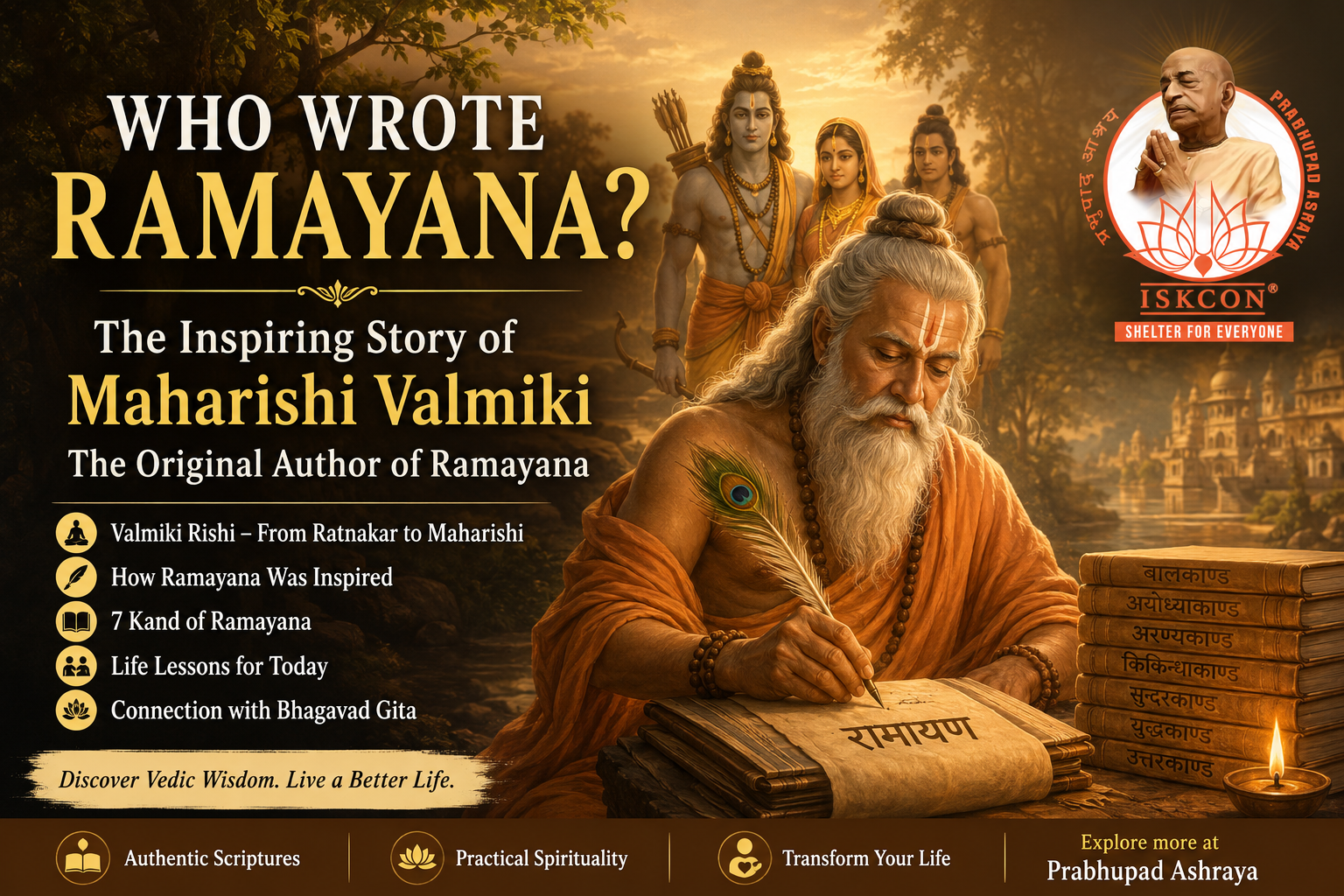
Who Wrote the Ramayana? The Amazing Story of Sage Valmiki
Who Wrote the Ramayana? Let’s Clear Up the Confusion First If you have ever searched for who wrote Ramayana on Google, you may have wondered about this question yourself. Some people say Lord Ganesha wrote it, others mention Tulsidas Ji, while some name Sage Valmiki. So, what is the truth? The answer is simple — the original Ramayana was written by Maharishi Valmiki. That is why it is also known as the Valmiki Ramayana. But there is much more to the story. The most interesting part is that Valmiki Rishi was not always a great saint. His life transformation teaches us that the holy name of the Lord and the association of saintly people can change anyone’s life. Let’s understand this in detail. Who Was Maharishi Valmiki? Today, we know him as Maharishi Valmiki, but his early life was completely different. According to popular traditional accounts, his original name was Ratnakar. He lived in the forest and supported his family by robbing people. One day, he met Devarshi Narada. Narada Muni asked him a simple question: “Will those for whom you are committing sins also share the consequences of your sinful actions?” When Ratnakar asked his family this question, everyone refused. This was the turning point of his life. Narada Muni advised him to chant the holy name of the Lord. Gradually, his heart became purified, and Ratnakar eventually became Maharishi Valmiki. This transformation teaches us that Bhakti can transform anyone, regardless of their past. How Did Valmiki Get the Inspiration to Write the Ramayana? Now the question arises… What inspired Valmiki Rishi to write the Ramayana? One day, he saw a pair of krauncha birds in the forest. Suddenly, a hunter killed one of the birds. The other bird began crying in grief. Witnessing this scene awakened compassion in Valmiki Rishi’s heart, and a verse spontaneously emerged from his mouth. This verse is traditionally regarded as the first shloka of Sanskrit poetry. Later, Lord Brahma blessed Valmiki and inspired him to compose a poetic account of the divine life of Lord Shri Ram. In this way, the Valmiki Ramayana came into being. How Many Kandas and Shlokas Are There in the Valmiki Ramayana? The Valmiki Ramayana is regarded as one of the world’s most ancient epic poems. It contains: 7 Kandas (Books) Approximately 24,000 Sanskrit shlokas More than 500 Sargas (Chapters) These are the seven Kandas: Bala Kanda Ayodhya Kanda Aranya Kanda Kishkindha Kanda Sundara Kanda Yuddha Kanda Uttara Kanda Each Kanda describes a different phase of Lord Shri Ram’s life. Did Tulsidas Ji Also Write the Ramayana? This is where most of the confusion arises. Many people think that Tulsidas Ji was the original author of the Ramayana. Actually, Goswami Tulsidas Ji composed the Ramcharitmanas, which is written in the Awadhi language. On the other hand, the Valmiki Ramayana was composed in Sanskrit and is regarded as the original Ramayana. Both scriptures describe the divine pastimes of Lord Shri Ram, but their styles, languages, and presentations are different. Therefore, when someone asks who wrote Ramayana, the correct answer is — Maharishi Valmiki. The Ramayana Is Not Just a Story; It Is a Guide to Life If you look carefully, the Ramayana is not merely a story from an ancient age. Its characters and teachings are still relatable to our daily lives. When we face challenges in our careers, Shri Ram teaches us patience and duty. When misunderstandings arise in relationships, the Ramayana shows us the importance of respect and sacrifice. When it comes to leadership, Shri Ram’s ideal character serves as an inspiration for every generation. Just as shortcuts cannot guarantee success in an examination, there is no substitute for righteousness and sincerity in life. That is why the Ramayana remains relevant to people of every age group. What Is the Connection Between the Bhagavad Gita and the Ramayana? You may be wondering what connects the Ramayana and the Bhagavad Gita. Both scriptures appeared in different ages, but their core messages guide us in the same spiritual direction. Lord Shri Ram demonstrates the practical application of dharma through His life. Lord Shri Krishna explains the same principles of dharma and karma in the Bhagavad Gita, providing philosophical clarity. One teaches us how to live an ideal life. The other explains how to understand and follow spiritual principles in practice. Krishna Consciousness and Bhakti Yoga express a common spiritual essence found in the teachings of both scriptures—love and service to the Supreme Lord. That is why Srila Prabhupada also consistently emphasized applying Vedic wisdom in our practical lives. What Should We Learn from the Ramayana? In today’s social media age, information is abundant, but direction is often lacking. The Ramayana reminds us that true success comes not merely from achievements but from character. This scripture teaches us that: We should not change our principles of dharma according to our circumstances. Sacrifice is never a sign of weakness. Good relationships are built on trust and service. Pride and arrogance ultimately lead to destruction. Faith in the Lord gives us strength even in the most difficult circumstances. These teachings remain just as relevant today as they were in Treta Yuga. Frequently Asked Questions (FAQs) 1. Who originally wrote the Ramayana? The original Ramayana was composed by Maharishi Valmiki in the Sanskrit language. 2. Who wrote the Ramcharitmanas? The Ramcharitmanas was composed by Goswami Tulsidas Ji in the Awadhi language. 3. Is the Valmiki Ramayana older than the Ramcharitmanas? Yes. The Valmiki Ramayana is an ancient scripture, while the Ramcharitmanas was composed many centuries later. 4. How many Kandas are there in the Ramayana? The Valmiki Ramayana contains seven Kandas. 5. Why is Valmiki called Adi Kavi? Because the first Sanskrit shloka attributed to him is traditionally regarded as the beginning of the Sanskrit poetic tradition. For this reason, he is known as Adi Kavi, meaning the first poet. 6. Is the Ramayana relevant to modern life? Absolutely. Principles such as leadership, family values, duty, integrity, and spiritual growth remain
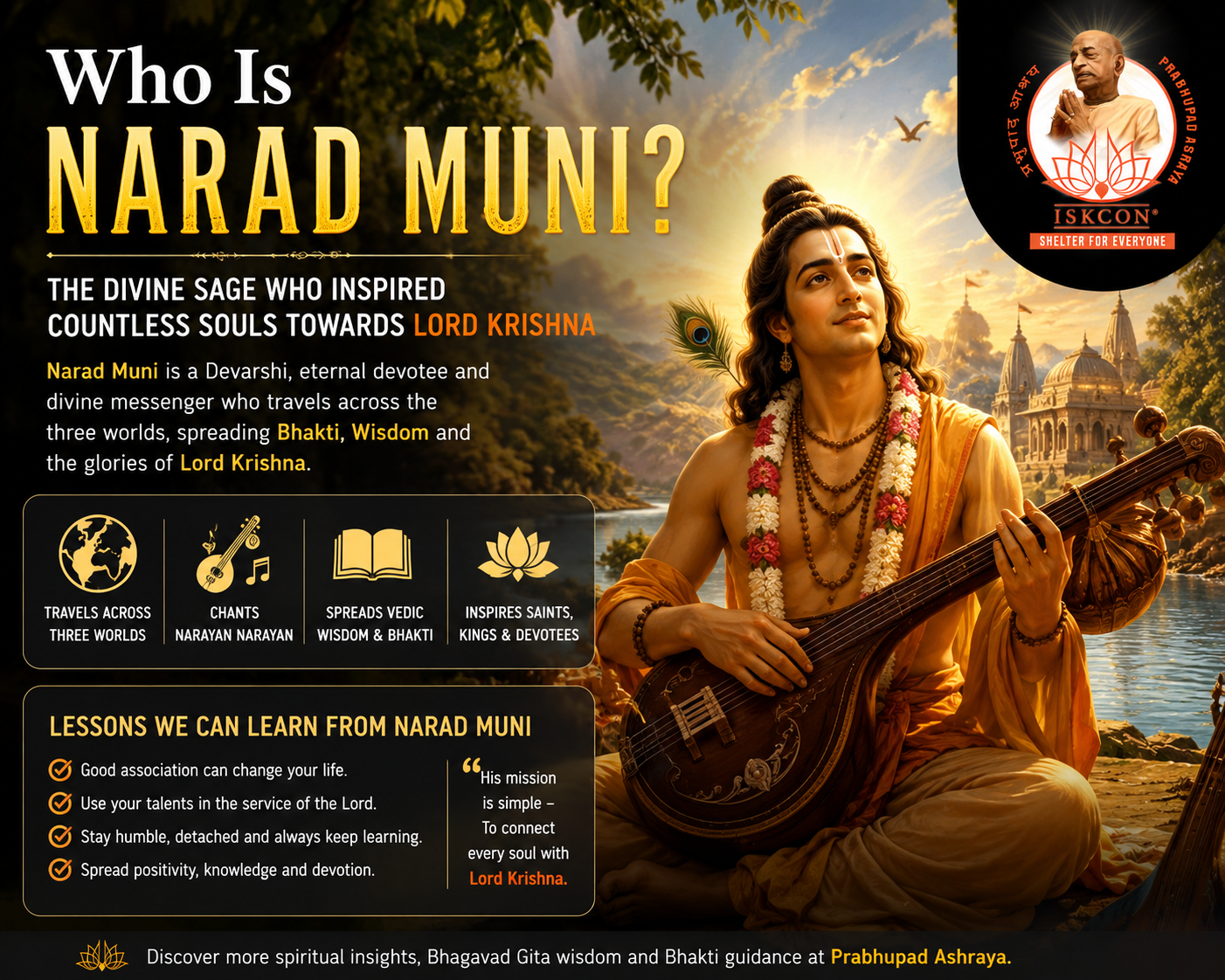
Who Is Narad Muni? Why Is Narada Muni Veena So Spiritually Significant?
If you have ever heard the name Narad Muni, the first image that probably comes to mind is that of a sage carrying a veena and wandering through the three worlds while chanting “Narayan, Narayan.” However, many people consider him merely a messenger or a humorous character. This is where much of the confusion begins. The truth is that when we ask who is Narad Muni, the answer is much more than simply calling him a sage. Narad Muni is one of the greatest devotees described in Vedic scriptures, inspiring every living being to turn toward devotion to the Supreme Lord. His life shows us that regardless of one’s background, sincere devotion can transform an entire life. Let’s understand this divine personality in a simple and practical way. Who Is Narad Muni? Narad Muni is a great Vedic sage, an eternal devotee, and an unalloyed servant of Lord Krishna. He is also known as “Devarshi,” meaning a great sage among the celestial beings. He does not remain in just one place. Narad Muni travels freely throughout the three worlds—Svarga, Earth, and other planetary systems. His mission is simple: to remind every living being of the Supreme Lord and spread the message of Bhakti Yoga. Interestingly, he does not hold grudges against anyone. Sometimes he guides a king, sometimes he instructs an ascetic, and sometimes he inspires even a small child to begin a spiritual life. That is why he is regarded as an eternal preacher of Krishna Consciousness. What Was Narad Muni’s Previous Life Like? You may think that Narad Muni was always a divine sage. However, his story is even more inspiring than that. According to the Śrīmad-Bhāgavatam, in his previous life, Narad Muni was the son of a poor maidservant. His mother served saintly devotees. Young Narada also served these saints, listened to their discussions, and respectfully honoured the prasadam they offered. The principle is simple: good association can transform a person’s way of thinking. For example, when a student spends time with positive and hardworking friends, their own focus naturally begins to improve. Similarly, Narada’s heart gradually became purified through the association of saintly devotees. One day, these saints narrated the pastimes of Lord Krishna to him. This marked the beginning of his spiritual journey. Later, when his mother passed away, he understood the temporary nature of worldly attachments and set out in search of the Supreme Lord. Because of his sincerity and devotion, in his next life he attained his eternal spiritual form as Narad Muni. This story teaches us a profound lesson—association and sincere effort are more important than birth alone. Why Does Narad Muni Travel Everywhere? Some people jokingly say that Narad Muni is always spreading news. However, if we carefully study the scriptures, we discover that his activities serve a higher spiritual purpose. Sometimes, his words break a king’s false pride. Sometimes, they strengthen a devotee’s faith. At other times, even the activities of a demon become the starting point for the Lord’s divine pastimes. In other words, Narad Muni does not merely carry information. He plays an important role in unfolding the divine plan of the Supreme Lord. In real life, too, we sometimes feel that a challenge or an unexpected situation is something bad. Later, however, that very event may become the reason for our growth. Narad Muni’s activities help us understand this principle. What Is Narad Muni’s Relationship with Lord Krishna? If we had to describe it in one phrase, the answer would be pure devotion. Narad Muni’s entire life is dedicated to serving Lord Krishna. Wherever he goes, he glorifies the Lord’s holy names, qualities, and pastimes. His veena is traditionally known as “Mahati.” Accompanied by its melodious music, he constantly chants “Narayan, Narayan.” This is also the essence of Bhakti Yoga. We do not follow spiritual practices merely to perform rituals. We follow them to revive our relationship with the Supreme Lord. Narad Muni is a living example of this principle. Which Great Personalities Did Narad Muni Inspire? When we study Vedic history, we find that Narad Muni played an important role in the spiritual journeys of many great personalities. Dhruva Maharaj Dhruva was a young boy who went to the forest after experiencing humiliation. Narad Muni showed him the path of devotion to the Supreme Lord rather than simply seeking revenge. Through his devotion, Dhruva Maharaj eventually received the audience of Lord Vishnu. Prahlad Maharaj When Prahlad was still in his mother’s womb, Narad Muni imparted spiritual knowledge to his mother. Prahlad was also influenced by this saintly association. This shows how powerful spiritual influence can be. Maharishi Valmiki There was once a robber named Ratnakar. Under Narad Muni’s guidance, he eventually became Maharishi Valmiki, the author of the Ramayana. Think about it: even a criminal can become a saint. This is the true power of Bhakti. Vyasadeva Vyasadeva, the compiler of the Mahabharata and many Vedic scriptures, once felt dissatisfied from within. Narad Muni explained to him that his heart would not find complete satisfaction until he extensively described the pure devotional glories of the Supreme Lord. Inspired by this guidance, the Śrīmad-Bhāgavatam was revealed through Vyasadeva’s composition. How Can We Understand Narad Muni in the Context of the Bhagavad Gita? The Bhagavad Gita does not directly provide a biography of Narad Muni, but many of its principles are clearly reflected in his life. For example, Krishna explains to Arjuna that through devotion, one can truly understand the Supreme Lord. Narad Muni is a practical example of this teaching. He never made fame, wealth, or social position the goal of his life. His focus remained entirely on devotional service. Today, we can become so caught up in social media followers, career growth, and comparisons with others that we forget the source of genuine happiness. Narad Muni reminds us that our inner connection with the Supreme Lord matters more than external success. This connection is known in Vedic philosophy as Bhakti Yoga. What Can Modern
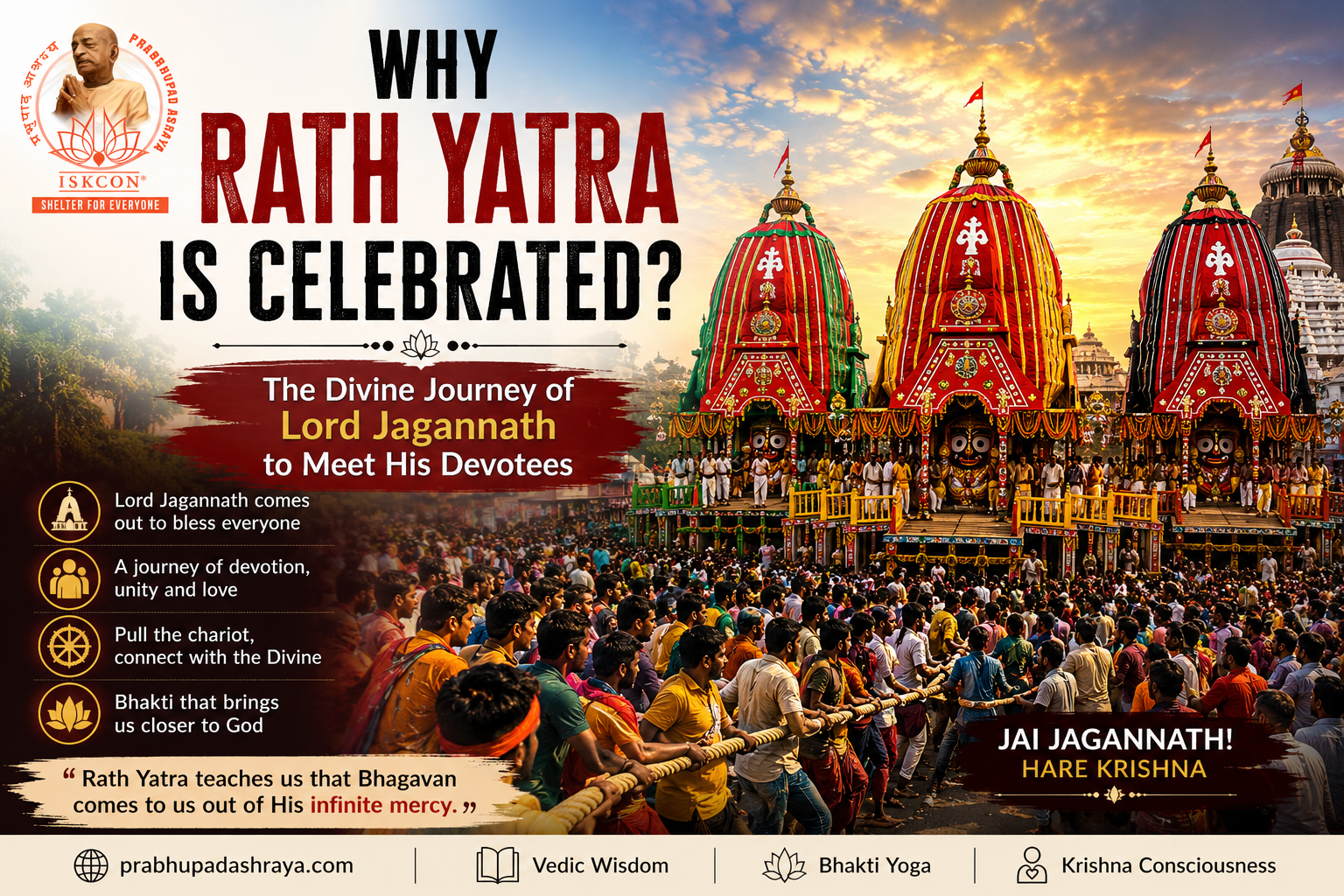
Why Rath Yatra Is Celebrated? The Beautiful Story Behind Jagannath Puri Rath Yatra
If you have ever seen videos on social media of thousands of people pulling a massive chariot, you may have wondered: Why is Rath Yatra celebrated? Every year, during the Jagannath Puri Rath Yatra, millions of people celebrate this festival with great devotion and enthusiasm in Puri, Odisha, and in cities around the world. But is it merely a cultural event? Or is there a deeper spiritual message behind it? The answer is simple: this festival is not just a procession. It is a celebration of Lord Jagannath’s boundless mercy and love for His devotees. Let’s understand the true story of this divine festival in a simple and practical way. Why Is Jagannath Puri Rath Yatra Celebrated? First, it is important to understand that the primary purpose of Jagannath Puri Rath Yatra is to make the divine darshan of Lord Jagannath accessible to everyone. On ordinary days, Lord Jagannath, Lord Baladeva, and Subhadra Devi reside in the sanctum sanctorum of the Jagannath Temple. Not everyone can enter the temple and have their darshan. That is why, once a year, the Lord comes out to meet His devotees. Think about it… We usually try to approach the Supreme Lord. But Rath Yatra teaches us that sometimes, instead of asking His devotees to come to Him, the Lord Himself comes to them. That is one of the most beautiful aspects of this festival. The Story Behind Jagannath Puri Rath Yatra Many people wonder how the Puri Rath Yatra began. Its spiritual significance is understood in connection with Lord Krishna’s pastimes in Vrindavan. Vaishnava acharyas explain that Lord Jagannath’s ecstatic form represents Krishna’s divine mood of remembering Vrindavan and His beloved devotees. During Rath Yatra, Lord Jagannath travels to the Shri Gundicha Temple along with His elder brother, Lord Baladeva, and His sister, Subhadra Devi. In the Vaishnava tradition, the Gundicha Temple is understood as a symbolic representation of Vrindavan. Therefore, this journey also represents the divine reunion of Lord Krishna with His beloved devotees. What Is the Significance of the Three Chariots? If you have seen pictures of Jagannath Rath Yatra, you may have noticed that there is not just one chariot, but three different chariots. These are the three divine chariots: Nandighosha — The chariot of Lord Jagannath Taladhwaja — The chariot of Lord Baladeva Darpadalana (Devadalana) — The chariot of Subhadra Devi New wooden chariots are constructed every year. Interestingly, their construction follows centuries-old traditions and specific measurements. This is not merely an example of engineering; it is also a beautiful example of devotional service. Why Is Pulling the Rath Considered So Special? Now the question arises… Why do thousands of people put in so much effort to pull the chariots? The answer goes beyond physical activity. In Bhakti, intention is what matters most. Just as we express our love rather than simply offering money when helping a friend, devotees express their love and service to the Supreme Lord by pulling His chariot during Rath Yatra. That is why many people consider participating in this festival a great spiritual opportunity. What Does Jagannath Puri Rath Yatra Teach Us? This is a very important point to understand. Today, all of us are busy running one race or another. College assignments, office deadlines, social media notifications, and worries about the future never seem to end. But Jagannath Puri Rath Yatra reminds us that life is not just about achievements. Our relationship with the Supreme Lord is equally important. Just as a mobile phone needs regular charging, our hearts also need a spiritual connection. Bhakti is the process of recharging ourselves from within. The Connection Between the Bhagavad Gita and Rath Yatra If you read the Bhagavad Gita, you will repeatedly encounter a common principle. The Supreme Lord does not look merely at rituals. He values devotion and sincerity. Rath Yatra is a practical celebration of this principle. Whether someone is rich or poor, a student or a businessperson, everyone can hold the same rope and pull the Lord’s chariot. This is a beautiful example of equality and devotion. Krishna Consciousness teaches us that, before the Supreme Lord, our true identity is defined by our devotion. Rath Yatra Is Not Limited to Puri Many people think that the Puri Rath Yatra takes place only in Odisha. However, today, Jagannath Rath Yatra is celebrated in hundreds of cities around the world. Devotees organize this divine festival every year in places such as London, New York, Mumbai, Delhi, Kolkata, Melbourne, and many other cities. This shows that the message of the Supreme Lord is not limited to one country or community. Love and devotion are universal. The Message of Rath Yatra for Today’s Youth If you belong to Gen Z, you may feel that spirituality and modern life are two separate things. But Rath Yatra teaches us something different. Bhakti does not mean abandoning the world. Bhakti means placing the Supreme Lord at the centre of our lives. When our life has the right direction, our decisions gradually become clearer as well. That is why thousands of young people actively participate in Jagannath Rath Yatra today. Frequently Asked Questions (FAQs) 1. Why is Rath Yatra celebrated every year? Jagannath Puri Rath Yatra is celebrated because Lord Jagannath comes out of the temple to give darshan to His devotees and travels to the Gundicha Temple in a divine procession. 2. What is the spiritual meaning of Jagannath Puri Rath Yatra? The festival represents the Lord’s love and compassion for His devotees and the divine reunion between them. 3. Where does Jagannath Rath Yatra take place? The most famous Rath Yatra takes place in Puri, Odisha. Jagannath Rath Yatra is also celebrated in many cities around the world. 4. Who travels in the Rath Yatra? Lord Jagannath, Lord Baladeva, and Subhadra Devi travel in their respective divine chariots. 5. Why do people pull the Rath? Devotees pull the chariots to express their devotion and service to the Supreme Lord. They regard this as an opportunity
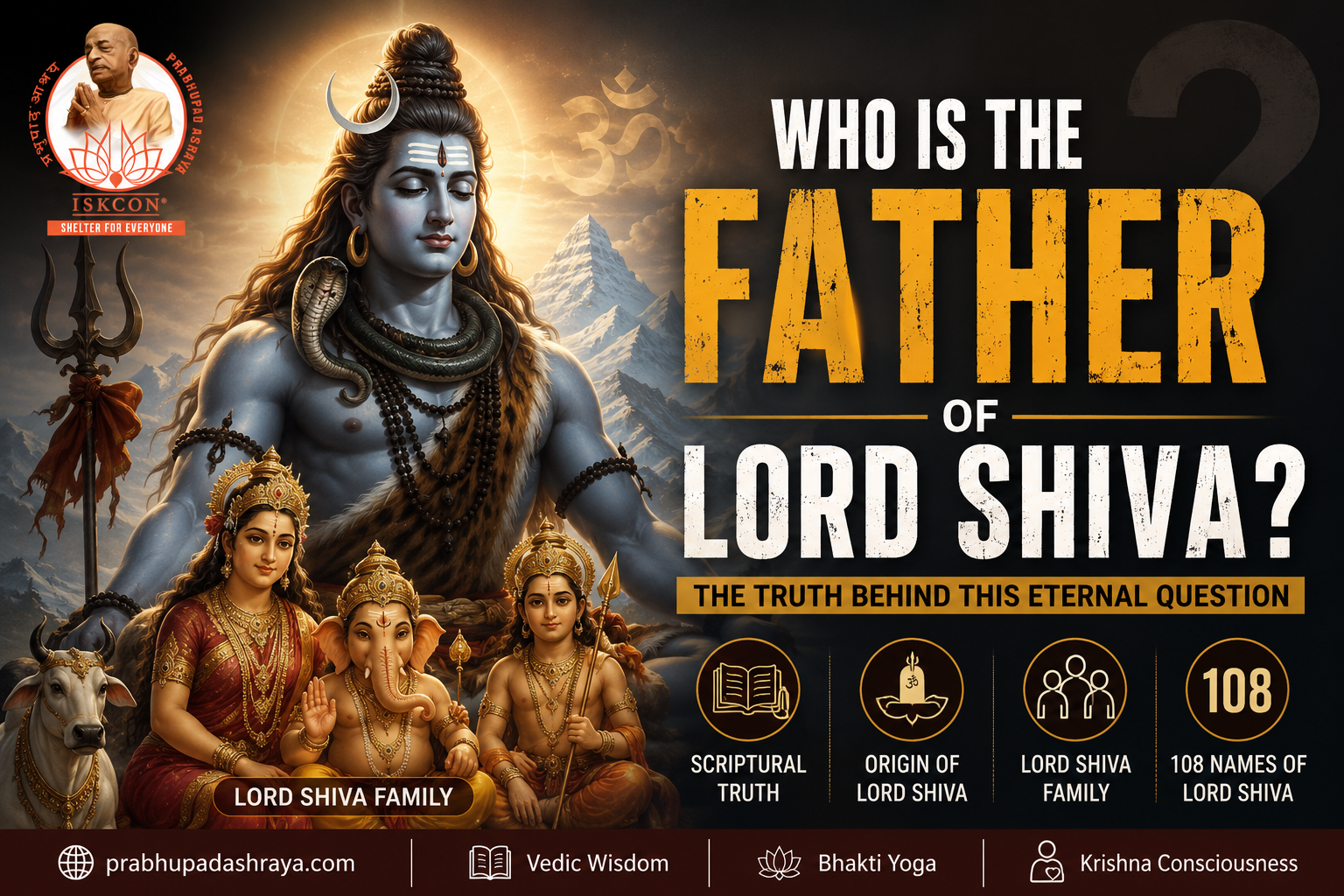
Who Is the Father of Lord Shiva? The Truth Behind This Eternal Question
People often search the internet for “Who is the father of Lord Shiva?” Sometimes, they come across a social media reel claiming that a particular deity is Shiva Ji’s father, which only adds to their confusion. The answer is not as straightforward as many people assume when we carefully study Vedic scriptures. This is where much of the confusion begins. Lord Shiva is not an ordinary living being, nor is His position comparable to that of a regular family member within material creation. In this article, we will explore what the scriptures say about whether Lord Shiva has a father, His origin, the Lord Shiva family, and how we can understand this topic in the light of the Bhagavad Gita and Vedic wisdom. Is Lord Shiva’s Father Really Someone? First, let us understand an important point. When we talk about an ordinary human being, we naturally think of their parents. However, this rule does not apply in the same way to every divine personality. In Vedic scriptures, Lord Shiva is described as eternal (anadi). This means His existence did not begin through an ordinary human birth. Therefore, if someone asks: “Who is the father of Lord Shiva?” According to the Vaishnava understanding presented here, the answer is: Lord Shiva does not have a biological father in the ordinary human sense. He is an eternal divine personality whose existence is not limited to the beginning of material creation. Then Why Do Some Scriptures Describe Brahma as Shiva’s Father? Now another question arises… If Lord Shiva has no father, why does Brahma Ji appear in some accounts of His origin? This confusion arises because different Puranic narratives describe divine manifestations in different ways. Some scriptural accounts describe Lord Shiva as appearing from the forehead of Lord Brahma. However, this does not necessarily mean biological birth in the ordinary sense. It can be understood as a manifestation. For example, light emanates from the sun, but that does not mean light becomes the sun’s daughter or son. Similarly, Shiva’s appearance through Brahma Ji can be understood as a cosmic event rather than an ordinary biological relationship. The precise interpretation depends on the particular scripture and the tradition through which the account is understood. What Is the Origin of Lord Shiva? This is a particularly important point to understand. According to Vaishnava scriptures such as the Śrīmad-Bhāgavatam and the Brahma-saṁhitā, along with the explanations of Vaishnava acharyas, Lord Shiva’s manifestation is intimately connected with the Supreme Lord. A famous analogy is often used to explain this relationship: The analogy of milk and yogurt. Think about it… Milk and yogurt are different, yet they share the same source. Yogurt is made from milk, but milk and yogurt are not exactly the same in their properties. Similarly, the relationship between Lord Shiva and the Supreme Lord is explained through this analogy. The Brahma-saṁhitā also describes this distinctive relationship. This example helps us understand Lord Shiva’s unique position. He is not an ordinary conditioned living being, nor is His role described as exactly identical to that of Lord Vishnu. Lord Shiva’s Family: Who Are Its Members? When people search for Lord Shiva’s family, they usually want to know about His divine household. The principal personalities associated with His family include: Mata Parvati Lord Ganesha Lord Kartikeya (Skanda) Nandi Maharaj, His divine associate Mount Kailash is traditionally regarded as His divine abode. Interestingly, the Shiva family is often seen as a symbol of unity and simplicity. Each member is associated with particular spiritual qualities. For example, Lord Ganesha is associated with wisdom, Lord Kartikeya with courage, and Mata Parvati with divine compassion. What Is the Significance of the 108 Names of Lord Shiva? Many people also search for the 108 names of Lord Shiva. Each name describes a particular divine quality, attribute, or aspect associated with Him. Some well-known names include: Mahadev Shambhu Rudra Neelkanth Pashupati Gangadhar Trilochan Bholenath Shankar Maheshwara These are not merely titles. Each name carries spiritual significance and may be associated with a particular divine pastime or quality. That is why devotees remember and chant these names as part of their devotional practices. What Does Mahadev Mean? People often hear the word Mahadev without knowing its meaning. The simple meaning of Mahadev is: “The great god” or “the greatest among the devas.” This title expresses reverence for Lord Shiva’s extraordinary spiritual position. However, Vedic philosophy also explains that different divine personalities have distinct roles. For example, in a government, the prime minister, a judge, and an army chief all hold important positions, but their responsibilities differ. Similarly, Vedic scriptures describe different roles and relationships among divine personalities. How Does the Bhagavad Gita Help Us Understand This Topic? When we study the Bhagavad Gita carefully, we encounter a beautiful principle. The Bhagavad Gita does not focus primarily on family trees or historical details. Its central emphasis is on understanding our relationship with the Supreme Lord and learning how to revive that relationship through devotion. For this reason, the central focus of Krishna Consciousness is not genealogy but devotion. As a person practises Bhakti Yoga, many spiritual doubts can gradually become clearer through proper study and guidance. Just as we learn the fundamentals of a subject in school before moving on to advanced topics, a strong foundation is essential in spiritual life as well. What Should We Learn from This Question? Perhaps your original question was simply: “Who is the father of Lord Shiva?” But there is a deeper lesson behind it. To understand divine personalities, we need the guidance of authentic scriptures and genuine acharyas. Drawing conclusions only from short videos or random social media posts can sometimes create more confusion. When we study Vedic wisdom properly, spiritual knowledge becomes more than information. It can become a means of personal transformation. Frequently Asked Questions (FAQs) Who is the father of Lord Shiva? According to the Vaishnava understanding presented in this article, Lord Shiva is eternal and does not have a biological father in the
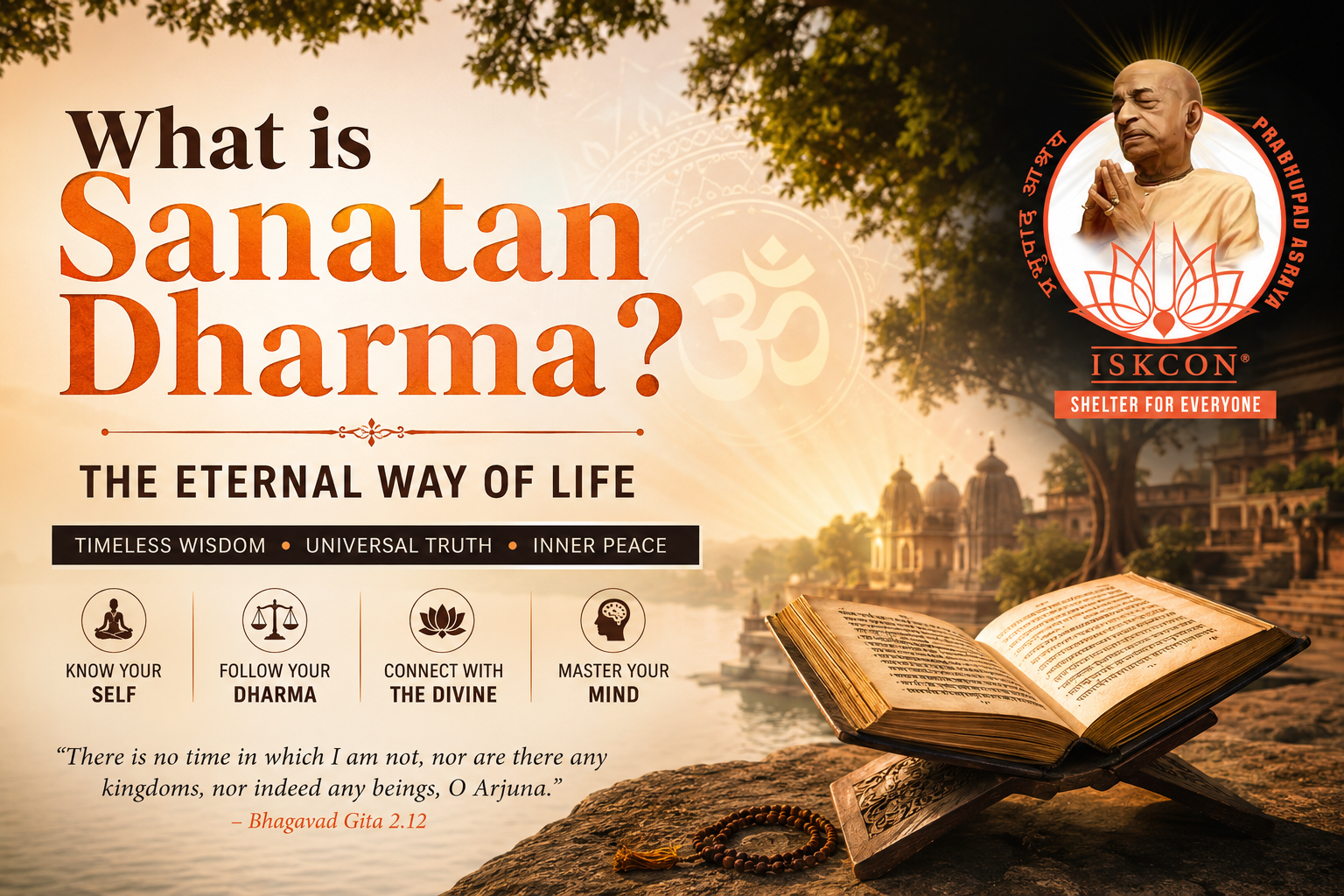
What is Sanatan Dharma? | Sanatan Dharma Meaning, Philosophy & Life Guide
Introduction Have you ever felt that even after having everything in life, you still don’t feel satisfied from within? Everything seems fine — your career, studies, and relationships — yet there is still a sense of emptiness. During such moments, a question often arises within us: “Who am I, and what am I doing?” This is where we naturally become drawn towards a deeper concept — Sanatan Dharma. What Is Sanatan Dharma? (Simple Meaning) Let’s understand the meaning of Sanatan Dharma in simple words: Sanatan = Eternal (that which never changes) Dharma = Your natural nature and your true duty This means: Sanatan Dharma is not merely a religion. It is an eternal way of life. It helps us understand who we are, how we should live, and what the real purpose of life is. Why Is Sanatan Dharma Important Today? Today, people are achieving many things, yet: Stress is increasing. Anxiety has become common. People feel confused about their purpose in life. One reason for this is that we focus primarily on the external world rather than developing a deeper understanding of ourselves. “Your peace depends on how you train your mind.” Sanatan Dharma helps us develop this inner understanding. Core Concepts of Sanatan Dharma 1. You Are Not the Body; You Are the Soul The Bhagavad Gita clearly explains that we are not merely the material body. The body keeps changing, but the soul is eternal. As long as we identify ourselves only with the body, fear and insecurity can naturally influence our lives. Understanding our spiritual identity helps us develop a deeper perspective on life, its challenges, and our purpose. 2. The Law of Karma One of the important principles of Sanatan Dharma is karma. In simple words: Our actions have consequences. What we do influences what happens in our lives and affects our future experiences. Our actions are not without consequences; they create reactions that can shape our lives. Understanding karma encourages us to act responsibly and think carefully before making decisions. 3. Mind Control What is one of the biggest challenges people face today? Controlling the mind. Overthinking Distraction Lack of focus Sanatan Dharma teaches us the importance of training the mind rather than allowing it to control us. “A trained mind brings peace, an untrained mind creates suffering.” By practising spiritual discipline and developing self-awareness, we can gradually learn to manage our thoughts and desires more effectively. Key Insight Sanatan Dharma does not teach you to run away from life. It teaches you to understand life and live it in the right way. It helps us approach our responsibilities, relationships, challenges, and decisions with greater understanding. Practical Application in Daily Life If you want to bring Sanatan Dharma into your daily life, you can begin by following these simple steps: Spend 5–10 minutes every day in self-reflection. Practise meditation or mantra chanting to calm your mind. Before taking any action, think about its possible consequences. Read spiritual literature regularly, such as the Bhagavad Gita. Spend time with positive people who encourage learning and personal growth. Great changes often begin with small, consistent steps. Common Misunderstandings About Sanatan Dharma There are several common misconceptions about Sanatan Dharma: It is only a religion. It is limited to rituals and traditions. It is not relevant to modern life. The reality is that Sanatan Dharma offers spiritual principles concerning our identity, duties, actions, and purpose. Its teachings can be studied and applied by people from different backgrounds who wish to understand life more deeply. A Simple Way to Understand Sanatan Dharma Imagine that life is a journey. If you do not know your direction, you may travel very fast and still end up somewhere you never intended to go. Sanatan Dharma provides direction by helping us understand who we are, how we should act, and what we should ultimately aim for in life. Reflection Questions Ask yourself these questions: Am I only this body, or am I something more? Are my actions conscious and responsible? Is my mind under my control, or am I controlled by my mind? Reflecting on these questions can help you gain greater clarity about yourself and your life. Conclusion Sanatan Dharma is not merely a complicated philosophy. It offers a simple yet profound spiritual understanding: You are an eternal soul, and the purpose of your life is not merely to survive, but to understand your true identity and grow spiritually. When you begin applying this understanding to your daily life, you can gradually develop greater clarity, peace, and a deeper sense of purpose. Call to Action If you found this blog meaningful, do not stop at simply reading this knowledge. Try to apply it in your daily life, even in small ways. And if you want to understand Sanatan Dharma and the Bhagavad Gita more deeply, explore these teachings through structured spiritual learning.