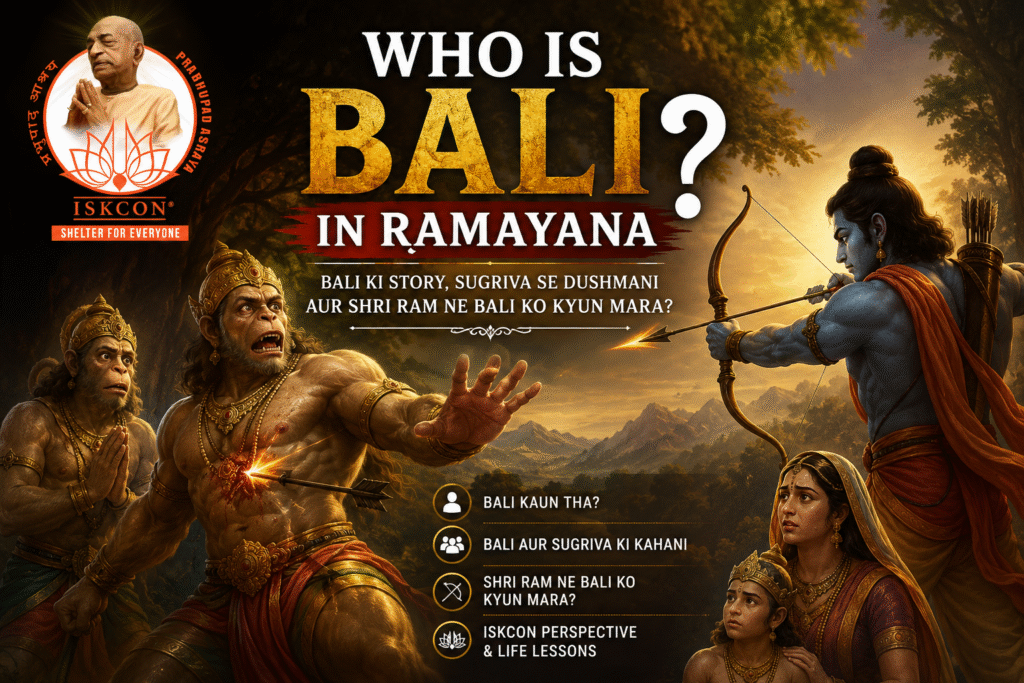
If you have read or watched the Ramayana, you must have heard the name of one character — Bali, who is also called Vali in the Valmiki Ramayana.
Bali was no ordinary vanara. He was the powerful king of Kishkindha and his strength was so extraordinary that even great warriors thought twice before fighting him.
However, Bali’s story is not just a story of his power.
Within it lies a connection to friendship, misunderstanding, ego, dharma, karma, and a very important decision made by Shri Ram.
The biggest question of all is — if Shri Ram stood on the side of dharma, why did he kill Bali by hiding instead of fighting him face-to-face?
Let’s understand the entire story in a simple way.
Who Was Bali in the Ramayana?
Bali, also known as Vali, was the vanara king of Kishkindha.
He was the elder brother of Sugriva, and both were initially part of the same kingdom and family. Bali was extraordinarily powerful and famous for his physical strength.
Bali’s wife was named Tara, who is one of the important and intelligent characters in the Ramayana. Bali’s son was Angada, who later plays an important role in Shri Ram’s Lanka campaign.
Bali possessed tremendous strength, but his story also shows us that having power alone and correctly understanding dharma are not the same thing.
This is where Bali’s story becomes interesting.
What Happened Between Bali and Sugriva?
Bali and Sugriva were brothers, but one incident completely changed their relationship.
A powerful asura, Mayavi, came to challenge Bali. Bali pursued him to a cave. Sugriva accompanied him as well.
Bali told Sugriva to wait outside and went inside the cave himself.
A lot of time passed.
Sugriva saw blood and heard terrifying sounds coming from inside the cave. He felt that Bali had perhaps been killed.
Considering the situation, Sugriva blocked the entrance to the cave and returned to Kishkindha.
His intention was not to steal Bali’s kingdom; he genuinely thought his brother was dead.
However, Bali was not dead.
When Bali eventually emerged from the cave and saw the entrance blocked, he interpreted the situation in a completely different way.
He felt that Sugriva had conspired against him.
And from here, the misunderstanding between the brothers turned into a serious conflict.
Why Did Bali Banish Sugriva?
Bali felt that Sugriva had intentionally trapped him inside the cave.
Therefore, Bali punished Sugriva and banished him from Kishkindha.
Sugriva fled for his life to Rishyamukha Mountain.
The interesting thing is that Bali could not directly attack Sugriva on Rishyamukha Mountain due to a curse associated with that place.
It was at this location that Sugriva met Shri Ram and Lakshmana.
And then, the story of the Ramayana took a completely new direction.
How Did the Friendship Between Shri Ram and Sugriva Happen?
While Shri Ram was searching for Sita Ji, he met Sugriva and Hanuman Ji.
Hanuman Ji introduced Shri Ram and Sugriva to each other.
Sugriva told Shri Ram his entire story — what happened with Bali, how he was banished from the kingdom, and how he was separated from his wife.
Shri Ram promised to help Sugriva.
In return, Sugriva promised to help Shri Ram in searching for Sita Ji.
Here an important principle is understood:
Spiritual life does not mean that friendship or practical relationships disappear.
Rather, properly utilizing relationships on the basis of dharma is also important.
How Was Bali So Powerful?
Bali’s extraordinary strength is a major part of the Ramayana’s story.
It is said that he possessed a special boon: whichever warrior faced him in direct combat, a portion of that opponent’s strength would be transferred to Bali.
For this reason, defeating Bali was extremely difficult.
Sugriva was naturally afraid to fight Bali.
Shri Ram understood the situation and asked Sugriva to challenge Bali.
However, in the first fight, Shri Ram did not kill Bali.
Why?
Because Bali and Sugriva were very similar in appearance, and Shri Ram could not clearly distinguish between the two.
Therefore, for the second confrontation, Sugriva was given an identification mark. Now Shri Ram clearly knew who Bali was.
Why Did Shri Ram Kill Bali by Hiding?
This is the most controversial and commonly asked question in the Ramayana.
People often think:
“Shri Ram was the protector of dharma. Then why did he not fight Bali face-to-face?”
Casually dismissing this question is not the right approach.
In fact, in the Valmiki Ramayana, there is a detailed conversation between Bali and Shri Ram on this point.
Bali asks Shri Ram why he attacked him without a direct confrontation.
Shri Ram explains his reasoning.
Bali had forcefully taken Sugriva’s wife, Ruma, under his control. From Shri Ram’s perspective, this was a severe violation of dharma.
Shri Ram also explained that Bali had not conducted himself appropriately toward his younger brother.
Therefore, Bali’s issue was no longer just a personal disagreement with Sugriva; it had reached the question of dharma versus adharma.
But an Important Point
To understand this incident, simply saying that “Bali was a bad guy, so Ram killed him” would be a superficial explanation.
The Ramayana shows us Bali’s strength, intelligence, family relationships, and mistakes — everything.
This is why Bali’s character does not feel black-and-white.
He possessed greatness within him as well as serious mistakes.
And perhaps that is why his story is so relevant.
What Happened Before Bali’s Death?
When Shri Ram’s arrow struck Bali, Bali questioned Shri Ram.
Shri Ram explained his actions and his violations of dharma.
Gradually, Bali came to understand Shri Ram’s position and reasoning.
He expressed concern about the future of his son Angada and his wife Tara.
After Bali’s death, Sugriva was made the king of Kishkindha.
Angada was given an important position.
Tara is also remembered in the story of the Ramayana for her intelligence and maturity.
Here the story gives an interesting lesson:
Power and position are temporary, but no one can escape the consequences of their actions.
What Do We Learn from Bali’s Story?
Understanding Bali’s story merely as an ancient war story would mean missing something important.
In modern times, we see similar situations:
-
Sometimes misunderstandings happen in families.
-
Sometimes trust breaks in friendships.
-
Sometimes we draw conclusions after seeing only one side of a situation.
In the case of Sugriva and Bali, a misunderstanding completely destroyed a relationship.
1. Don’t Let Misunderstandings Become Ego
Sugriva saw the situation one way.
Bali understood the exact same situation in a completely different way.
The problem was not just the misunderstanding; the problem was that after the misunderstanding, anger and ego replaced communication.
The same thing happens in modern life:
-
A reply from a friend on WhatsApp is delayed, and we assume they are ignoring us.
-
Someone sees an Instagram story but doesn’t reply, and the mind immediately creates a narrative.
Sometimes, more than the actual problem, our interpretation creates the problem.
2. With Strength Comes Responsibility
Bali was extremely powerful.
However, the deeper lesson of the Ramayana is that alongside power, there must also be dharma and self-control.
Today, a student can be academically successful.
A professional can be financially powerful.
Someone can hold social influence.
However, if there is no character alongside power, that very strength can create problems.
3. Dharma Is Not Just the Name of Your Convenience
We generally remember dharma when another person does something wrong.
However, the real challenge arises when we have to judge our own actions.
The Bhagavad Gita also repeatedly leads us toward duty, self-control, and higher spiritual understanding.
The purpose of Krishna Consciousness is also not merely to collect religious information; the purpose is to gradually purify our consciousness.
Connection Between Bali and the Bhagavad Gita
Bali’s story is not directly an episode of the Bhagavad Gita, but its themes are strongly connected to dharma, action, attachment, and consciousness.
In the Bhagavad Gita, Lord Krishna explains to Arjuna that while performing duties in life, it is essential to understand the higher purpose.
The problem is that we often view life only from our personal perspective:
-
“What do I want?”
-
“What happened to me?”
-
“What will I get?”
Spiritual understanding gradually changes the question:
“What is dharma in this situation?”
This shift is very powerful. When consciousness moves beyond just “I” and “mine,” decisions also begin to mature.
Was Bali a Completely Negative Character?
No, simply calling Bali a “villain” does not give an accurate picture.
Bali was brave, powerful, and a strong ruler of his kingdom.
However, some of his actions went against dharmic standards.
The characters of the Ramayana give us the opportunity to understand that the human personality can have multiple dimensions.
A person can possess great qualities and still make serious mistakes.
Therefore, Bali’s story can teach us to examine our own actions rather than judge others.
Bali, Sugriva, and Today’s Life
If you look honestly, a familiar problem of modern relationships is visible in the story of Bali and Sugriva — communication gap.
One person takes action with a certain intention.
Another person derives a completely different meaning from that action.
Then, instead of explanation, assumptions begin.
And gradually, the relationship starts getting damaged.
This is common in college friendships, family relationships, workplace teams — even romantic relationships.
Therefore, developing a simple habit is useful:
Try to understand the situation before reacting.
Not every thought is a fact.
Not every assumption is reality.
And it is not necessary to make every misunderstanding an ego battle.
Frequently Asked Questions
Who was Bali in the Ramayana?
Bali, or Vali, was the powerful vanara king of Kishkindha. He was the elder brother of Sugriva, the husband of Tara, and the father of Angada.
Why did enmity arise between Bali and Sugriva?
A misunderstanding occurred between the two brothers. Bali thought Sugriva tried to trap him in the cave to take the kingdom, whereas Sugriva thought Bali had died inside the cave.
Why did Shri Ram kill Bali?
In the Valmiki Ramayana, Shri Ram explains Bali’s actions in the context of the violation of dharma, especially regarding the issue of keeping Sugriva’s wife, Ruma, under his control.
Was Bali more powerful than Sugriva?
Yes, Bali is described in the Ramayana as a warrior of extraordinary strength. He also possessed a special boon due to which a portion of his opponent’s strength was transferred to him in direct combat.
What was the name of Bali’s wife?
Bali’s wife was named Tara. Tara is one of the highly intelligent and respected characters in the Ramayana.
Who was Bali’s son?
Bali’s son was Angada. Angada played an important role in Shri Ram’s Lanka campaign.
What lesson do we get from Bali’s story?
Bali’s story forces us to think about power, ego, misunderstanding, dharma, and consequences. Just being powerful is not enough; using power with dharma and self-control is also necessary.
Final Thought
If Bali’s story is understood merely as “Ram killed Bali”, an important dimension of the Ramayana is missed.
Within this story lies family conflict, misunderstanding, power, ego, and the difficult question of dharma.
And perhaps because of this, Bali’s character raises so many questions even today.
Sometimes in life, we too might be viewing a situation like Bali or Sugriva from our own limited perspective.
We feel that “My side is completely clear.”
However, spiritual wisdom teaches us to step back and look at the situation on a deeper level.
On this journey, Bhagavad Gita, Bhakti Yoga, and Krishna Consciousness can gradually deepen our understanding.
If you want to understand the characters of the Ramayana and Vedic wisdom not just as a story, but from the perspective of life lessons, you can explore more spiritual insights on Prabhupad Ashraya.
Hare Krishna.
Kya aapko iss translated post ke liye SEO keywords, meta description, ya tags chahiye?